



S. Korea's external debt hits record high, but external soundness improves
Nov 19, 2026, 01:34 pm


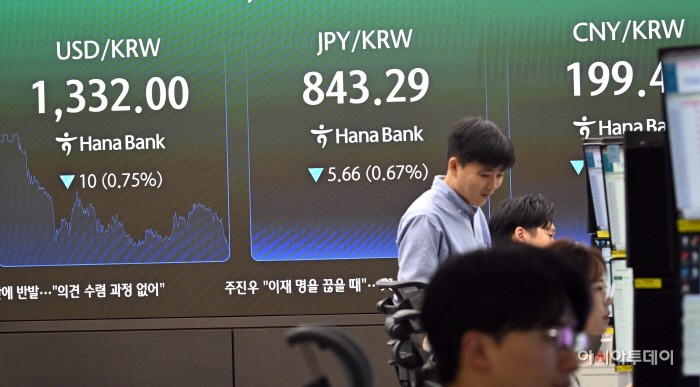 |
| An electronic board displays the Korean won's exchange rates against the U.S. dollar and Japanese yen at Hana Bank's dealing room in Jung District, Seoul. /Hana Bank |
South Korea's external debt has hit another record high. However, external soundness has improved as external claims have grown faster than external debt.
According to the Ministry of Finance and Economy's report on external claims and debt for the third quarter of 2026, released on Nov. 19, South Korea's external claims stood at $1.2473 trillion at the end of the third quarter, up $66.7 billion from the previous quarter.
Over the same period, external debt rose by $17.7 billion to a record $830.6 billion. However, with the increase in external claims roughly 3.8 times that of external debt, the gap between what South Korea is owed by nonresidents and what it owes them widened considerably.
Net external claims, calculated by subtracting external debt from external claims, stood at $416.8 billion, up $49 billion from the previous quarter. Net external claims increased for the second consecutive quarter. Although external debt itself increased, the country's external payment capacity strengthened further as its claims on nonresidents grew at a faster pace.
The maturity structure of external debt also improved. Short-term external debt, with a maturity of one year or less, fell by $9.5 billion from the previous quarter to $189 billion. Long-term external debt, meanwhile, increased by $27.2 billion to $641.5 billion.
Short-term external debt can give rise to repayment pressures within a relatively short period if foreign currency funding conditions deteriorate due to financial market instability or other factors. Even if total external debt increases, a decline in short-term external debt gives the country greater capacity to withstand shocks in the foreign exchange market.
The share of short-term external debt in total external debt fell from 24.4% at the end of the second quarter to 22.8% at the end of the third quarter. The ratio of short-term external debt to foreign exchange reserves also declined from 46.5% to 42.9%.
The increase in external debt was driven by the government sector. Government external debt rose by $20.6 billion from the previous quarter, while banks' external debt increased by $1.4 billion. In contrast, external debt in other sectors, including nonbank financial institutions, public corporations and private companies, fell by $2.3 billion, while that of the central bank declined by $2 billion.
Foreign exchange reserves increased to $440.6 billion at the end of the third quarter. The foreign currency liquidity coverage ratio (LCR) of domestic banks stood at 193.3%, well above the regulatory requirement of 80%.
"Considering the substantial increase in net external claims and the rise in foreign exchange reserves, the country's external payment capacity remains sound," the ministry said. "However, given persistent global uncertainties arising from changes in the monetary and fiscal policies of major economies and ongoing geopolitical risks, we will continue our efforts to maintain external soundness."
Kim Deok-ho
Most Read
-
1
AMD's Lisa Su floated as potential Nvidia successo..

-
2
Iran resumes attacks after two months, targeting U..

-
3
Alice Huang, affair partner of Jensen Huang, repor..

-
4
Xi secures fourth term as China reshuffles next-ge..

-
5
Hegseth rejects calls for impeachment over Iran wa..

-
6
Nvidia executive Kimberly Powell at center of Jens..

-
7
U.S. Asia policy expected to hold despite Democrat..

PEOPLE






HEADLINE NEWS
- Presidential office hails S. Korea-China FTA follow-up deal, cites progress on easing Hallyu ban
- Lee meets Putin at APEC, agrees to ease tensions on Korean Peninsula
- AI and electronics boom yields uneven growth across Southeast Asia
- Inside Kylin Villa, the symbol of China's reform hosting the U.S.-China-Rus..

-
Address : In-Young Bldg., 34, Uisadang-daero 1-gil, Yeongdeungpo-gu, Seoul
Copyright by ASIATODAY CO., LTD. All rights resereved