



Presidential office hails S. Korea-China FTA follow-up deal, cites progress on easing Hallyu ban
Nov 19, 2026, 09:55 am


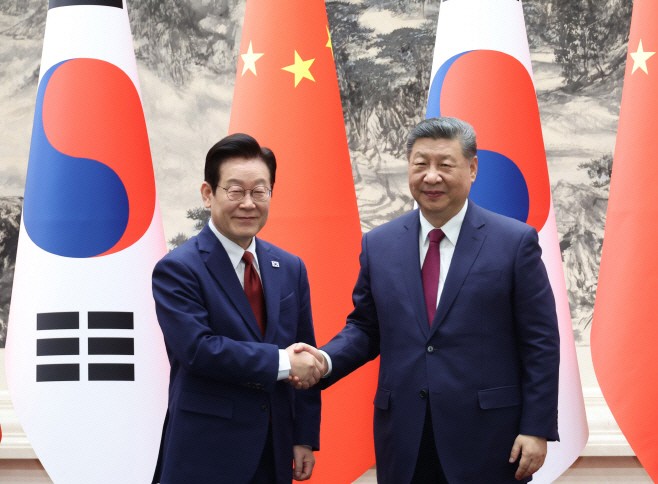 |
| South Korean President Lee Jae-myung and Chinese President Xi Jinping shake hands during a signing ceremony for memorandums of understanding (MOUs) between South Korea and China at the Great Hall of the People in Beijing on Jan. 5. /Yonhap News Agency |
Cheong Wa Dae said on Nov. 19 that "the substantive conclusion of follow-up negotiations on services and investment under the South Korea-China free trade agreement (FTA) has laid the institutional groundwork for a qualitative leap in bilateral economic cooperation." With China pledging to grant most-favored-nation treatment to South Korean films and games, the presidential office believes some progress has also been made in easing the so-called ban on Korean cultural content, which has long restricted its access to the Chinese market.
Ha Joon-kyung, Presidential Chief of Staff for Policy, made the remarks during a briefing on the outcome of the South Korea-China summit at a press center in Shenzhen, China, the previous day, saying that "the two sides agreed through the negotiations to improve conditions for mutual market access across various service sectors, including content, tourism and legal services."
Earlier, South Korean President Lee Jae-myung and Chinese President Xi Jinping announced the substantive conclusion of follow-up negotiations on services and investment under the bilateral FTA during their summit on Nov. 18. The second phase of negotiations, aimed at further liberalizing the services, investment and financial sectors under the FTA that entered into force in 2015, was concluded eight years and eight months after talks began in March 2018.
Under the agreement, China pledged to grant most-favored-nation (MFN) treatment to South Korean films, games and other products, ensuring treatment no less favorable than that accorded to third countries. China also agreed to apply the principle of non-discrimination to prior reviews of content, including online games and films.
In the tourism sector, an institutional framework has been established to allow South Korean travel agencies operating in 23 regions of China to arrange overseas trips for Chinese and foreign nationals residing there. Conditions for South Korean companies seeking to enter the Chinese market will also improve in sectors such as legal services and distribution.
Cheong Wa Dae expects the conclusion of the negotiations to provide momentum for expanding bilateral trade in services. Ha noted that China accounts for approximately 21% of South Korea's total trade in goods but only about 12% of its trade in services, highlighting considerable room for expanding bilateral services trade.
South Korea's annual trade in services with China currently stands at approximately $38.8 billion. "Assuming the share of services trade rises to the same level as that of goods trade, there is room for an additional $10 billion to $20 billion in annual trade," a senior presidential official said.
Cheong Wa Dae also expressed optimism about the possibility of easing China's restrictions on Korean cultural content. "Although it is difficult to characterize the ban on Korean cultural content as an official measure from the Chinese government, some progress has been made in easing what have been perceived as restrictions under the ban, given the agreement not to treat South Korean content less favorably than content from other countries," the official explained.
Conditions for entering China's distribution market have also improved. The official noted that Chinese authorities have become more receptive to South Korean companies entering local distribution networks, describing this as a change stemming from the restoration of mutual trust between the two countries.
Park Young-hoon
Most Read
-
1
AMD's Lisa Su floated as potential Nvidia successo..

-
2
Iran resumes attacks after two months, targeting U..

-
3
Alice Huang, affair partner of Jensen Huang, repor..

-
4
Xi secures fourth term as China reshuffles next-ge..

-
5
Hegseth rejects calls for impeachment over Iran wa..

-
6
Nvidia executive Kimberly Powell at center of Jens..

-
7
U.S. Asia policy expected to hold despite Democrat..

PEOPLE





HEADLINE NEWS
- Presidential office hails S. Korea-China FTA follow-up deal, cites progress on easing Hallyu ban
- Lee meets Putin at APEC, agrees to ease tensions on Korean Peninsula
- AI and electronics boom yields uneven growth across Southeast Asia
- Inside Kylin Villa, the symbol of China's reform hosting the U.S.-China-Rus..

-
Address : In-Young Bldg., 34, Uisadang-daero 1-gil, Yeongdeungpo-gu, Seoul
Copyright by ASIATODAY CO., LTD. All rights resereved