



AI and electronics boom yields uneven growth across Southeast Asia
Nov 19, 2026, 09:08 am


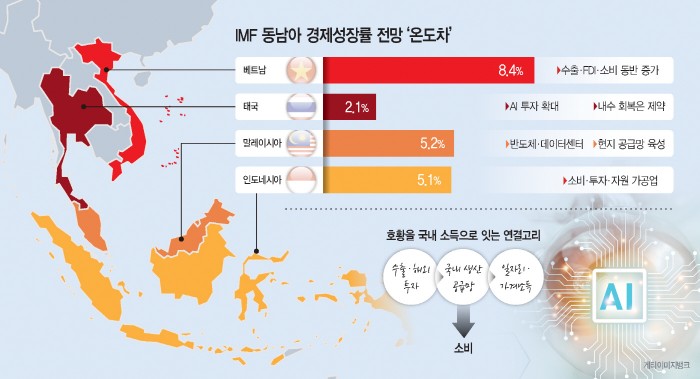 |
Investment in artificial intelligence (AI) and booming electronics exports are buoying Southeast Asian economies, but growth varies widely across countries. Vietnam is expected to post growth of more than 8% this year, while Thailand is projected to grow by just over 2%. Key factors behind the disparity include the extent to which booming exports translate into domestic jobs and income and how much domestic demand, including consumption and investment, supports growth.
According to the International Monetary Fund's (IMF) World Economic Outlook (WEO) released last month, economic growth this year is projected at 8.4% for Vietnam, 5.2% for Malaysia, 5.1% for Indonesia and 2.1% for Thailand. The growth gap between Vietnam and Thailand amounts to 6.3 percentage points. The IMF expects several Southeast Asian countries to benefit from data center-related activities and the global technology upcycle.
Exports surge, but reliance on imported components limits domestic gains
According to the Bank of Thailand, electronics exports rose 77.3% year-on-year in September. However, the economic gains retained domestically are limited. Minutes of the Monetary Policy Committee meeting released by the central bank on Nov. 11 showed that the import content of AI-related exports by the top 1% of exporters stood at 68% in the first eight months of this year. Despite strong export performance, less income is left for Thai businesses and workers in the form of profits and wages once the cost of imported raw materials and components is deducted.
The situation is similar for data centers. Although they require substantial investment to build, they employ relatively few workers once operational, limiting their impact on employment and wage income. The central bank noted that the benefits of the boom are concentrated in related manufacturing and service industries and have not spread widely to workers in other sectors or to households.
Vietnam also relies on assembling imported components for export. According to Vietnam's Ministry of Industry and Trade, exports of computers, electronic products and components rose 71% in the January-October period, while imports of the same product categories increased 74.4%. This reflects the country's reliance on imported semiconductors, memory chips and other components for assembly.
Efforts are also underway to translate investment into local jobs and income. On Nov. 10, the Thai government approved a policy prioritizing employment, skills training and local companies' participation in supply chains when assessing data center investment projects. In Malaysia, Google is providing business opportunities in construction, power supply, logistics and catering to some 80 local companies and organizations. The aim is to extend the benefits of investment beyond direct employment at the facilities to suppliers and contractors.
Consumption and public investment bolster Vietnam's growth, while household debt holds back Thailand
The extent to which domestic demand supports booming exports also varies across countries. Rising consumption is contributing to growth in Vietnam, Malaysia and Indonesia, while consumption remains stagnant in Thailand.
According to Vietnam's National Statistics Office, actual disbursements of foreign direct investment (FDI) increased 13.1% year-on-year in the first 10 months of this year. Investment financed by the state budget also rose 19.8%, while retail sales of goods and consumer service revenues increased 7.7% after adjusting for inflation. Rising investment and consumption have thus reinforced the export boom.
Malaysia has also seen growth in both exports and consumption. Bank Negara Malaysia said AI demand supported electrical and electronics manufacturing in the second quarter, while expanded data center operations bolstered the information and communications sector. Consumption also increased during the same period, supported by rising household income and policy measures. The volume index of retail trade, which tracks trends in the volume of goods sold, rose 4.2% year-on-year in September.
The strength of domestic demand is even more pronounced in Indonesia. Household consumption and investment increased 5.04% and 6.06% year-on-year, respectively, in the third quarter. Government spending also increased, including civil servants' salaries and allowances and expenditure on the Free Nutritious Meals program.
However, whether the export boom will continue remains uncertain. The IMF projects growth of 7.5% for Vietnam and 4.6% for Malaysia next year, both below this year's forecasts. The IMF warned that if expectations about AI profitability weaken and investment declines, the shock could spread to countries integrated into technology supply chains.
Jeong Ri-na
Most Read
-
1
AMD's Lisa Su floated as potential Nvidia successo..

-
2
Iran resumes attacks after two months, targeting U..

-
3
Alice Huang, affair partner of Jensen Huang, repor..

-
4
Xi secures fourth term as China reshuffles next-ge..

-
5
Hegseth rejects calls for impeachment over Iran wa..

-
6
Nvidia executive Kimberly Powell at center of Jens..

-
7
U.S. Asia policy expected to hold despite Democrat..

PEOPLE






HEADLINE NEWS
- Presidential office hails S. Korea-China FTA follow-up deal, cites progress on easing Hallyu ban
- Lee meets Putin at APEC, agrees to ease tensions on Korean Peninsula
- AI and electronics boom yields uneven growth across Southeast Asia
- Inside Kylin Villa, the symbol of China's reform hosting the U.S.-China-Rus..

-
Address : In-Young Bldg., 34, Uisadang-daero 1-gil, Yeongdeungpo-gu, Seoul
Copyright by ASIATODAY CO., LTD. All rights resereved