



S. Korea-China FTA breakthrough raises hopes of lifting K-content ban
Nov 19, 2026, 01:16 pm


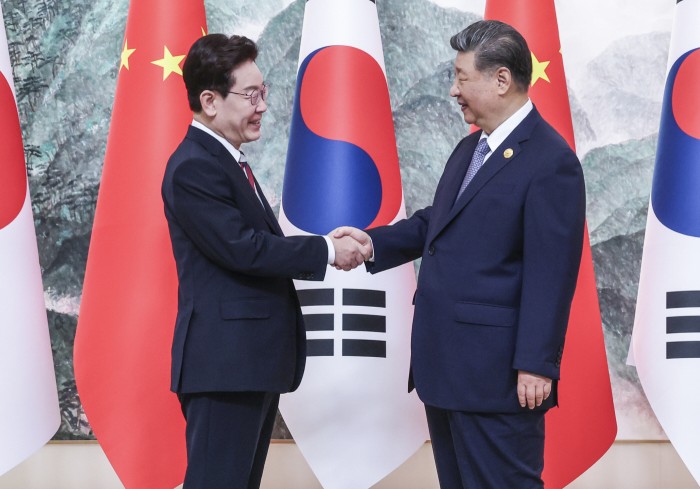 |
| South Korean President Lee Jae-myung (left) and Chinese President Xi Jinping shake hands during their summit at Kylin Villa in Shenzhen, China, on Nov. 18 (local time). /Yonhap News Agency |
South Korea and China have substantially concluded follow-up negotiations on services and investment under their free trade agreement (FTA), reopening opportunities for South Korean companies in sectors such as K-content, tourism, finance and distribution to enter the Chinese market.
During his summit with Lee in January, Xi commented on bilateral cultural content exchanges, saying, "Three feet of ice cannot melt all at once, and fruit falls naturally when it ripens." His remarks prompted speculation that lifting China's restrictions on Korean cultural content would not be easy. Ten months later, however, the two countries have wrapped up their follow-up FTA negotiations on services and investment, raising hopes that the restrictions, commonly known as the ban on Korean cultural content, could be lifted.
Cheong Wa Dae attributed the progress toward lifting the restrictions — one of the biggest outstanding issues between the two countries for about a decade — to Lee's strong commitment to restoring South Korea-China relations.
China became more flexible as relations improved
According to Cheong Wa Dae and the government on Nov. 19, the third summit between Lee and Xi led to the substantive conclusion of follow-up negotiations on services and investment under the South Korea-China FTA, eight years and eight months after talks began. The negotiations were launched in March 2018 as a follow-up measure under the original bilateral FTA, which entered into force in December 2015.
"The most significant economic achievement of the South Korea-China summit was the announcement that follow-up FTA negotiations on services and investment had been substantially concluded," Ha Joon-kyung, presidential chief of staff for policy, said during a briefing at a press center in Shenzhen the previous day.
"When the two countries signed the FTA in 2015, they agreed to hold separate follow-up negotiations to further liberalize the services and investment sectors. Negotiations began but encountered difficulties, including periods of suspension," Ha explained. "However, since our administration took office, bilateral relations have improved, with the leaders making reciprocal state visits. This led China to adopt a more flexible position, allowing us to conclude the negotiations after eight years and eight months."
"I believe that expanding the scope of the South Korea-China FTA beyond goods to broadly encompass services and investment is an achievement that would never have been possible without our administration's efforts to fully restore bilateral relations," he added.
Regarding the substantive conclusion of the follow-up negotiations, a senior presidential official said, "Meetings between our president and the Chinese president helped provide a breakthrough."
"In particular, when President Lee met with President Xi earlier this year, they discussed working toward meaningful progress within the year. That can be seen as a very important turning point," the official stressed.
"Following the South Korea-China summit in January, China also presented more favorable positions in areas of key interest to us, such as culture and tourism, which helped accelerate the negotiations," the official explained.
Trade in services with China could grow by 13 trillion to 26 trillion won
K-content, including games and films, is expected to benefit the most from the conclusion of the follow-up negotiations on services and investment under the South Korea-China FTA.
In particular, China's commitment to granting most-favored-nation (MFN) treatment to South Korean films and games, ensuring that they receive treatment no less favorable than that accorded to third countries, is expected to provide more stable conditions for K-content to enter the Chinese market.
With the substantive conclusion of the negotiations, South Korean travel agencies will be able to engage in outbound tourism services, arranging overseas trips for Chinese and foreign nationals residing in China. Another achievement is that South Korean retailers seeking to operate 30 or more stores in China will be able to do so independently without forming joint ventures with Chinese companies.
"The confirmation that we will receive most-favored-nation treatment in the content sector means that South Korean content will not be singled out for less favorable treatment than content from other countries. In that respect, we can say that some progress has been made in addressing what we regard as the ban on Korean cultural content," the senior presidential official said.
The official estimated that South Korea's trade in services with China could increase by nearly $10 billion to $20 billion (approximately 13.3 trillion to 26.6 trillion won) as a result of the conclusion of the negotiations.
"A rough calculation, assuming China's share of South Korea's trade in services rises to the same level as its share of trade in goods, suggests there is room for an additional $10 billion to $20 billion in trade," the official projected.
Hong Sun-mi
Most Read
-
1
AMD's Lisa Su floated as potential Nvidia successo..

-
2
Iran resumes attacks after two months, targeting U..

-
3
Alice Huang, affair partner of Jensen Huang, repor..

-
4
Xi secures fourth term as China reshuffles next-ge..

-
5
Hegseth rejects calls for impeachment over Iran wa..

-
6
Nvidia executive Kimberly Powell at center of Jens..

-
7
U.S. Asia policy expected to hold despite Democrat..

PEOPLE





HEADLINE NEWS
- Presidential office hails S. Korea-China FTA follow-up deal, cites progress on easing Hallyu ban
- Lee meets Putin at APEC, agrees to ease tensions on Korean Peninsula
- AI and electronics boom yields uneven growth across Southeast Asia
- Inside Kylin Villa, the symbol of China's reform hosting the U.S.-China-Rus..

-
Address : In-Young Bldg., 34, Uisadang-daero 1-gil, Yeongdeungpo-gu, Seoul
Copyright by ASIATODAY CO., LTD. All rights resereved