



S. Korean crypto exchanges look to custody, AI to break through downturn
Nov 19, 2026, 11:28 am


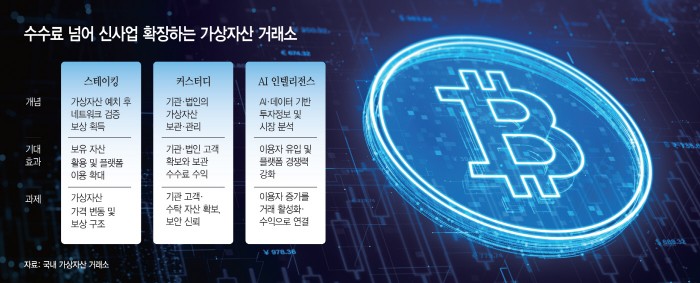 |
South Korean cryptocurrency exchanges are expanding into new business areas to overcome deteriorating earnings amid sluggish trading activity. Moving beyond business models centered on facilitating trades and earning transaction fees, exchanges are seeking to develop staking, digital asset custody and artificial intelligence (AI)-powered investment information services into new growth drivers.
According to cryptocurrency industry sources on Nov. 17, domestic exchanges are pursuing new businesses to diversify their fee-dependent revenue streams. As their transaction fee revenue increases with trading activity, a prolonged market downturn could make it difficult for them to restore profitability, highlighting the need for new sources of growth. Staking is one of the emerging business areas attracting attention. The service allows users to commit digital assets to blockchain networks that use a proof-of-stake (PoS) mechanism, such as Ethereum and Solana, and earn rewards by participating in transaction validation. For exchanges, staking is significant because it allows them to facilitate users' staking requests and distribute rewards while encouraging users to put their digital asset holdings to use within their platforms.
According to data submitted by individual exchanges to Rep. Park Min-gyu, a member of the National Assembly's National Policy Committee, the total value of assets staked through four won-based cryptocurrency exchanges — Upbit, Bithumb, Coinone and Digital X (Korbit) — stood at 4.6936 trillion won as of the end of July. The number of users also reached 1,225,455, up 58.8% from 771,568 at the end of last year.
Custody services for institutions and corporate clients are also seen as an area of medium- to long-term growth. Custody involves securely storing and managing clients' digital assets. As more companies and institutions hold and use digital assets, demand could increase not only for asset custody but also for wallet management, transaction support and the establishment of internal control and security systems. Dunamu launched Upbit Custody, a digital asset custody service exclusively for corporate and institutional clients, in August last year. The service enhances security by storing assets in offline cold wallets and employing multiple layers of security controls.
However, custody has yet to establish itself as a stable source of revenue. According to a survey of the domestic virtual asset market for the first half of this year by the Korea Financial Intelligence Unit (KoFIU) and the Financial Supervisory Service (FSS), the total value of assets held in custody by domestic wallet and custody service providers fell 25% from the previous six-month period to 230.4 billion won, while their operating losses increased by 101%. The market has room to grow if regulatory changes allow greater participation by companies and institutions in the digital asset market, but regulatory frameworks must first be refined and trust established.
Exchanges are also strengthening the competitiveness of their platforms through AI-powered investment information services. In June, Dunamu launched Intelligence, a data-driven content platform, through Upbit Data Lab. It features Market Letter, a market analysis report; Data Digging, educational content for investors; AI news briefings; and Value Up, educational content on digital asset projects. Bithumb also introduced its AI-powered investment information service, Bithumb AI, in September. The service analyzes market data and major issues through four features: AI-generated asset signals, individual asset analysis, daily market updates and suggested questions. By providing AI-powered investment information and integrating it with existing trading services, exchanges are expanding the ways in which users engage with their platforms.
For exchanges to establish a stable revenue base without relying solely on a market recovery, they will need to expand the user base of each new service and increase its actual contribution to revenue. "Staking is affected by digital asset prices and network reward structures, while custody providers need to attract institutional clients and secure assets under custody to improve commercial viability. Expanding into new businesses does not necessarily translate into an immediate improvement in earnings," a cryptocurrency industry official said. "Another challenge for AI services is turning user engagement into increased trading activity or generating separate revenue streams."
Meanwhile, according to third-quarter earnings releases issued on Nov. 16 by Upbit operator Dunamu and Bithumb, both companies posted losses in the third quarter of this year. Dunamu's consolidated third-quarter revenue fell 60.7% year-on-year to 151.7 billion won, with an operating loss of 3.5 billion won and a net loss of 18.6 billion won. Bithumb's revenue also declined from a year earlier to 59.4 billion won, while its operating loss and net loss stood at 8.1 billion won and 1.5 billion won, respectively.
Kim Min-joo
Most Read
-
1
AMD's Lisa Su floated as potential Nvidia successo..

-
2
Iran resumes attacks after two months, targeting U..

-
3
Alice Huang, affair partner of Jensen Huang, repor..

-
4
Xi secures fourth term as China reshuffles next-ge..

-
5
Hegseth rejects calls for impeachment over Iran wa..

-
6
Nvidia executive Kimberly Powell at center of Jens..

-
7
U.S. Asia policy expected to hold despite Democrat..

PEOPLE






HEADLINE NEWS
- Presidential office hails S. Korea-China FTA follow-up deal, cites progress on easing Hallyu ban
- Lee meets Putin at APEC, agrees to ease tensions on Korean Peninsula
- AI and electronics boom yields uneven growth across Southeast Asia
- Inside Kylin Villa, the symbol of China's reform hosting the U.S.-China-Rus..

-
Address : In-Young Bldg., 34, Uisadang-daero 1-gil, Yeongdeungpo-gu, Seoul
Copyright by ASIATODAY CO., LTD. All rights resereved