



S. Korea pushes for rewards up to 100 million won to crack down on AI-assisted CSAT cheaters
Nov 19, 2026, 11:11 am


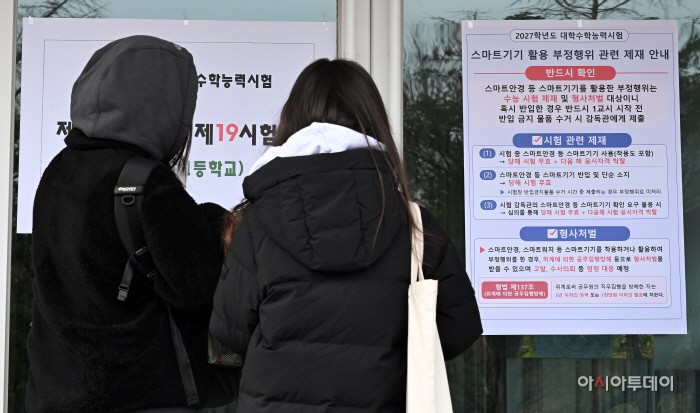 |
| Students check their assigned exam rooms at Ewha Girls' High School in Jung District, Seoul, on Nov. 18, the preliminary orientation day for the College Scholastic Ability Test (CSAT) for the 2027 academic year. /Song Ui-ju |
A day ahead of the College Scholastic Ability Test (CSAT) for the 2027 academic year, the South Korean government announced plans to offer rewards of up to 100 million won to those who report cheating involving artificial intelligence (AI) and ban offenders from taking the CSAT for the next 10 years. The government also plans to conduct a special government-wide investigation after the exam to ensure that cheating is detected even after the test has ended.
In a joint press release issued by relevant ministries on Nov. 18, the government announced the measures, saying it would "mobilize all government resources to prevent, detect and penalize cheating involving the misuse of advanced devices."
First, the government plans to offer rewards of up to 100 million won if tips submitted to cheating reporting centers or through other channels lead to confirmed cases of cheating. It intends to swiftly establish the relevant regulations and apply them starting with this year's CSAT.
Penalties for cheating will also be strengthened. The government will work with the National Assembly to revise the law so that anyone found to have cheated on this year's CSAT will be barred from taking the exam for the next 10 years. It will also pursue criminal liability through referrals for investigation and the filing of criminal complaints, with offenders facing up to five years in prison. University students found to have cheated will be expelled from their respective universities.
The government will continue investigating suspected cheating even after the exam. Starting Nov. 20, the day after the CSAT, it will launch a government-wide task force on CSAT cheating, headed by the prime minister. The task force will include the Ministry of Education, the Ministry of Science and ICT, the Ministry of Justice, the Ministry of the Interior and Safety and the Korean National Police Agency. It plans to investigate suspected cases of cheating in cooperation with global AI companies, telecommunications carriers and other relevant parties.
Measures to prevent advanced devices from being brought into or used at exam sites have also been strengthened. To prevent cheating using miniature cameras, the government has limited the writing instruments test-takers may personally carry during the exam to black pencils. Other items that test-takers were previously allowed to bring, including optical mark recognition (OMR) pens, correction tape, erasers and mechanical pencils, will be provided at exam sites.
To this end, 700,000 erasers, 663,540 correction tape dispensers and 77,040 packs of mechanical pencil leads will be distributed to exam sites nationwide. Stickers designed to prevent test-takers from using miniature cameras attached to clothing buttons will also be made available at all exam sites.
At 8:30 a.m. on Nov. 19, the day of the CSAT, the government will send emergency disaster alerts nationwide to detect smart devices that have not been handed in, with additional alerts to be sent at unannounced times throughout the day. Test-takers will be required to leave their bags in corridors outside exam rooms, where additional proctors will monitor smart devices for responses to emergency alerts and check for Wi-Fi signals.
Measures have also been introduced to protect teachers serving as exam proctors. The government said it would assume responsibility for matters arising from the detection of cheating so that proctors would not have to worry about complaints or lawsuits.
"We will ensure that anyone who cheats is caught and held administratively and criminally accountable without exception," the government stressed. "We will continue to mobilize all available government resources even after the exam has ended."
Park Ji-sook
Most Read
-
1
AMD's Lisa Su floated as potential Nvidia successo..

-
2
Iran resumes attacks after two months, targeting U..

-
3
Alice Huang, affair partner of Jensen Huang, repor..

-
4
Xi secures fourth term as China reshuffles next-ge..

-
5
Hegseth rejects calls for impeachment over Iran wa..

-
6
Nvidia executive Kimberly Powell at center of Jens..

-
7
U.S. Asia policy expected to hold despite Democrat..

PEOPLE






HEADLINE NEWS
- Presidential office hails S. Korea-China FTA follow-up deal, cites progress on easing Hallyu ban
- Lee meets Putin at APEC, agrees to ease tensions on Korean Peninsula
- AI and electronics boom yields uneven growth across Southeast Asia
- Inside Kylin Villa, the symbol of China's reform hosting the U.S.-China-Rus..

-
Address : In-Young Bldg., 34, Uisadang-daero 1-gil, Yeongdeungpo-gu, Seoul
Copyright by ASIATODAY CO., LTD. All rights resereved