



S. Korea expands ties with Australia, IEA in its push for green transformation
Nov 19, 2026, 10:37 am


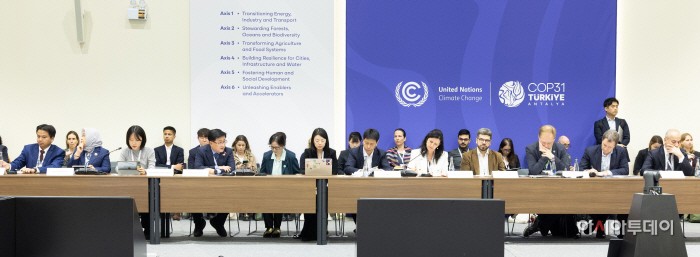 |
| South Korean Minister of Climate, Energy and Environment Kim Sung-whan delivers a national statement at a high-level meeting of the Open Coalition on Compliance Carbon Markets at the Antalya Expo Center in Türkiye on Nov. 16 (local time), where the 31st Conference of the Parties to the United Nations Framework Convention on Climate Change (COP31) is taking place. /Ministry of Climate, Energy and Environment |
South Korean Minister of Climate, Energy and Environment Kim Sung-whan announced at the 31st Conference of the Parties to the United Nations Framework Convention on Climate Change (COP31) that South Korea would expand its Korea Green Transformation (K-GX) initiative through international cooperation. South Korea will work with Australia to advance electrification and industrial decarbonization and with the International Energy Agency (IEA) to strengthen power system stability in Asia. Kim also proposed a global climate dialogue involving young people and civil society.
According to the Ministry of Climate, Energy and Environment on Nov. 17, Kim emphasized in his national statement at the COP31 high-level segment in Antalya, Türkiye, that countries must translate their greenhouse gas emissions reduction targets into industrial and energy transitions. His vision is to develop K-GX, announced in October, from a domestic policy initiative into a broader effort to advance green transformation globally in partnership with other countries.
Kim cited decarbonization cooperation with Australia, which is leading negotiations at COP31, as a concrete example of such international cooperation. That day, Kim signed a memorandum of understanding (MOU) with Australian Minister for Climate Change and Energy Chris Bowen to cooperate in six areas, including electrification and power grid expansion, clean energy investment and industrial decarbonization. The initiative is intended to help both countries meet their 2035 greenhouse gas emissions reduction targets and achieve carbon neutrality by 2050.
The two countries agreed to develop green industry cooperation projects to support clean energy businesses and conduct joint research on hydrogen certification and clean energy supply chains. They will also pursue a Track 1.5 dialogue involving government and private-sector experts. These efforts are aimed at translating the Green Economy Partnership Arrangement on Climate and Energy (GEPACE), signed in 2024, into technical and industrial cooperation focused on electrification and industrial decarbonization.
The two countries also submitted a joint proposal to the UNFCCC secretariat. The proposal outlines their intention to share with the international community their cooperation on electrification, power grid expansion, decarbonization technologies and investment to support the implementation of emissions reduction targets. They also intend to contribute to the second global stocktake (GST2) by sharing their experiences in implementing emissions reduction targets and their expertise in climate transparency.
In addition to its bilateral cooperation with Australia, South Korea will work with the IEA to strengthen energy security and power system stability in Asia. The initiative introduced by Kim, known as the Resilient & Integrated Strategy for Energy Security in Asia (RISE ASIA), involves assessing energy and resource supply and demand alongside power system stability to support greater electrification, help Asian countries build stable power systems and strengthen their capacity to respond to energy crises.
Kim also outlined South Korea's emissions reduction policies to the international community. Last year, South Korea set a target of reducing greenhouse gas emissions by 53% to 61% from 2018 levels by 2035. This year, it enshrined in law an emissions reduction pathway with five-year milestones through 2050. Marking the 10th anniversary of the Paris Agreement's entry into force, Kim also stressed the need for countries to turn their emissions reduction pledges into concrete action.
"Turning the commitments of the Paris Agreement into tangible change requires international cooperation and civil society participation alongside policy efforts by national governments," Kim said. "Building on the Korea Green Transformation, the Republic of Korea will contribute to the global green transformation and work with the international community to make further progress in climate multilateralism."
Jeong Soon-young
Most Read
-
1
AMD's Lisa Su floated as potential Nvidia successo..

-
2
Iran resumes attacks after two months, targeting U..

-
3
Alice Huang, affair partner of Jensen Huang, repor..

-
4
Xi secures fourth term as China reshuffles next-ge..

-
5
Hegseth rejects calls for impeachment over Iran wa..

-
6
Nvidia executive Kimberly Powell at center of Jens..

-
7
U.S. Asia policy expected to hold despite Democrat..

PEOPLE






HEADLINE NEWS
- Presidential office hails S. Korea-China FTA follow-up deal, cites progress on easing Hallyu ban
- Lee meets Putin at APEC, agrees to ease tensions on Korean Peninsula
- AI and electronics boom yields uneven growth across Southeast Asia
- Inside Kylin Villa, the symbol of China's reform hosting the U.S.-China-Rus..

-
Address : In-Young Bldg., 34, Uisadang-daero 1-gil, Yeongdeungpo-gu, Seoul
Copyright by ASIATODAY CO., LTD. All rights resereved