



[Market Power] Plunging shares, new shipyard funding woes weigh heavily on SK oceanplant
Nov 19, 2026, 10:18 am


 |
 |
"Call off the acquisition and let SK take the company back." "My entire family is crying tears of blood."
Complaints from minority shareholders are mounting on online stock discussion boards ahead of a change in SK oceanplant's largest shareholder. SK ecoplant, the current largest shareholder, has agreed to sell its entire stake in SK oceanplant to The Ocean Asset Management and its investment partner, leaving the company poised to exit SK Group. Investor anxiety is mounting as the share price has plunged nearly 70% from its peak this year and the company's medium- to long-term business direction following the ownership change remains unclear.
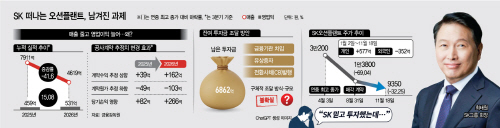
In particular, the remaining investment required to build a new production yard for offshore wind substructures amounts to nearly 700 billion won, but how the company will secure the funds remains uncertain. SK oceanplant has spent only about 40% of the total planned investment, and its cash holdings fall far short of the remaining amount. Concerns are growing that any move to raise funds through new share issuances or convertible bonds (CBs) could dilute existing shareholders' stakes, potentially triggering a further decline in the share price.
According to the Financial Supervisory Service (FSS) on Nov. 18, SK oceanplant had spent 466.8 billion won as of the end of September on the construction of the new yard, accounting for just 40.5% of the total planned investment of 1.153 trillion won. Although the investment period is scheduled to end next month, 686.2 billion won, or 59.5% of the total, has yet to be spent. SK oceanplant has been pursuing the construction of the new yard in Goseong County, South Gyeongsang Province, since 2022 to expand its production capacity for offshore wind substructures.
On Aug. 31, SK ecoplant signed a share purchase agreement (SPA) to sell its entire 35.62% stake in SK oceanplant to The Ocean Asset Management and its investment partner. Osung Advanced Materials is participating as a co-investor, and the transaction is valued at 410 billion won. Once the transaction is completed, SK oceanplant will cease to be a subsidiary of SK ecoplant and an affiliate of SK Group.
The sale is part of SK Group's broader business restructuring. SK ecoplant has been pursuing the sale of SK oceanplant as it shifts its business focus from construction and environmental services to semiconductor and artificial intelligence (AI) infrastructure. SK Inc. has also begun restructuring its ownership arrangements, deciding earlier this month to acquire shares in SK ecoplant to make it a wholly owned subsidiary.
The problem is that it remains unclear how SK oceanplant will secure the remaining 686.2 billion won needed for the new yard. The 410 billion won that SK ecoplant will receive from the stake sale will not flow directly into SK oceanplant.
SK oceanplant's cash holdings also fall well short of the required investment. As of the end of the third quarter, its cash and cash equivalents stood at 51.2 billion won, equivalent to just 7.5% of the remaining investment. Although the company could raise funds through borrowing from financial institutions, third-party allotments of new shares or convertible bond issuances, these financing methods could impose additional burdens. Further borrowing could increase interest expenses, while new share issuances or convertible bond issuances could dilute existing shareholders' stakes, depending on their terms.
"The original plan was to finance investment in the new yard through borrowing from financial institutions and other means, and as far as we understand, that approach has not changed significantly," an SK oceanplant official said. "However, with the sale of management control underway, it is difficult to give a definitive answer on specific financing plans going forward."
Amid such uncertainty, SK oceanplant's share price has more than halved since the beginning of the year and has continued to decline even after the agreement to transfer management control was signed. The share price fell 52.44% from 19,660 won on Jan. 2 to 9,350 won on Nov. 18. This represents a decline of 69.04% from its highest closing price this year of 30,200 won, recorded on April 3, and 32.25% from its closing price of 13,800 won on Aug. 31, when the share purchase agreement was signed.
The sharp decline in the share price has also heightened concerns over unrealized losses among retail investors. According to the Korea Exchange (KRX), retail investors made net purchases of 57.7 billion won worth of SK oceanplant shares between Jan. 2 and Nov. 18, while foreign investors sold a net 35.2 billion won. Retail investors are believed to have incurred mounting losses as the share price fell sharply despite their continued buying.
Whether the improvement in earnings can be sustained is another source of uncertainty. Revenue for the first nine months of this year fell 41.6% year-on-year to 461.9 billion won, while operating profit rose 15.9% to 53.1 billion won. "Revenue declined as our special-purpose vessel construction business entered its final stages, while operating profit increased as the relatively more profitable offshore wind business accounted for a larger share of revenue," an SK oceanplant official explained.
However, changes in estimates of construction contract revenue and costs also affected the company's financial results. For the first nine months of this year, SK oceanplant revised its estimated total contract revenue for its shipbuilding and offshore business segment upward by 16.2 billion won and its estimated total contract costs downward by 10.3 billion won. The resulting impact on profit or loss for the period amounted to 26.6 billion won, up 18.4 billion won from 8.2 billion won in the same period last year. Given that operating profit increased by only about 7.2 billion won over the same period, it is also necessary to assess whether underlying profitability has improved after accounting for the effects of these changes in accounting estimates. It also remains unclear to what extent the offshore wind business can offset the revenue shortfall in the special-purpose vessel business.
"We understand that the impact on profit or loss arising from changes in estimated construction contract revenue and costs is partly reflected in operating profit," an SK oceanplant official said. "However, the specific breakdown by business needs to be confirmed."
Brokerages have also lowered their expectations for SK oceanplant. Of the six securities firms that recently published research reports on the company, five lowered their price targets. Meritz Securities cut its target by 48%, from 25,000 won to 13,000 won, while DS Investment & Securities lowered its target by 31.6%, from 19,000 won to 13,000 won. Hana Securities, Shinhan Securities and Eugene Investment & Securities also lowered their price targets. Only Hanwha Investment & Securities maintained its existing target of 20,000 won.
"There is a possibility that the change in the largest shareholder could be delayed, and even after the transaction closes, it is difficult to predict the medium- to long-term direction of the offshore wind and shipbuilding divisions," said Ahn Joo-won, an analyst at DS Investment & Securities. "The offshore wind business was expected to expand through the new yard, but it remains unclear whether the existing investment strategy will be maintained following the change in the largest shareholder."
Park Joo-yeon
#SK Oceanplant #Shipbuilding #Shipyard #Funding
Copyright by Asiatoday
Most Read
-
1
AMD's Lisa Su floated as potential Nvidia successo..

-
2
Iran resumes attacks after two months, targeting U..

-
3
Alice Huang, affair partner of Jensen Huang, repor..

-
4
Xi secures fourth term as China reshuffles next-ge..

-
5
Hegseth rejects calls for impeachment over Iran wa..

-
6
Nvidia executive Kimberly Powell at center of Jens..

-
7
U.S. Asia policy expected to hold despite Democrat..

PEOPLE






HEADLINE NEWS
- Presidential office hails S. Korea-China FTA follow-up deal, cites progress on easing Hallyu ban
- Lee meets Putin at APEC, agrees to ease tensions on Korean Peninsula
- AI and electronics boom yields uneven growth across Southeast Asia
- Inside Kylin Villa, the symbol of China's reform hosting the U.S.-China-Rus..

-
Address : In-Young Bldg., 34, Uisadang-daero 1-gil, Yeongdeungpo-gu, Seoul
Copyright by ASIATODAY CO., LTD. All rights resereved