



Special bill on nuclear-powered submarines enters parliamentary review
Nov 19, 2026, 09:37 am


 |
| A public hearing on special bills concerning the nuclear-powered submarine program, held by the National Assembly's National Defense Committee in Yeouido, Seoul, on the morning of Nov. 18. /Office of Rep. Yu Yong-weon |
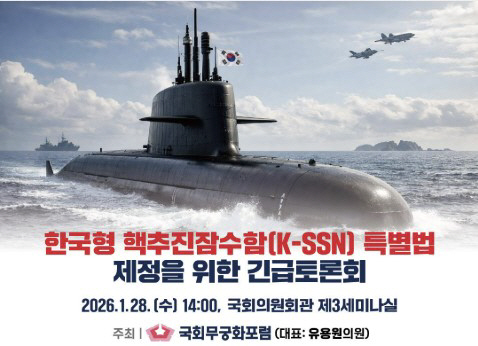
A special bill to support South Korea's acquisition of nuclear-powered submarines has entered full-fledged legislative review at the National Assembly.
Amid growing concerns over North Korea's development of submarine-launched ballistic missiles (SLBMs) and nuclear-powered submarines, the question of whether the president or the prime minister should oversee the program emerged as the biggest point of contention at a parliamentary public hearing. Opinions also differed over which agency should regulate reactor safety and how to secure funding for the long-term program.
The National Assembly's National Defense Committee held a public hearing on special bills concerning the nuclear-powered submarine program on the morning of Nov. 18. Under review are a bill introduced on Aug. 27 by 31 lawmakers, including Rep. Yu Yong-weon of the People Power Party, and a government bill submitted on Sept. 30.
Five experts testified at the hearing: Moon Keun-sik, a distinguished professor at Hanyang University; Yoo Guk-hee, a chair professor at Dankook University; Yoon Jeong-sang, vice president of the Korea Submarine League; Lee Jong-seon, a former submarine commanding officer; and Cheong Seong-chang, vice president of the Sejong Institute.
Yoon argued that a presidentially led National Nuclear-Powered Submarine Committee, as proposed in Yu's bill, would be more effective in coordinating government ministries and conducting negotiations with the United States than the prime minister-led framework outlined in the government bill.
The nuclear-powered submarine program requires the participation not only of the Ministry of National Defense and the Defense Acquisition Program Administration (DAPA) but also of diplomatic, nuclear energy and fiscal authorities. South Korea-U.S. nuclear cooperation to secure nuclear fuel and consultations with the International Atomic Energy Agency (IAEA) on safeguards are additional challenges that need to be addressed separately.
Moon proposed establishing a permanent program management organization directly under the president or under the prime minister. He argued that a single organization should manage the overall schedule, given the interdependence of nuclear fuel supply, the construction of land-based test facilities and the development of reactors and submarine hulls.
Another point of contention is which authority should oversee the safety regulation of military reactors. The government bill proposes a safety management framework centered on the Ministry of National Defense, while Yu's bill calls for drawing on the expertise of the Nuclear Safety and Security Commission (NSSC).
Citing examples from the United States, the United Kingdom, France and Australia, Yoo, a former chairman of the NSSC, emphasized the need for an independent regulatory framework that reflects the unique characteristics of military reactors. He argued that the independence of safety reviews must be ensured while protecting classified military information and taking military operational requirements into account.
The two bills also differ in their proposed funding mechanisms.
Yu's bill calls for establishing a separate special account, while the government bill proposes using the existing fiscal framework. Moon recommended establishing a special account to prevent the program from being disrupted by changes of administration or fluctuations in annual budgets, while also determining how program risks should be allocated at the contracting stage.
Cheong stressed that the special legislation should establish state responsibility throughout the entire lifecycle of nuclear-powered submarines, from reactor development, nuclear fuel management and crew training to maintenance, operations, decommissioning and dismantlement. He also identified independent safety regulation, securing specialized personnel and establishing a maintenance, repair and overhaul (MRO) framework as key tasks.
Lee pointed out that the operational utility, economic viability and technical feasibility of nuclear-powered submarines should be thoroughly assessed before the special legislation is enacted.
He argued that it was necessary to determine which missions nuclear-powered submarines could perform more effectively and to what extent, compared with enhancing the capabilities of next-generation conventional submarines. Key issues in the forthcoming legislative review will include how to allocate authority over overall program management and safety regulation, and what procedures should be established to review nuclear fuel negotiations and the long-term fiscal burden.
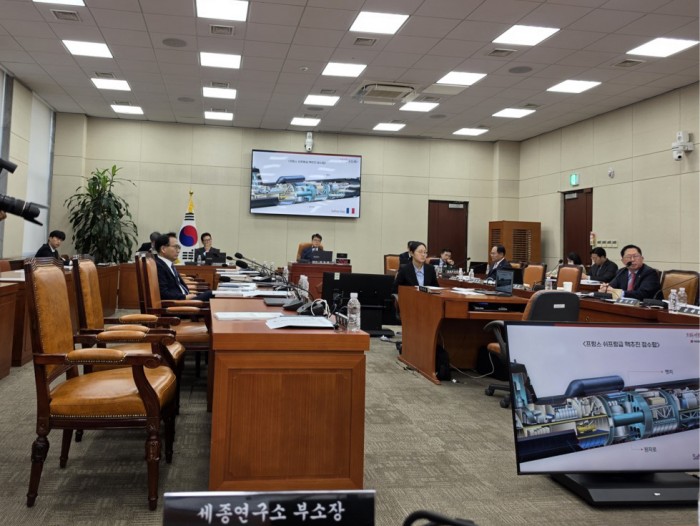 |
| Cheong Seong-chang, vice president of the Sejong Institute, presents his views on the management framework and safety regulation of South Korea's nuclear-powered submarine program at a public hearing on related special bills held by the National Assembly's National Defense Committee in Yeouido, Seoul, on Nov. 18. Securing nuclear fuel, establishing a government-wide coordinating body and creating a special account were among the key issues discussed at the hearing. |
Koo Pil-hyun
Most Read
-
1
AMD's Lisa Su floated as potential Nvidia successo..

-
2
Iran resumes attacks after two months, targeting U..

-
3
Alice Huang, affair partner of Jensen Huang, repor..

-
4
Xi secures fourth term as China reshuffles next-ge..

-
5
Hegseth rejects calls for impeachment over Iran wa..

-
6
Nvidia executive Kimberly Powell at center of Jens..

-
7
U.S. Asia policy expected to hold despite Democrat..

PEOPLE






HEADLINE NEWS
- Presidential office hails S. Korea-China FTA follow-up deal, cites progress on easing Hallyu ban
- Lee meets Putin at APEC, agrees to ease tensions on Korean Peninsula
- AI and electronics boom yields uneven growth across Southeast Asia
- Inside Kylin Villa, the symbol of China's reform hosting the U.S.-China-Rus..

-
Address : In-Young Bldg., 34, Uisadang-daero 1-gil, Yeongdeungpo-gu, Seoul
Copyright by ASIATODAY CO., LTD. All rights resereved