



With AI boom nearing end, U.S. growth masks sluggish hiring and falling real wages
Nov 17, 2026, 11:20 am


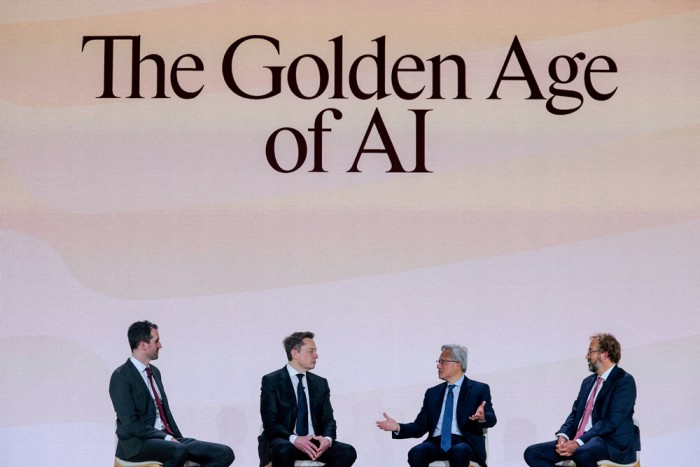 |
| From left, Anthropic co-founder Tom Brown, Tesla and SpaceX CEO Elon Musk, then-Nvidia CEO Jensen Huang and Atreides Management Chief Investment Officer (CIO) Gavin Baker speak during an event hosted by the National Design Studio to mark the launch of an AI-powered government website at the Andrew W. Mellon Auditorium in Washington, D.C., on Sept. 29 (local time). /Reuters-Yonhap News Agency |
The U.S. economy continues to grow on the back of robust investment in artificial intelligence (AI), but the economic benefits felt by workers, including job creation and wage growth, appear to be limited.
In particular, analysts say that while AI investment has emerged as a key driver of economic growth, a tight labor market has exacerbated the phenomenon of "jobless growth." This has raised concerns that the U.S. economy could lose growth momentum once the AI stock boom ends.
According to U.S. business magazine Fortune, global economic research firm Capital Economics (CE) said in a report released on Nov. 16 (local time) that the boom in AI-related stocks was nearing its end.
Global investment bank Goldman Sachs estimates that AI-related spending accounted for more than half of the increase in business investment in the first three quarters of this year.
If CE's assessment is correct, the recent AI boom has been underpinning the growth component of what Goldman Sachs economists have called "jobless growth."
The U.S. economy grew at an annualized rate of 3.4% in the third quarter from the previous quarter, but employers added only about 48,000 jobs per month on average over the 12 months through September. However, job gains rose sharply to 165,000 last month.
David Kelly, chief global strategist at J.P. Morgan Asset Management, said that two years of average annual economic growth of 2.3% should have generated about 155,000 jobs per month, but actual monthly job gains amounted to just 48,000. He attributed this primarily to a shortage of available workers resulting from a sharp shift in immigration policy.
Kelly projected that real gross domestic product (GDP) growth would slow to 1.6% over the next four quarters, with monthly job gains stagnating at around 50,000.
Accordingly, the threshold for employment growth needed to sustain economic growth has also fallen. In a research summary released on Nov. 16 outlining the 2027 outlook of Michael Gapen, its chief U.S. economist, global investment bank Morgan Stanley put the breakeven level of monthly job gains at around 50,000.
According to the U.S. Bureau of Labor Statistics (BLS), average hourly earnings in the United States rose 3.1% over the 12 months through last month.
J.P. Morgan Asset Management noted that "despite a tight labor market, real year-over-year wage growth has been negative for seven consecutive months." Workers are losing purchasing power despite a shortage of labor.
Goldman Sachs economists expect the low-hire, low-fire labor market to persist for about another year before AI-driven job displacement becomes more pronounced in subsequent years.
Kim Hyun-min
Most Read
-
1
AMD's Lisa Su floated as potential Nvidia successo..

-
2
Iran resumes attacks after two months, targeting U..

-
3
Alice Huang, affair partner of Jensen Huang, repor..

-
4
U.S. links Myanmar peace efforts to rare earth acc..

-
5
Hegseth rejects calls for impeachment over Iran wa..

-
6
Xi secures fourth term as China reshuffles next-ge..

-
7
Democrats flip U.S. Congress in historic midterm s..

PEOPLE







-
Address : In-Young Bldg., 34, Uisadang-daero 1-gil, Yeongdeungpo-gu, Seoul
Copyright by ASIATODAY CO., LTD. All rights resereved