



Russian military aircraft enter KADIZ again after three months
Nov 17, 2026, 09:40 am


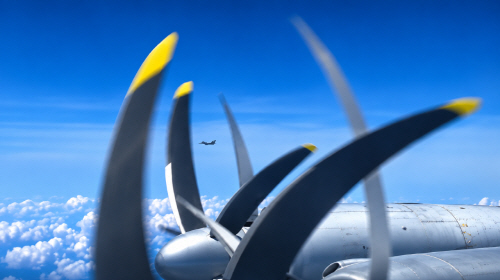 |
| A video released by Russian state-run news channel RT on July 23, 2019, purportedly showing a joint aerial patrol by Russian and Chinese air forces. A fighter jet believed to be a South Korean Air Force F-15K is seen flying beyond the propeller of a Russian strategic bomber. RT did not identify the aircraft's model or country of origin, but its distinctive features, including two vertical stabilizers, have led to speculation that it was an F-15K. /Screenshot from RT video; Yonhap News Agency file photo |
Several Russian military aircraft entered and subsequently exited South Korea's air defense identification zone (KADIZ) over the East Sea early on Nov. 17. The South Korean military detected the aircraft's movements in advance and deployed Air Force fighter jets in response. However, there was no violation of South Korean airspace.
"Several Russian military aircraft entered and subsequently exited the KADIZ over the East Sea early on Nov. 17, but there was no violation of South Korean airspace," the Joint Chiefs of Staff (JCS) said that day.
"Our military detected the Russian aircraft before they entered the KADIZ and deployed Air Force fighter jets to take tactical measures in preparation for any contingencies," the JCS added.
The response is noteworthy because the South Korean military had detected the Russian aircraft through its surveillance systems even before they entered the KADIZ. The military is believed to have tracked the aircraft's movements and deployed fighter jets to prepare for possible contingencies.
This marks the third time this year that Russian military aircraft have entered South Korea's air defense identification zone.
On Aug. 25, several Russian military aircraft entered and exited the KADIZ near Ulleungdo and Dokdo without prior notice. At the time, Russia deployed Tu-142 long-range maritime patrol aircraft over the East Sea and the Sea of Okhotsk.
On June 27, approximately 10 Chinese and Russian military aircraft entered the KADIZ over the East Sea and the South Sea and conducted a joint flight lasting about four hours. China described the operation as its "11th Joint Strategic Air Patrol," while South Korea's Ministry of National Defense lodged a strong protest with both countries.
Chinese and Russian military aircraft have repeatedly conducted aerial operations around the Korean Peninsula since 2019.
In December last year, nine military aircraft from the two countries also entered the KADIZ. Notably, in July 2019, a Russian A-50 airborne early warning and control aircraft violated South Korean airspace over Dokdo, prompting the South Korean Air Force to fire approximately 360 warning shots.
Entering the KADIZ does not, in itself, constitute a violation of South Korean airspace. However, as flights by Chinese and Russian military aircraft without prior notice have become increasingly routine, concerns are growing over military tensions and the risk of accidental clashes around the Korean Peninsula.
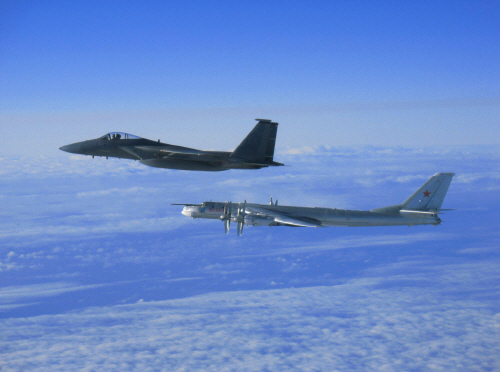 |
| A U.S. Air Force F-15 fighter jet flies alongside a Russian Air Force Tu-95-series long-range strategic bomber. Tu-95-series strategic bombers are among the Russian military aircraft that have repeatedly entered South Korea's air defense identification zone (KADIZ) over the East Sea in the past. /North American Aerospace Defense Command (NORAD) |
An air defense identification zone (ADIZ) is an area established by a country to identify and monitor foreign aircraft at an early stage for the purpose of defending its airspace. It is distinct from sovereign airspace, which extends over a country's land territory and territorial waters.
Therefore, the entry of a foreign military aircraft into the KADIZ does not automatically constitute an airspace violation or a breach of international law.
Russian military aircraft have entered the KADIZ over the East Sea on previous occasions, prompting responses from the South Korean military, including the deployment of fighter jets.
The East Sea, in particular, is an area where military bases in Russia's Far East, the Korean Peninsula and the Japanese archipelago are located in close proximity. As a result, military aircraft operations by neighboring countries in the region could lead to heightened military tensions.
However, the JCS did not disclose the exact types of Russian military aircraft involved in the latest incident, their flight paths, how long they remained in the zone or the purpose of their entry in its initial announcement. It has also not been confirmed whether Russia provided advance notice.
From a military perspective, further analysis is needed to determine whether the latest Russian flights were routine military operations or an attempt to demonstrate Russia's strategic presence around the Korean Peninsula.
The South Korean military will likely need to continue closely monitoring foreign military aircraft approaching the KADIZ and maintain air defense readiness to prevent accidental clashes.
Koo Pil-hyun
Most Read
-
1
China President Xi's Keynote Speech at the APEC C..

-
2
Alice Huang, affair partner of Jensen Huang, repor..

-
3
Iran resumes attacks after two months, targeting U..

-
4
Russian warship sinks in suspected drone attack at..

-
5
Inside Kylin Villa, the symbol of China's reform h..

-
6
Trump, Xi, Putin call for security cooperation at..

-
7
Trump, Putin, Zelenskyy may hold peace talks at G2..

PEOPLE







-
Address : In-Young Bldg., 34, Uisadang-daero 1-gil, Yeongdeungpo-gu, Seoul
Copyright by ASIATODAY CO., LTD. All rights resereved