



Philippines, Australia lower hurdles for joint military activities with new defense arrangement
Nov 16, 2026, 09:35 am


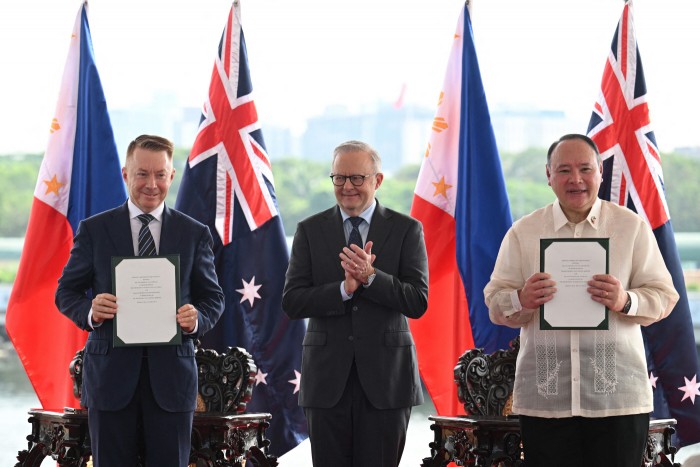 |
| Australian Ambassador to the Philippines Marc Innes-Brown (left) and Philippine Defense Secretary Gilberto Teodoro (right) hold up the signed Defence Cooperation Arrangement at Manila International Port in the Philippines on Nov. 15 (local time). Australian Prime Minister Anthony Albanese stands in the center. /AFP-Yonhap News Agency |
The Philippines, which is locked in a dispute with China over the South China Sea, has agreed with Australia to reduce administrative procedures required for joint military activities. The move is intended to streamline implementation of an existing military agreement, expand cooperation among the countries' land, naval and air forces, and strengthen deterrence in the South China Sea.
According to Reuters on Nov. 15 (local time), the Philippines and Australia signed a Defence Cooperation Arrangement (DCA) in Manila that day. Australian Prime Minister Anthony Albanese, who was visiting Manila to attend the Association of Southeast Asian Nations (ASEAN) Summit, witnessed the signing ceremony.
Philippine Defense Secretary Gilberto Teodoro explained that the arrangement would streamline coordination procedures needed to implement the two countries' existing Status of Visiting Forces Agreement (SOVFA).
"Rather than 100 steps to do a single thing, it will just now take 10," he said, describing the arrangement as a measure to reduce bureaucratic procedures.
Teodoro said the arrangement would facilitate closer cooperation not only in maritime, air and land military activities but also in humanitarian assistance and disaster response. He explained that it would also help strengthen the Philippines' credible deterrence posture in the region, including the South China Sea.
The Philippines has expanded its security partnerships while criticizing what it describes as China's aggressive behavior in the South China Sea. Its approach has been to maintain its longstanding treaty alliance with the United States while complementing that relationship through military cooperation with other friendly countries.
Australia has supported the Philippines' position on the South China Sea. It also supports a 2016 international arbitral tribunal ruling that found no basis in international law for China's extensive claims to rights in the South China Sea.
China has rejected the ruling and maintains that its activities in the South China Sea are conducted lawfully and professionally. Beijing has also opposed joint military activities between the Philippines and its allies and partners, arguing that they heighten regional tensions.
Albanese said the arrangement would strengthen maritime domain awareness and information sharing, while expanding cooperation in strategic dialogue, training, interoperability between the two countries' armed forces, and defense infrastructure development.
He also announced that Australia would make additional investments in maritime surveillance capabilities, including drone technology, equipment and training, to improve the detection of maritime and cyber threats.
Jeong Ri-na
Most Read
-
1
China President Xi's Keynote Speech at the APEC C..

-
2
Alice Huang, affair partner of Jensen Huang, repor..

-
3
Iran resumes attacks after two months, targeting U..

-
4
Russian warship sinks in suspected drone attack at..

-
5
Inside Kylin Villa, the symbol of China's reform h..

-
6
Trump, Xi, Putin call for security cooperation at..

-
7
Trump, Putin, Zelenskyy may hold peace talks at G2..

PEOPLE







-
Address : In-Young Bldg., 34, Uisadang-daero 1-gil, Yeongdeungpo-gu, Seoul
Copyright by ASIATODAY CO., LTD. All rights resereved