



Will history repeat without S. Korea as U.S., China, Russia push for 'new Yalta' summit?
Nov 16, 2026, 09:14 am


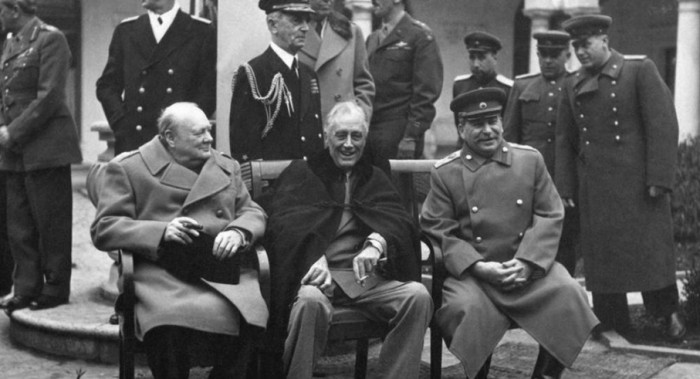 |
| British Prime Minister Winston Churchill (from left), U.S. President Franklin D. Roosevelt and Soviet leader Joseph Stalin attend the Allied summit held in Yalta, Crimea, Soviet Union, from Feb. 4 to 11, 1945. At the time, the three leaders discussed the reorganization of the international order after World War II, along with the Korean Peninsula's independence and the question of trusteeship. The meeting carries great historical significance because the peninsula's future was discussed by major powers without Korean representation. However, the decision to divide the peninsula into occupation zones along the 38th parallel was made in August of that year, not at the Yalta Conference. /Photo from the U.S. National Archives and Records Administration (NARA) |
The global nuclear security order is approaching a major turning point as the leaders of the United States, China and Russia seek to hold their first-ever trilateral summit in Shenzhen, China, on Nov. 19.
With U.S. President Donald Trump, Chinese President Xi Jinping and Russian President Vladimir Putin moving toward direct talks on nuclear arms reduction and international security issues, speculation is growing that the meeting could mark a revival of the 1945 Yalta Conference, where major powers discussed the postwar international order.
In particular, if North Korea's nuclear program is included in the discussions, nuclear security issues affecting the Korean Peninsula could be placed on the negotiating table among major powers without South Korea's participation, raising questions about the potential diplomatic and security implications.
Reuters reported on Nov. 14 (local time) in an analysis titled "A new Yalta?" that negotiations over a summit involving the leaders of the United States, China and Russia were underway, but that the specific agenda and format of the meeting had yet to be finalized.
The report also raised concerns that major powers could strike deals on major security issues without adequately reflecting the interests of other countries. However, Reuters assessed that a comprehensive agreement was unlikely because the three countries have differing interests.
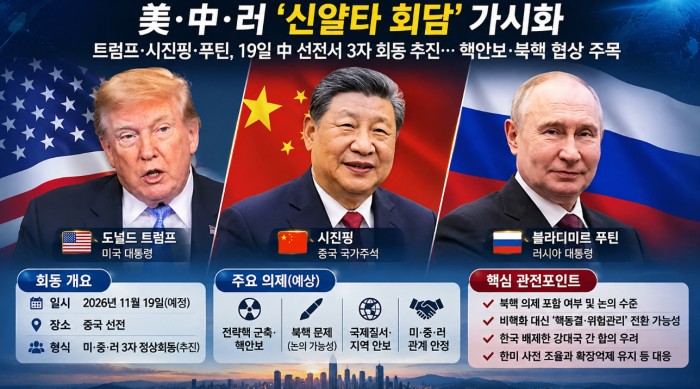 |
| U.S. President Donald Trump (from left), Chinese President Xi Jinping and Russian President Vladimir Putin. As the three leaders seek to meet in Shenzhen, China, on Nov. 19 to discuss strategic nuclear arms reduction and international security issues, the idea of a "new Yalta," reminiscent of the 1945 Yalta Conference, is drawing attention. Of particular concern is the possibility that North Korea's nuclear program could be discussed in negotiations among major powers without South Korea's participation, as well as the potential implications for Korean Peninsula security. However, the inclusion of North Korea's nuclear program on the agenda has not been confirmed. /AI-generated image |
‘Yalta’ resurfaces after 81 years: Will nuclear powers reshape the international order?
The proposed meeting is being pursued on the sidelines of the Asia-Pacific Economic Cooperation (APEC) leaders' summit, scheduled for Nov. 18–19 in Shenzhen.
The White House confirmed plans for the trilateral summit on Nov. 13, while the Kremlin also confirmed them on Nov. 14. The United States has identified nuclear weapons reduction as a major topic for discussion but has indicated that it does not expect a concrete agreement.
The term "new Yalta" derives from the historic meeting held in Yalta, Crimea, in February 1945, when U.S. President Franklin D. Roosevelt, British Prime Minister Winston Churchill and Soviet leader Joseph Stalin discussed the postwar European order, the future of Germany and other issues.
Because that meeting had a profound influence on the formation of the international order after World War II, some interpret the upcoming U.S.-China-Russia meeting as a possible catalyst for the emergence of a new security consultation framework centered on major powers.
Unlike the 1945 Yalta Conference, however, the upcoming meeting is not scheduled to produce a specific agreement on restructuring the international order.
Trump is pursuing new nuclear arms reduction negotiations that would include China. The New Strategic Arms Reduction Treaty (New START), the last strategic nuclear arms reduction treaty between the United States and Russia, expired in February this year, eliminating the existing treaty-based limits and verification framework governing the two countries' strategic nuclear forces.
China, however, has been reluctant to participate in trilateral nuclear arms reduction negotiations, arguing that its nuclear warhead stockpile is smaller than those of the United States and Russia.
While Washington seeks to broaden the scope of nuclear arms reduction talks, Beijing maintains that the existing disparity in nuclear forces must be taken into account, leaving the two sides at odds from the very outset of negotiations.
Could North Korea's nuclear program reach the negotiating table?
North Korea's nuclear program is a key variable that South Korea's foreign affairs and security authorities must closely monitor.
Citing a New York Post report, Reuters said on Nov. 13 that nuclear arms reduction was expected to be a central focus of the trilateral meeting and that North Korea and Iran could also be discussed.
Trump also made remarks indicating that a range of issues, including denuclearization, would be discussed at the meeting. However, there has been no announcement confirming North Korea's nuclear program as an official agenda item.
Nevertheless, it is difficult to rule out the possibility that North Korea's nuclear program could be raised as the United States, China and Russia discuss nuclear arms reduction and nuclear nonproliferation.
Of particular interest are the objectives and approach of any negotiations over North Korea's nuclear program.
With North Korea having institutionalized the possession of nuclear weapons as state policy and refusing to engage in denuclearization negotiations, some observers suggest that the United States could consider negotiating immediate nuclear risk reduction and restrictions on nuclear activities while maintaining its longstanding principle of complete denuclearization.
In that case, phased measures such as restrictions on nuclear material production, a halt to nuclear testing and curbs on further expansion of nuclear weapons and missile capabilities could become subjects of discussion.
However, these are analytical scenarios concerning possible future negotiations over North Korea's nuclear program, not confirmed agenda items for the upcoming trilateral summit.
It is also essential to draw a clear distinction between taking account of the reality of North Korea's nuclear weapons possession in military and diplomatic terms and formally recognizing North Korea as a nuclear-weapon state under international law.
This is because the scope of nuclear-weapon states recognized under the Treaty on the Non-Proliferation of Nuclear Weapons (NPT) is a separate legal matter.
Therefore, even if a nuclear freeze or nuclear risk management measures are discussed in future negotiations, it would be difficult to interpret such discussions as an immediate indication that the United States has abandoned its policy of denuclearizing North Korea or recognized the country as a nuclear-weapon state.
Major-power nuclear talks without South Korea: Could they affect U.S. extended deterrence commitments?
The question is how fully South Korea's position, as a country directly affected by security developments on the Korean Peninsula, would be reflected if the United States, China and Russia discuss North Korea's nuclear program.
China is a major economic and diplomatic backer of North Korea, while Russia has strengthened military cooperation with Pyongyang. The United States is South Korea's principal ally and provides extended deterrence.
The views these three countries share and the consultations they undertake concerning nuclear security on the Korean Peninsula could influence the future direction of diplomacy over North Korea's nuclear program.
In particular, if the United States links discussions on strategic nuclear arms reduction with China and Russia to restrictions on North Korea's nuclear capabilities, South Korea could face the challenge of simultaneously considering its denuclearization objectives and the credibility of U.S. extended deterrence commitments under the South Korea-U.S. alliance.
However, there is currently no confirmed evidence that the meeting will lead to negotiations over North Korea's nuclear program that exclude South Korea.
Whether South Korea and the United States have held prior consultations, and how Washington would reflect the South Korean government's position if it raises North Korea's nuclear program, are also matters requiring further confirmation.
The South Korean government's diplomatic task is clear: it must maintain the principle of North Korea's denuclearization while preparing for the possibility of diplomatic discussions aimed at reducing nuclear risks, and closely examine how consultations among the United States, China and Russia could affect the alliance's extended deterrence framework and security on the Korean Peninsula.
Above all, it is important to secure South Korea's substantive participation in consultations and sufficient prior coordination on issues directly affecting security on the Korean Peninsula.
It remains uncertain whether the Shenzhen meeting will become the starting point for actual nuclear arms reduction negotiations or amount to little more than symbolic summit diplomacy.
Nevertheless, the mere prospect of the leaders of the world's three leading nuclear powers gathering to discuss a new nuclear security order makes the potential changes in the international security environment noteworthy.
If the major powers gathered in Yalta 81 years ago to discuss the postwar order, a diplomatic experiment aimed at exploring new strategic relations among nuclear powers could begin in Shenzhen, China, in 2026.
For South Korea, what matters more than the symbolism of the meeting is how its outcome will affect security on the Korean Peninsula and how fully South Korea's position will be reflected in the process.
Koo Pil-hyun
Most Read
-
1
AMD's Lisa Su floated as potential Nvidia successo..

-
2
Southeast Asian auto parts makers hit hard by Chin..

-
3
U.S. links Myanmar peace efforts to rare earth acc..

-
4
Alice Huang, affair partner of Jensen Huang, repor..

-
5
Hegseth rejects calls for impeachment over Iran wa..

-
6
Democrats flip U.S. Congress in historic midterm s..

-
7
Xi secures fourth term as China reshuffles next-ge..

PEOPLE






HEADLINE NEWS

-
Address : In-Young Bldg., 34, Uisadang-daero 1-gil, Yeongdeungpo-gu, Seoul
Copyright by ASIATODAY CO., LTD. All rights resereved