



Jensen Huang's dramatic rise and fall
Nov 13, 2026, 02:53 pm


The global AI industry's godfather, Jensen Huang, the former CEO of Nvidia, can fairly be described as a dramatic figure who rose from virtually nothing through sheer brilliance and hard work to achieve a level of success ordinary people could hardly imagine. But he has now, against his own will, become a fallen legend after an affair with Alice Huang (Huang Le), a woman suspected of being a spy for Chinese intelligence, and his resulting ouster from the industry. In that sense, his extraordinary life now appears marked by both glory and disgrace.
 |
| The family of former Nvidia CEO Jensen Huang. /AI-generated image. |
Unless a miracle occurs, a comeback appears impossible for Huang. He was born in 1963 in Tainan, Taiwan, into an unremarkable family. His ancestral roots are known to trace back to Qingtian, Zhejiang, on the Chinese mainland. That may help explain why he traveled frequently between Taiwan and China.
Said to have been exceptionally bright from an early age, Huang emigrated to the United States with his family at the age of 10, beginning the first half of what would become a classic American dream story. Little is specifically known about his teenage years. But in 1979, at the remarkably young age of 16, he entered the Department of Electrical Engineering at Oregon State University, slowly beginning to lay the foundations for his legend. It was possible because he was talented enough to skip grades.
As a result, he reportedly became the youngest student in the department at the time of his admission. It was an early sign of unusual promise. After graduating, he went on to earn a master's degree in electrical engineering from Stanford University, which could almost be seen as a natural outcome.
He met Lori Huang, his wife and fellow co-founder, during his college years, and the two married in 1984, the year after graduation. They later had two children. Both grew up without major problems and are now serving as key executives at Nvidia. From a Korean perspective, they might be expected to become successors, but that appears unlikely.
After completing his master's degree and taking on various jobs, Huang co-founded Nvidia in 1993 at the age of 30 with his wife and several people around him. In the company's early years, it is known to have focused on developing 3D graphics chips for PC games. In 1999, he made history. Leading the company's development team, he invented the world's first GPU, or graphics processing unit, redefining modern computer graphics technology.
Then, in 2006, despite opposition from those around him, he launched CUDA, a parallel computing platform, thereby writing another miraculous chapter by laying the foundation for the global AI boom. From then on, he went from strength to strength and rose to where he is today. In 2025, he even led Nvidia to become the world's first listed company valued at $5 trillion. Given that the company has now effectively come to dominate the global market for high-performance AI computing chips, this is hardly surprising. The same can be said of Time's naming him one of the "founders of artificial intelligence" and its Person of the Year in 2025, as well as his receiving the National Medal of Science the following year.
But Huang ultimately set himself on the path to ruin through the suddenly explosive issue of his affair with Alice Huang. With reports now surfacing that there were two more women inside the company with whom he was allegedly involved, it has become difficult for him even to seize an opportunity for a comeback. Under such circumstances, his departure from the post of Nvidia CEO was only natural, whether partly voluntary or partly forced.
Huang, who had once been regarded as a rare success story of the American dream and a global role model who overcame the limitations of being a non-mainstream figure from Taiwan, might have gone down in history had it not been for the affair. But in the end, he failed to manage himself and tumbled into disgrace. It can only be seen as the result of his own actions, for which no one else should be blamed.
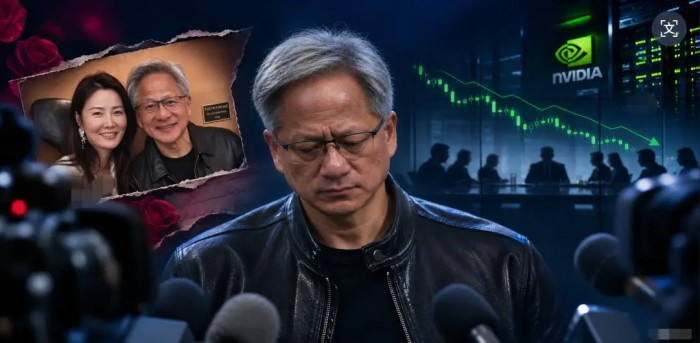 |
| Graphic symbolizing the downfall of former Nvidia CEO Jensen Huang. /AI-generated image. |
Of course, there are still some who sympathize with him and argue that he fell into a trap laid by mainstream American society. But now that the damage is done, such claims seem no more than futile conspiracy theories. There is no room left for excuses, because the reality is that his failure to manage himself led him to throw away a 40-year success story with his own hands. The fact that he reportedly belatedly lashed out at himself, saying, "I am a terrible person," makes that point all the clearer.
Hong Soon-do
Most Read
-
1
AMD's Lisa Su floated as potential Nvidia successo..

-
2
Ukraine halts strikes on Russian oil refineries un..

-
3
Southeast Asian auto parts makers hit hard by Chin..

-
4
U.S. links Myanmar peace efforts to rare earth acc..

-
5
Hegseth rejects calls for impeachment over Iran wa..

-
6
Democrats flip U.S. Congress in historic midterm s..

-
7
Xi secures fourth term as China reshuffles next-ge..

PEOPLE






HEADLINE NEWS

-
Address : In-Young Bldg., 34, Uisadang-daero 1-gil, Yeongdeungpo-gu, Seoul
Copyright by ASIATODAY CO., LTD. All rights resereved