



N. Korea changes national flag ratio for the first time since its founding
Nov 13, 2026, 01:34 pm


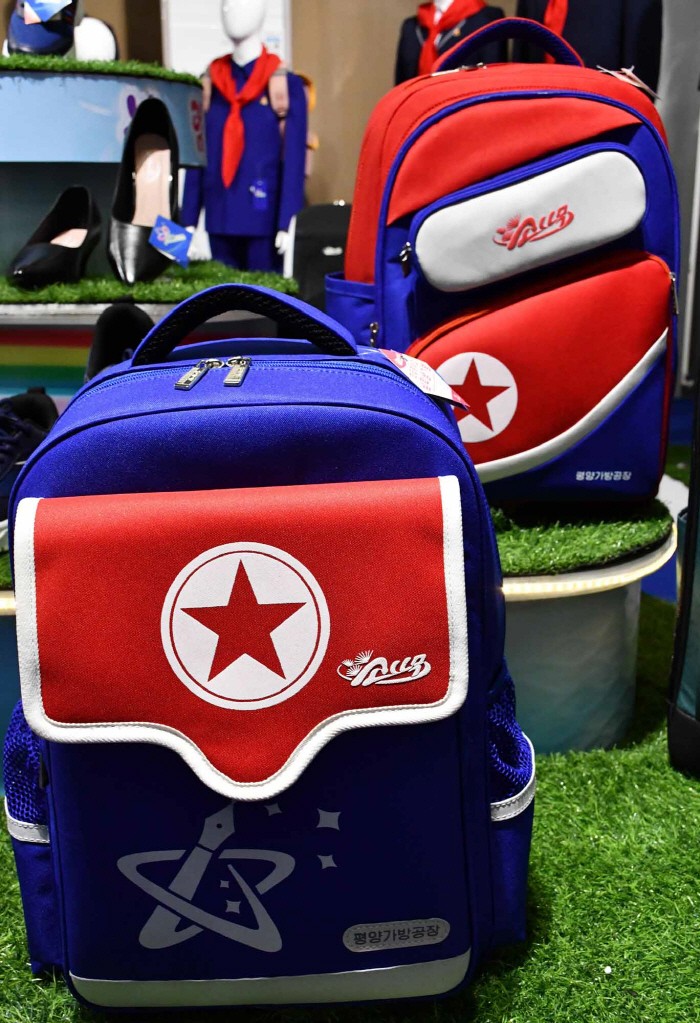 |
| North Korea has introduced new "Sonamu" schoolbags and wheeled schoolbags featuring the three colors of its national flag — red, blue and white — and a five-pointed star, the Choson Sinbo reported on Nov. 13. /Yonhap News Agency |
North Korea is believed to have changed the proportions of its national flag, known as the Ingonggi or red-blue five-pointed star flag, through a constitutional amendment in March, marking the first such change since the regime was established in 1948.
According to the full text of the revised constitution published on Nov. 13 by North Korea's external propaganda outlet Naenara, Article 166 of Chapter 7, titled "National Emblem, National Flag, National Anthem and Capital," states that "the ratio of the flag's height to its width is 1:1.65."
This replaces the previous constitutional requirement of a 1:2 height-to-width ratio, making the flag narrower relative to its height. The 1:2 ratio had remained in place from 1948 through the constitutional amendment adopted at the ninth session of the 14th Supreme People's Assembly in September 2023.
The flag's basic design, including its red star and colors, remains unchanged. Article 166 of Chapter 7 states, "The national flag has a broad red band in the center, with narrow white bands above and below it, followed by blue bands. A red five-pointed star is placed inside a white circle near the hoist side of the red band."
North Korea's decision to change the flag's proportions is interpreted as an attempt by leader Kim Jong-un to consolidate his power base and establish a new national image distinct from those of his predecessors.
Russia also changed its national flag's proportions in 1993, adopting a ratio used during the imperial era instead of the proportions previously associated with the Soviet period.
Lim Eul-chul, a professor at the Institute for Far Eastern Studies at Kyungnam University, said, "The existing national flag, established in 1948 during Kim Il-sung's rule amid the Cold War, has been a symbol closely associated with a reunification-oriented narrative that portrayed North Korea as the sole legitimate government representing the entire Korean Peninsula."
"The 1:2 ratio was a traditional standard commonly adopted by the former Soviet Union and socialist satellite states during the Cold War. This change reflects a move away from the legacy of the Cold War-era socialist bloc toward a ratio of between 1:1.5 and 1:1.67, a standard associated with modern, independent sovereign states," he explained.
Lim added, "The intention is to preserve the basic framework inherited from previous leaders, including the colors and five-pointed star, while modifying the detailed specifications to establish a distinct national identity for the 'Kim Jong-un era' and maximize the image of North Korea as a sovereign state, both domestically and internationally."
"This symbolizes the institutional completion of the hostile two-state policy. It is a legal and symbolic declaration that North Korea will no longer recognize any form of special relationship with South Korea based on their shared national identity, but will instead treat it as a separate, hostile country," he said.
Lim also said, "North Korea will seek to highlight its presence by raising the new flag at international sporting and diplomatic events and will fully adopt the revised proportions as the official standard for future international conferences, summits and international sporting competitions."
He added that the change was intended to present the Kim Jong-un regime's new national identity and the permanent division of the Korean Peninsula as established facts to the international community.
Lee Han-sol
Most Read
-
1
AMD's Lisa Su floated as potential Nvidia successo..

-
2
Ukraine halts strikes on Russian oil refineries un..

-
3
Southeast Asian auto parts makers hit hard by Chin..

-
4
U.S. links Myanmar peace efforts to rare earth acc..

-
5
Hegseth rejects calls for impeachment over Iran wa..

-
6
Democrats flip U.S. Congress in historic midterm s..

-
7
Xi secures fourth term as China reshuffles next-ge..

PEOPLE





HEADLINE NEWS

-
Address : In-Young Bldg., 34, Uisadang-daero 1-gil, Yeongdeungpo-gu, Seoul
Copyright by ASIATODAY CO., LTD. All rights resereved