



Different interpretations of commercial viability could limit Seoul's options in U.S. investments
Nov 13, 2026, 01:24 pm


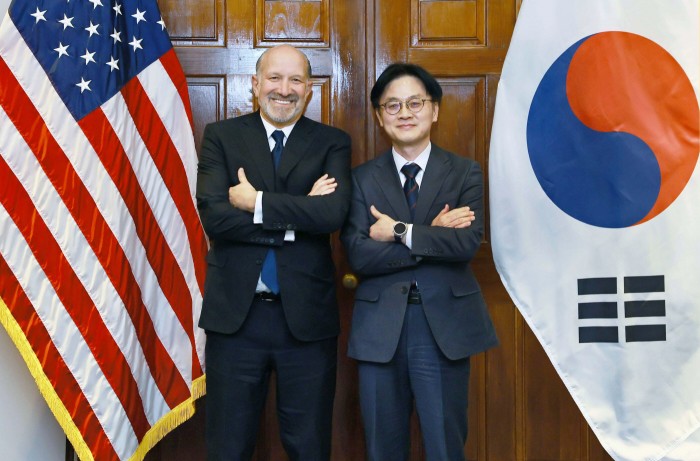 |
| South Korean Minister of Trade, Industry and Resources Kim Jung-kwan (right) and U.S. Secretary of Commerce Howard Lutnick pose for a photo in a meeting room at the U.S. Department of Commerce in Washington, D.C., on Jan. 29 (local time). /Yonhap News Agency |
Questions are emerging over who has the authority to select projects and how commercial reasonableness will be assessed under South Korea's $350 billion investment commitment to the United States.
The South Korean government has presented commercial viability assessments as a safeguard for its investments, but the final authority to select projects rests with the U.S. president. In particular, concerns have been raised that South Korea's ability to reject investments could be limited by potential consequences, including higher tariffs.
According to the Ministry of Trade, Industry and Resources (MOTIR) and foreign media reports as of Nov. 13, the Financial Times (FT) reported on Nov. 12 (local time) that only $37.5 billion, or 2.7%, of the $1.4 trillion in investment and financing pledged to the United States by South Korea, Japan and Taiwan had actually been secured.
The analysis by fDi Intelligence, a Financial Times publication, identified disagreements over project selection and commercial terms, among other factors, as obstacles delaying the implementation of the investment commitments.
The FT also highlighted the "commercial reasonableness" provision in the memorandum of understanding (MOU) on Korea-U.S. Strategic Investment.
Nils Wollesen Osterberg, a researcher at the Korea Economic Institute of America (KEI), suggested that South Korea might believe it has a greater say in project selection than the U.S. administration is prepared to allow. This points to the possibility that the two countries may interpret their respective authority over project selection differently.
Under the MOU signed in November last year, projects under the $200 billion investment portion of South Korea's $350 billion commitment are recommended by an investment committee chaired by the U.S. Secretary of Commerce, with the U.S. president making the final selection.
A South Korean consultation committee chaired by MOTIR Minister Kim Jung-kwan provides input in advance, but the MOU does not explicitly grant it the authority to bind the United States' final decision.
Paragraph 9 of the MOU allows South Korea to exercise its discretion not to invest in a particular project. However, if South Korea fails to make a requested investment payment following consultations, the terms for sharing investment returns could be changed to its disadvantage, and the United States could also raise tariffs on South Korean imports.
Although tariff increases would not be automatic, rejecting an investment could still impose an economic burden on South Korea.
The criteria for assessing commercial viability are another key issue. The MOU defines a commercially reasonable investment as a project that the U.S. investment committee determines, in good faith, is expected to generate sufficient cash flow during the investment period to recover the principal and interest.
By contrast, the Korea-U.S. Strategic Investment Special Act, enacted in March, requires that the expected returns accruing to South Korea be sufficient to cover the principal and interest on the investment.
Within South Korea, a Project Management Committee chaired by the MOTIR minister reviews commercial viability, while an Operating Committee chaired by the Deputy Prime Minister and Minister of Economy and Finance deliberates on whether to proceed with an investment.
The process also requires prior reporting to the National Assembly and consultations with the United States. The special act permits investments that do not meet commercial viability requirements in exceptional circumstances, such as national security or supply chain stability, but requires prior consent from the relevant standing committee of the National Assembly.
Investment implementation is still at an early stage. The only project approved by South Korea so far is Project Star, a gas-fired power plant construction project in Texas, for which $2.4 billion has been provided.
The $10 billion in advance payments for nuclear power projects expected by the United States and the Alaska liquefied natural gas (LNG) project still require agreement on specific investment terms and completion of South Korea's domestic review procedures.
However, there has been no confirmed case so far of South Korea and the United States officially clashing over the commercial reasonableness of a particular project or South Korea refusing to make an investment.
The MOU itself is also characterized as an administrative arrangement that does not create legally binding rights or obligations.
Ultimately, the key question is how much practical influence South Korea's commercial viability assessments will have as the investment terms for large-scale projects, including nuclear power and Alaska LNG, are finalized.
Whether South Korea can demand changes to investment terms on profitability grounds when the United States selects projects based on strategic priorities, and how Seoul would address tariff issues separately if negotiations break down, remain central questions for future talks.
Last month, after U.S. President Donald Trump announced South Korea's investment in the Alaska LNG development project, MOTIR emphasized that "investment projects in the United States will be pursued in a manner that serves the national interest, taking into comprehensive consideration commercial reasonableness, strategic interests and other factors."
Han Dae-ui
Most Read
-
1
AMD's Lisa Su floated as potential Nvidia successo..

-
2
Ukraine halts strikes on Russian oil refineries un..

-
3
Southeast Asian auto parts makers hit hard by Chin..

-
4
U.S. links Myanmar peace efforts to rare earth acc..

-
5
Hegseth rejects calls for impeachment over Iran wa..

-
6
Democrats flip U.S. Congress in historic midterm s..

-
7
Xi secures fourth term as China reshuffles next-ge..

PEOPLE






HEADLINE NEWS

-
Address : In-Young Bldg., 34, Uisadang-daero 1-gil, Yeongdeungpo-gu, Seoul
Copyright by ASIATODAY CO., LTD. All rights resereved