



56 years on, S. Korea's smallest workplaces remain a blind spot for labor rights
Nov 13, 2026, 09:42 am


 |
| This image was generated by AI. |
"They told me there was nothing they could legally do because the workplace had fewer than five employees."
An employee identified only as A visited a local labor office after the company owner refused to enroll a newly hired employee in the four major social insurance programs and then fired the employee. However, a labor inspector explained that provisions allowing workers to seek remedies for unfair dismissal do not apply to workplaces with fewer than five employees.
"It's so unfair that we can't even receive legal protection simply because the workplace has fewer than five employees," A said.
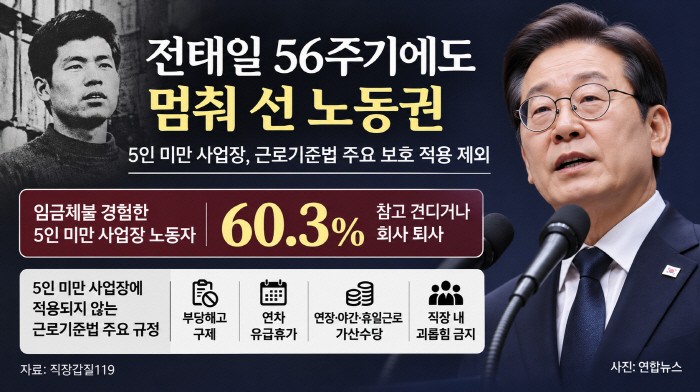
Although 56 years have passed since labor activist Jeon Tae-il died after calling for compliance with the Labor Standards Act, some workers still fall through the cracks of the law. Workers' rights have continued to vary depending on workplace size for more than half a century, prompting growing calls for President Lee Jae Myung, a former child factory worker, to introduce institutional reforms to protect labor rights.
Under the Labor Standards Act and related regulations as of Nov. 12, the law generally applies in full to workplaces that regularly employ five or more workers. Only some provisions apply to workplaces with fewer than five employees, leaving workers without protections such as restrictions on unfair dismissal, remedies through labor relations commissions, paid annual leave and premium pay for overtime, night and holiday work. Provisions prohibiting workplace harassment also do not apply.
Basic requirements, including wage payments and written employment contracts, still apply to workplaces with fewer than five employees. However, the legal remedies available to workers who are dismissed or experience workplace harassment differ depending on workplace size.
According to a survey of 1,000 employees conducted in September by polling firm Global Research on behalf of Gapjil 119, 60.3% of respondents working at businesses with fewer than five employees who had experienced unpaid or delayed wages said they either endured the situation or left their jobs.
Labor groups argue that these differences in legal protections make it difficult for workers at small businesses to exercise their rights.
Last year, marking the 55th anniversary of Jeon's death, Lee pledged, "For workers like Jeon Tae-il, I, Lee Jae Myung, a former child factory worker, will be a dependable friend to them as president."
"We can no longer delay eliminating blind spots in labor protection," Gapjil 119 said. "We hope that the president, who once worked as a child factory worker, will improve the system so that all workers can receive equal legal protection, regardless of the size of their workplace."
Kim Tae-hoon
Most Read
-
1
AMD's Lisa Su floated as potential Nvidia successo..

-
2
Ukraine halts strikes on Russian oil refineries un..

-
3
Southeast Asian auto parts makers hit hard by Chin..

-
4
U.S. links Myanmar peace efforts to rare earth acc..

-
5
Hegseth rejects calls for impeachment over Iran wa..

-
6
Democrats flip U.S. Congress in historic midterm s..

-
7
Xi secures fourth term as China reshuffles next-ge..

PEOPLE





-
Address : In-Young Bldg., 34, Uisadang-daero 1-gil, Yeongdeungpo-gu, Seoul
Copyright by ASIATODAY CO., LTD. All rights resereved