



Foreign tourists to S. Korea top 20 million for first time
Nov 13, 2026, 09:14 am


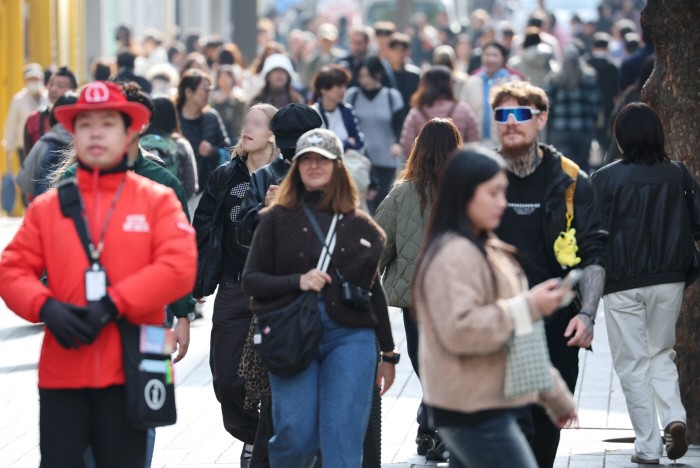 |
| Tourists visit Myeong-dong in Seoul on Nov. 3. /Yonhap News Agency |
The number of foreign tourists visiting South Korea surpassed 20 million in a single year for the first time on Nov. 12, 14 years after the country reached the 10 million mark in 2012.
The Ministry of Culture, Sports and Tourism (MCST) announced that the number of international visitors to South Korea had exceeded 20 million that day. The estimate was based on a provisional total of 19.97 million visitors as of the previous day and a daily average of 64,000 visitors this year. With time still remaining until the end of the year, each additional visitor will push the annual total to a new record high.
Tourism spending by foreign visitors has also risen sharply alongside the increase in arrivals. From January to September this year, foreign visitors spent 15.9416 trillion won in the tourism sector, up 47.7% from 10.794 trillion won during the same period last year.
Arrivals through airports and seaports outside the Seoul Capital Area also increased. Through September this year, 3.24 million foreign visitors entered South Korea through regional airports, including Gimhae, Jeju, Cheongju and Daegu, accounting for 19.0% of the total. This represented a 37.4% increase from the same period last year. Another 1.58 million visitors entered through regional seaports, including Busan, Jeju, Seogwipo, Yeosu and Gunsan, accounting for 9.2% of the total and marking a 14.5% year-on-year increase.
The MCST attributed the growth in inbound tourism, despite external challenges such as instability in the Middle East and high oil prices, to the global spread of K-culture, cooperation across government ministries and the hospitality of the Korean people. In particular, the ministry said the Korean Wave's growing influence beyond music and dramas into food and beauty had helped boost demand for travel to South Korea.
According to the "2026 Overseas Hallyu Survey," conducted among 27,000 people who had experienced Korean Wave content in 30 countries, the proportions of respondents who said Korean cultural content was popular in their home countries as of the end of last year were 55% for food, 54% for music, 53% for beauty, 51% for dramas and 49% for films. The proportion who said the Korean Wave positively influenced their purchases of Korean products and services also rose steadily over the past three years, from 58% to 64% and then 65%.
Government policies to revitalize tourism also supported the growth. Following the 11th National Tourism Strategy Meeting chaired by the president on Feb. 25, the government launched a cross-ministerial cooperation framework and pursued measures to improve immigration procedures, expand international flight operations at regional airports and strengthen penalties for price gouging.
Voluntary acts of kindness and hospitality by the Korean public also helped improve South Korea's image as a travel destination. One example occurred at Incheon International Airport in June, when a convenience store employee dismantled product display shelves and searched through gaps to retrieve a pair of wireless earbuds dropped by a foreign tourist. The story went viral on social media, and the employee received a special merit award from Incheon International Airport Corporation on July 15.
To commemorate the milestone of 20 million foreign visitors, the MCST plans to hold an official ceremony, meetings with tourism industry representatives, welcome events for arriving passengers at regional international airports, events linked to the Korea Grand Sale and a series of promotional campaigns on social media.
Minister of Culture, Sports and Tourism Chae Hwi-young said, "Surpassing 20 million foreign tourists is the starting point for South Korea's leap toward becoming an 'irreplaceable tourism powerhouse.'" He added, "We will share this achievement with the Korean people while thoroughly preparing to reach 30 million inbound tourists and build the capacity to welcome 40 million."
Lee Jang-won
Most Read
-
1
AMD's Lisa Su floated as potential Nvidia successo..

-
2
Ukraine halts strikes on Russian oil refineries un..

-
3
Southeast Asian auto parts makers hit hard by Chin..

-
4
U.S. links Myanmar peace efforts to rare earth acc..

-
5
Hegseth rejects calls for impeachment over Iran wa..

-
6
Democrats flip U.S. Congress in historic midterm s..

-
7
Xi secures fourth term as China reshuffles next-ge..

PEOPLE







-
Address : In-Young Bldg., 34, Uisadang-daero 1-gil, Yeongdeungpo-gu, Seoul
Copyright by ASIATODAY CO., LTD. All rights resereved