



Chilean truckers' strike over soaring fuel prices shows no signs of abating
Nov 12, 2026, 01:10 pm


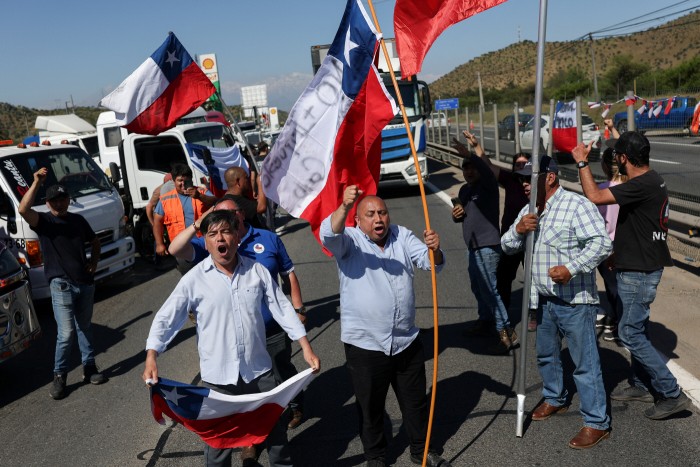 |
| Truck drivers wave Chilean national flags as they block roads with their vehicles during a protest in Santiago, Chile, on Nov. 10 (local time). /Reuters-Yonhap News Agency |
Truck drivers in Chile have launched an indefinite strike to protest rising fuel prices, raising concerns that traffic disruptions and logistics problems across the country could be prolonged.
Local media outlets, including CNN Chile, reported that taxi drivers serving Santiago International Airport joined the protests on Nov. 11 (local time), the second day of an indefinite strike and road blockades by truck drivers and long-distance bus drivers.
Protesters have continued occupying lanes by parking trucks, long-distance buses, tow trucks and other vehicles at key points in Chile's road network, including Route 5 and Route 68, which connect to the capital, Santiago.
According to local media, traffic congestion caused by road blockades has continued in at least five regions, including Santiago, Biobío, Tarapacá, La Araucanía and Ñuble.
Although police have been working to prevent complete road blockades, severe traffic congestion has developed on Route 68 as more vehicles join the protests, leaving only one lane open to traffic.
Route 68 is a major highway in Chile connecting Santiago with key cities along the Pacific coast, including Valparaíso and Viña del Mar.
Narciso Molina, president of the Official Airport Taxi Association, said, "Rising diesel prices are having a significant impact on our costs, making it difficult to operate taxis." He explained that the association had decided to join the strike and protests to draw public attention to the difficulties facing the taxi industry.
Molina, who drives a diesel-powered taxi, said, "In February, I spent 20,000 Chilean pesos (about 27,000 won) a day on fuel, but now I spend 40,000 pesos (about 54,000 won)." He lamented, "That's 1.2 million pesos (about 1.63 million won) a month on fuel alone. It simply isn't financially viable, so I can't keep operating my taxi."
Drivers are demanding lower fuel prices and tolls. Since the outbreak of the war in Iran, gasoline prices in Chile have risen by about 32% and diesel prices by about 62%, dealing a severe blow to the trucking, bus and taxi industries. Self-employed drivers and small businesses, in particular, are struggling to maintain operations.
Concerns are also growing over disruptions to the transportation industry caused by the strike. Gonzalo Bravo, a director of Lo Valledor, one of Chile's major wholesale agricultural markets, warned, "If the situation continues, it could cause a logistics crisis, inevitably followed by supply shortages, resulting in enormous economic losses for merchants and producers."
Son Young-sik
Most Read
-
1
AMD's Lisa Su floated as potential Nvidia successo..

-
2
Ukraine halts strikes on Russian oil refineries un..

-
3
Southeast Asian auto parts makers hit hard by Chin..

-
4
U.S. links Myanmar peace efforts to rare earth acc..

-
5
Hegseth rejects calls for impeachment over Iran wa..

-
6
Democrats flip U.S. Congress in historic midterm s..

-
7
Xi secures fourth term as China reshuffles next-ge..

PEOPLE






HEADLINE NEWS

-
Address : In-Young Bldg., 34, Uisadang-daero 1-gil, Yeongdeungpo-gu, Seoul
Copyright by ASIATODAY CO., LTD. All rights resereved