



Auto overcapacity raises fears of mutual ruin for China and EU car industries
Nov 02, 2026, 03:41 pm


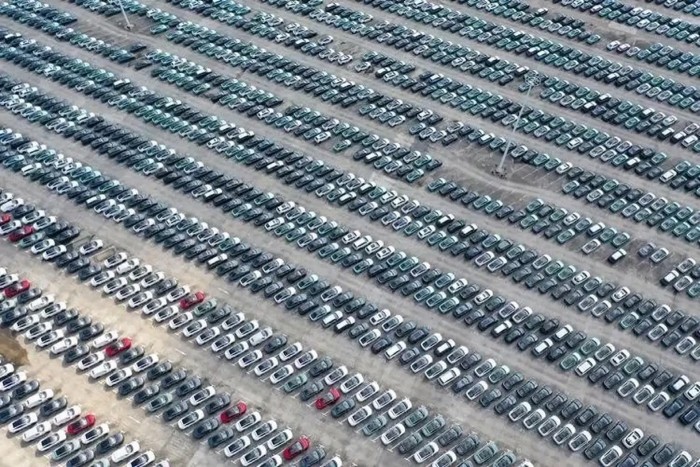 |
| A storage yard at an automobile factory in Shanghai, China. Enormous numbers of cars are rolling off production lines as if they were loaves of bread. / Beijing Youth Daily |
As China aggressively seeks to resolve its recent automobile overproduction problem by exporting large volumes of vehicles to European Union (EU) markets, which have long been stable, some analysts suggest that both sides may be heading toward their worst crises at the same time. In other words, China could face a disastrous situation because of overproduction, while EU countries could suffer a similar fate as their domestic brands lose substantial market share.
The situation has now changed so dramatically that it would not be an exaggeration to call it a complete transformation. However, as recently as the beginning of this century, there was a considerable gap between China and EU countries in the automobile industry. To put it bluntly, their competitiveness was not even comparable. Since then, however, China's internal combustion engine vehicle technology has advanced rapidly, and the country has also become highly competitive in new energy vehicles, completely transforming the situation.
Moreover, as Chinese cars became known for their high cost-performance ratio, or xingjiabi (性價比), developments took an entirely unexpected turn. Made-in-China brands began making waves in EU markets, backed by their rapidly growing competitiveness and production capacity so enormous that they could seemingly manufacture vehicles without limit.
According to automotive industry experts in Beijing on Nov. 2, Chinese brands' market share reached 12.7% in the third quarter of this year, surpassing Japanese brands. It could be described as an unprecedented breakthrough that would have been unimaginable at the beginning of this century.
If this situation is allowed to continue unchecked, it is almost only a matter of time before leading EU automobile-producing countries such as Germany, France and Italy face crises unlike anything they have experienced before.
Germany, in particular, is already facing an urgent situation. Volkswagen, one of the country's flagship companies, is a prime example. Despite the formidable reputation it has built over nearly a century, the company has reportedly recently finalized restructuring measures involving approximately 100,000 job cuts and the closure of four factories. It would be fair to say that the relentless offensive by Chinese automakers was a decisive factor.
France and Italy have no reason to remain complacent either. There was good reason why they were just as active as Germany when the EU decided on Oct. 12 (local time) to adopt safeguard measures limiting imports of Chinese hybrid vehicles to a maximum of 350,000 units annually.
The same reasoning can be seen in the position taken by Gu Yueping (顧越平), an automotive industry commentator in Beijing, who expressed understanding of the EU's measures.
"Frankly, I can understand the EU's measures. If it had simply stood by, its market and industry would have completely collapsed. It had to do something immediately," Gu said.
Even so, it is difficult to say that the crisis facing the EU has been easily resolved. If Chinese manufacturers shift their main exports from hybrid vehicles to electric and internal combustion engine vehicles, which have recently been praised in China's automotive industry for their exceptional value for money, EU countries may once again find themselves unable to cope. There is a strong possibility that their markets could be devastated again. The crisis facing the automobile industries of EU countries may only be beginning.
Naturally, China's automotive industry is hardly comfortable watching this extraordinary situation unfold. That is perhaps because there appears to be virtually no possibility of resolving its overproduction problem, which has been described as almost unimaginable, within the next several years. Indeed, some in the industry have offered the pessimistic prediction that, in the worst-case scenario, no solution may emerge even after 10 years.
The figures speak for themselves. While only around 25 million Chinese-made vehicles were sold in the market last year, production capacity stood at a minimum of approximately 50 million and a maximum of around 63 million vehicles. Total vehicle output is also estimated to have exceeded demand by more than 30%.
It is therefore hardly surprising that rumors are widespread in the industry that nearly 200 companies are competing to avoid bankruptcy almost every day.
Against this backdrop, numerous predictions are circulating in the industry that China and the EU could face the tragedy of tongguiyujin (同歸於盡), meaning mutual destruction, or liangbaijushang (兩敗俱傷), meaning both sides suffer losses and injuries, if the current situation continues.
Hong Soon-do
Most Read
-
1
Putin proposes trilateral U.S.-China-Russia summit..

-
2
U.S., Israel plan to resume strikes on Iran after..

-
3
Ukraine halts strikes on Russian oil refineries un..

-
4
China's fifth plenum to conclude amid expectations..

-
5
ASEAN to discuss Myanmar's return next month

-
6
AI-discovered PHP flaw triggers global cybersecuri..

-
7
UK court orders worldwide asset freeze on Vietnam'..

PEOPLE







-
Address : In-Young Bldg., 34, Uisadang-daero 1-gil, Yeongdeungpo-gu, Seoul
Copyright by ASIATODAY CO., LTD. All rights resereved