



Japan's next five-year defense outlay estimated at nearly double current plan
Nov 02, 2026, 02:44 pm


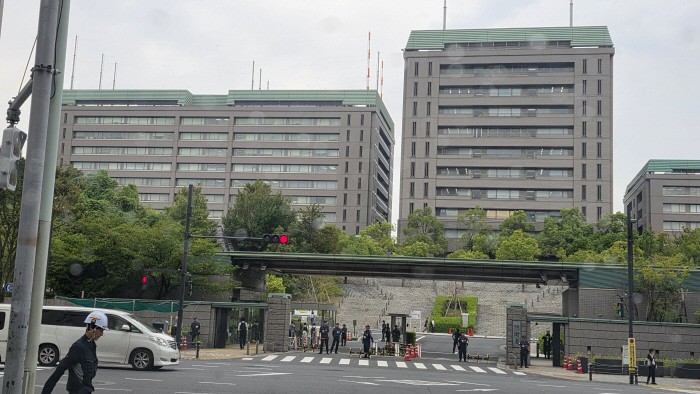 |
| A view of Japan's Ministry of Defense building in Ichigaya-Honmuracho, Shinjuku, Tokyo. / Choi Young-jae, Tokyo correspondent |
Japan's Ministry of Defense has estimated that approximately 80 trillion yen (about 680 trillion won) will be needed to strengthen the country's defense capabilities over five years starting next year. The ministry plans to expand investment in unmanned equipment, artificial intelligence (AI), space and cyber capabilities in response to factors including China's expanding military activities and the war in Ukraine. The estimated amount is nearly double that of the current plan.
The Sankei Shimbun reported on Nov. 2, citing multiple government officials, that the ministry had estimated the cost of the next Defense Buildup Program, which is set to be revised by the end of the year, at approximately 80 trillion yen. The next program will cover fiscal years 2027 through 2031.
However, the 80 trillion yen figure is a preliminary estimate calculated by the ministry based on the costs of necessary equipment and maintaining defense capabilities. It is not a budget finalized by the Japanese government. The newspaper reported that, given limited financial resources, the government is expected to review equipment procurement plans and other expenditures in detail before adjusting the amount to the upper end of the 70 trillion yen range.
The Defense Buildup Program is one of Japan's three key national security documents, alongside the National Security Strategy and the National Defense Strategy. It specifies the capabilities to be acquired and the costs required over the next five years in line with the two strategies, which set the broad direction of the country's security and defense policies.
Under the current program, formulated at the end of 2022, the Japanese government set defense buildup spending for fiscal years 2023 through 2027 at approximately 43 trillion yen. This represented a substantial increase from the approximately 27.5 trillion yen allocated under the previous program. Japan has since pursued the acquisition of long-range missiles to develop "counterstrike capabilities" to attack enemy missile bases, as well as the expansion of ammunition stockpiles and equipment spare parts.
The latest revision involves drawing up the next five-year program before the final year of the current program begins. The Sankei Shimbun explained that Japan intends to bring forward the revision by one year and further increase defense spending to respond to the deteriorating security environment.
 |
| An image depicting drones and a digital network on the Japanese Ministry of Defense's website. / Screenshot from the Japanese Ministry of Defense website |
Large-scale drone procurement, expansion of ammunition stockpiles, logistics and aging facilities
A major area of increased investment is the SHIELD initiative, which involves the use of unmanned equipment. The plan calls for the large-scale procurement of drones, unmanned surface vessels and unmanned underwater vehicles to establish a coastal defense system capable of monitoring and attacking enemy ships and landing forces. In its 2026 Defense White Paper, Japan's Ministry of Defense set a goal of establishing the SHIELD system during fiscal 2027.
The initiative envisions deploying large numbers of relatively inexpensive unmanned systems alongside existing manned equipment to respond in multiple stages to enemy forces approaching by sea or attempting to land. Another objective of expanding the use of unmanned equipment is to reduce risks and burdens for Self-Defense Forces personnel.
Additional spending is also expected to be required to build cloud infrastructure for AI applications and strengthen space and cyber capabilities. The estimate also includes the costs of acquiring weapons, securing sufficient ammunition and spare parts, repairing aging facilities, and improving transportation and logistics capabilities.
This means that Japan intends not only to acquire new equipment but also to strengthen its maintenance and logistics infrastructure to keep that equipment operational during actual military operations. The Sankei Shimbun reported that the ministry concluded that approximately 80 trillion yen would be needed over five years after adding up the estimated costs of these items.
Reuters also reported that day, based on separate reporting, that the government and ruling party were discussing increasing the size of the next program to between 70 trillion and 80 trillion yen. An official interviewed by Reuters cited rising procurement costs for imported equipment due to the weaker yen, in addition to the large-scale purchase of drones, as a financial burden.
The final scale of the defense spending increase could change during the revision of national security documents and the budget formulation process through the end of the year. Reuters reported, citing an official, that the amount was likely to be settled in the mid-to-upper 70 trillion yen range.
Choi Young-jae
Most Read
-
1
Putin proposes trilateral U.S.-China-Russia summit..

-
2
U.S., Israel plan to resume strikes on Iran after..

-
3
Ukraine halts strikes on Russian oil refineries un..

-
4
China's fifth plenum to conclude amid expectations..

-
5
ASEAN to discuss Myanmar's return next month

-
6
AI-discovered PHP flaw triggers global cybersecuri..

-
7
UK court orders worldwide asset freeze on Vietnam'..

PEOPLE







-
Address : In-Young Bldg., 34, Uisadang-daero 1-gil, Yeongdeungpo-gu, Seoul
Copyright by ASIATODAY CO., LTD. All rights resereved