



Xi Jinping holds back-to-back summits with German and Swiss presidents
Nov 02, 2026, 10:27 am


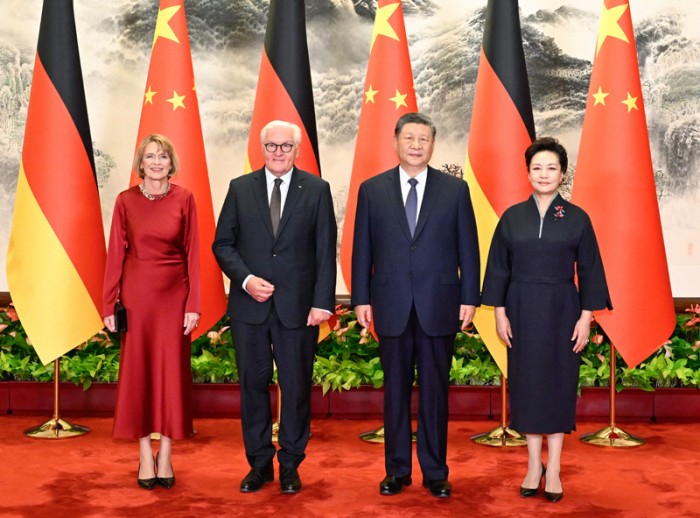 |
| Chinese President Xi Jinping and his wife pose for a commemorative photo with German President Frank-Walter Steinmeier and his wife, who recently visited China for five days. / Beijing Youth Daily |
According to reports on Oct. 31 by Beijing Youth Daily and other media outlets, Xi held talks with German President Frank-Walter Steinmeier, who was on a state visit to China, at the Great Hall of the People in Beijing the previous day and emphasized that "China has always regarded the European Union (EU) as a partner."
"China and Europe must uphold the fundamental position that they are partners. As long as we maintain dialogue on an equal footing, differences and problems can always be resolved," Xi said, adding, "That way, the development of bilateral relations will not be hindered."
He went on to urge Europe to "move in the same direction as China and jointly promote an equal and orderly multipolar world and inclusive economic globalization."
Xi also stressed that "China and Germany, as the world's second- and third-largest economies, must strengthen communication and cooperation. We must establish new models of cooperation."
"The two countries should send a message to the outside world of openness rather than isolation, and cooperation rather than confrontation," he added.
Xi also said, "We welcome Germany playing a greater role in European and international affairs," adding that China also welcomed companies from Germany and other countries to enter the Chinese market and share in the benefits of its vast market.
In response, Steinmeier expressed hope that Germany would maintain high-level exchanges with China and strengthen cooperation in areas including trade, science and technology, artificial intelligence (AI) and environmental protection.
"Germany hopes to work with China to support free trade and the rules of the World Trade Organization (WTO)," he said, adding, "We also want to jointly oppose protectionism and trade wars."
Steinmeier also addressed the "one China" policy, saying, "We firmly adhere to that principle and remain optimistic about the future of bilateral relations." His remarks can be seen as once again emphasizing Germany's consistent and firm support for the "one China" principle.
Xi also met with Swiss President Guy Parmelin that day and said China would strengthen economic cooperation with Switzerland following the signing of an agreement to revise the bilateral free trade agreement (FTA).
"At a time when the headwinds of unilateralism and protectionism are growing stronger, free trade cooperation is the most notable achievement in China-Switzerland relations," Xi said. "When economies remain connected, they develop together, but when they close their doors, they all fall behind."
In response, Parmelin said, "We must uphold multilateralism and defend free trade. By doing so, we hope to work with China to contribute to global development, prosperity, peace and stability."
The two leaders then attended a signing ceremony for a protocol amending the China-Switzerland FTA and cooperation documents covering scientific research, labor and employment, and the media.
Once the revised FTA enters into force, the share of Swiss exports eligible for duty-free entry into the Chinese market will increase from just over half to as much as 99.8% in terms of export value.
For Switzerland, this could be described as an enormous and entirely unexpected windfall. It would not be an exaggeration to say that Switzerland, which is not an EU member, is reaping substantial benefits through its skillful diplomacy of maintaining an equal distance from both sides while securing what it stands to gain.
Hong Soon-do
Most Read
-
1
Putin proposes trilateral U.S.-China-Russia summit..

-
2
U.S., Israel plan to resume strikes on Iran after..

-
3
Ukraine halts strikes on Russian oil refineries un..

-
4
China's fifth plenum to conclude amid expectations..

-
5
ASEAN to discuss Myanmar's return next month

-
6
AI-discovered PHP flaw triggers global cybersecuri..

-
7
UK court orders worldwide asset freeze on Vietnam'..

PEOPLE






-
Address : In-Young Bldg., 34, Uisadang-daero 1-gil, Yeongdeungpo-gu, Seoul
Copyright by ASIATODAY CO., LTD. All rights resereved