



Over 70 percent of workers call for ban on inclusive wage system
Nov 02, 2026, 09:47 am


 |
| / An AI-generated image. |
"When video editing runs late, there are many days when I don't get off work until after midnight. By then, the subway has stopped running, so I take a taxi home, but I don't receive any transportation expenses, let alone overtime pay."
For Kim, 25, who works at a video production company, overtime has long been a part of everyday life. Frequent filming and video editing work often keep Kim at work past midnight. Despite frequently working past midnight because of filming and editing, Kim receives no additional pay for the extra hours. This is because the company operates under an inclusive wage system.
The situation is not much different for Jang, 29, who works at an online advertising agency. Work-related messages from clients continue after regular working hours and even on weekends. Although Jang must frequently respond to work matters outside regular hours, the company does not recognize this as separate working time. Jang is also subject to the inclusive wage system.
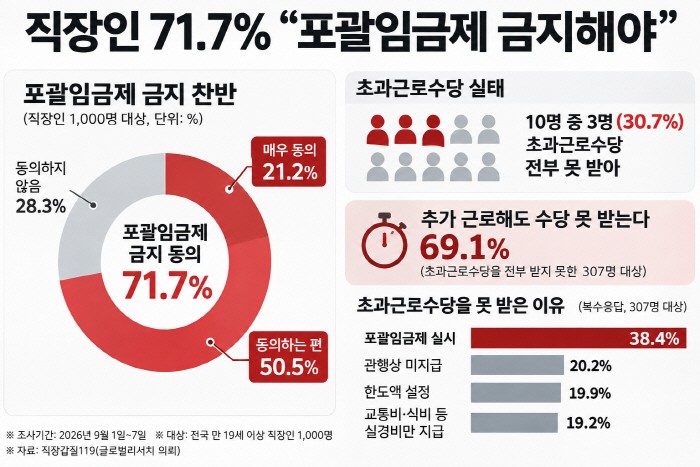
Seven out of 10 workers believe the inclusive wage system should be banned, according to a survey. Criticism is growing that the system prevents workers from receiving fair compensation for the hours they actually work and encourages so-called "unpaid overtime." Among workers who have not properly received overtime pay, the inclusive wage system was cited as the biggest reason for nonpayment.
According to a survey commissioned by civic group Gapjil119 and conducted by polling firm Global Research among 1,000 employed adults aged 19 and older nationwide from Sept. 1 to 7, 71.7% of respondents said they supported banning the inclusive wage system, the group said on Nov. 1.
Of the respondents, 21.2% said they strongly agreed with a ban, while 50.5% said they somewhat agreed. In contrast, only 28.3% said they did not support a ban.
The inclusive wage system is an arrangement under which allowances for overtime, night work and holiday work are set at a fixed amount in advance and either included in wages or paid separately, rather than calculated each time according to actual working hours. However, if the statutory allowances based on actual working hours exceed the agreed amount, employers must pay the difference. The problem is that some workplaces use the system as a means of avoiding additional allowance payments.
In the survey, 30.7% of respondents said they had not received the additional wages due for overtime, night work and holiday work based on the hours they actually worked. When these respondents were asked how the allowances had gone unpaid, the most common answer was the implementation of the inclusive wage system, at 38.4%.
The survey also found that additional work was not being properly compensated. When the same respondents were asked whether they received additional pay for working beyond the hours covered by the inclusive wage agreement, 69.1% said they did not. Only 8.5% said they received additional pay.
The government has also introduced measures to prevent misuse of the inclusive wage system, but the practice of withholding wages in workplaces has shown little improvement.
In April, the Ministry of Employment and Labor introduced the "Guidelines for Preventing Misuse of the Inclusive Wage System to Eliminate Unpaid Work." The key provision is that employers must pay the difference if statutory allowances based on actual working hours exceed the amount agreed under an inclusive wage arrangement.
However, legislation banning the inclusive wage system itself has yet to be enacted. Gapjil119 argued that administrative guidance alone would not be sufficient to eliminate the practice of withholding overtime pay. It called for an explicit ban on the inclusive wage system in the Labor Standards Act and stronger employer obligations to record working hours and pay wages.
"The findings show that the inclusive wage system is acting as a factor that hinders fair compensation for overtime work and causes so-called 'unpaid overtime,'" said Park Eun-ha, a certified labor consultant at Gapjil119.
"We need to ban the inclusive wage system and establish a clear legal basis requiring wages to be calculated and paid according to actual working hours," Park said.
Kim Tae-hoon
Most Read
-
1
Putin proposes trilateral U.S.-China-Russia summit..

-
2
U.S., Israel plan to resume strikes on Iran after..

-
3
Ukraine halts strikes on Russian oil refineries un..

-
4
China's fifth plenum to conclude amid expectations..

-
5
ASEAN to discuss Myanmar's return next month

-
6
AI-discovered PHP flaw triggers global cybersecuri..

-
7
UK court orders worldwide asset freeze on Vietnam'..

PEOPLE







-
Address : In-Young Bldg., 34, Uisadang-daero 1-gil, Yeongdeungpo-gu, Seoul
Copyright by ASIATODAY CO., LTD. All rights resereved