



S. Korea to expand AI use across maritime and fisheries sectors
Oct 28, 2026, 10:45 am


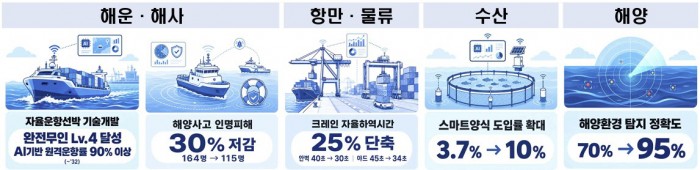 |
| Key objectives of the AI Transformation (AX) Strategy for Oceans and Fisheries. / Courtesy of the Ministry of Oceans and Fisheries |
The government plans to develop core technologies for fully autonomous ships capable of operating without crews by 2032 and establish artificial intelligence (AI) systems to forecast seafood supply and demand and assess navigation conditions along Arctic shipping routes. It will also develop port automation technologies that enable AI to control cargo-handling equipment and move containers autonomously.
The government unveiled its "AI Transformation (AX) Strategy for Oceans and Fisheries" at a joint meeting of economy-related and science and technology-related ministers held at the Government Complex Seoul on Oct. 28. The strategy focuses on advancing AI capabilities in relatively technologically mature sectors such as shipping and ports, while prioritizing data collection and digital transformation in the fisheries sector.
According to the government's assessment based on an analysis conducted by the Korea Maritime Institute (KMI) last October, Korea's AI technology capabilities in the maritime and fisheries sectors stood at just 55% to 80% of those of leading countries. The maritime sector was assessed at 55% of the level of leading countries, while the fisheries sector stood at 73%.
The government will first invest a total of 464 billion won from 2026 to 2032 to develop core technologies for Level 4 autonomous ships capable of fully unmanned navigation. It will pursue technologies for unmanned navigation, engine room automation and remote operation, as well as the testing, certification and international standardization needed for commercialization.
The government also plans to gradually expand domestic waters designated for autonomous navigation trials and support the introduction of autonomous navigation systems on existing and newly built vessels operated by Korean shipping companies starting in 2027.
To improve maritime safety, the government will introduce an "AI Sea Navigation" system by 2030 to identify waters with high risks of collisions and groundings and recommend optimal routes to avoid such hazards. It will also develop AI navigation assistance technology for small vessels that can operate in areas without communications coverage, warn of capsizing and collision risks, and facilitate automatic distress reporting.
For Arctic shipping routes, the government will establish a system to analyze sea ice and weather data collected by icebreaking research vessels and satellites, predict hazardous sections along individual routes and assess navigation conditions.
In the port sector, the government will establish an automation test bed at Gwangyang Port to demonstrate smart port technologies, including AI-powered equipment and digital twins. By 2031, it aims to develop technologies that apply AI to cranes and mobile cargo-handling equipment to load and unload containers without human intervention. It also plans to develop equipment capable of transporting containers autonomously within ports by 2028.
In the fisheries sector, the government will introduce a system starting in 2027 that uses intelligent closed-circuit television (CCTV) cameras to automatically identify catches on fishing vessels, compare them with reported figures and detect vessels suspected of illegally landing their catches. It will also adopt a system in which AI analyzes fishing activity and location data to flag signs of suspected illegal fishing, with personnel at a control center making final assessments and taking enforcement action.
The government will invest 167.5 billion won in state funding by 2030 to establish a leading smart fisheries innovation district in Goheung, South Jeolla Province. It plans to collect and analyze aquaculture farm data, including water temperature, salinity and wave height, to respond to disasters such as high water temperatures and typhoons. The data will also be used to develop aquaculture technologies, including intelligent feed delivery systems.
In the seafood distribution sector, the government will establish an AI fisheries monitoring system starting in 2027. The system will analyze news reports, statistics and other information to identify the causes and impacts of seafood supply and demand issues and propose response scenarios.
The government plans to monitor progress on individual projects through a maritime and fisheries AX task force and draw up annual implementation plans to oversee their execution.
Lee Ji-hoon
Most Read
-
1
Celltrion nears additional contract with major U.S..

-
2
Putin proposes trilateral U.S.-China-Russia summit..

-
3
U.S. weighs dropping MOAB, world's most powerful n..

-
4
"Aren't those foreigners on welfare?": M..

-
5
Attention centers on APEC for possible Trump-Xi-Pu..

-
6
U.S., Israel plan to resume strikes on Iran after..

-
7
China tightens grip on boosting domestic demand an..

PEOPLE







-
Address : In-Young Bldg., 34, Uisadang-daero 1-gil, Yeongdeungpo-gu, Seoul
Copyright by ASIATODAY CO., LTD. All rights resereved