



Inbound tourists to Korea hit record high this year
Oct 28, 2026, 09:56 am


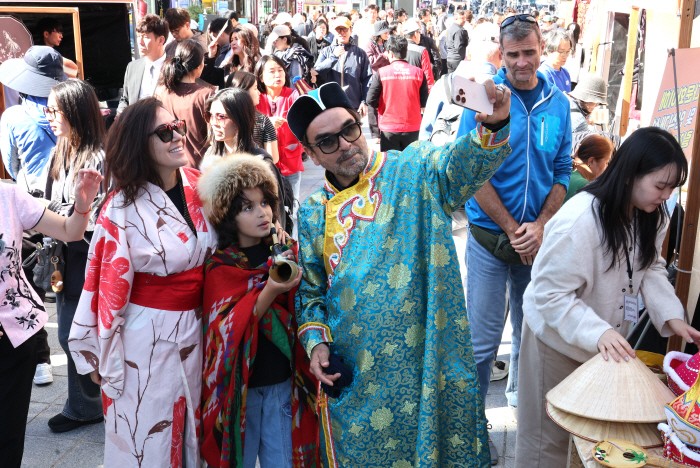 |
| Tourists try on traditional costumes from around the world during the second Haeundae World Culture Festival held on Gunam-ro in Haeundae District, Busan, on Oct. 27. / Yonhap News Agency |
The number of foreign tourists visiting South Korea this year has surpassed the previous annual record, the Ministry of Culture, Sports and Tourism said on Oct. 27.
According to the ministry, the number of inbound foreign tourists as of that day exceeded last year's record annual total of 18.94 million.
In particular, South Korea recorded a sharp increase in foreign tourist arrivals compared with major neighboring countries. From January to September, foreign tourist arrivals fell 2.9% in Japan and 3.8% in Thailand compared with the same period last year, while Vietnam recorded an increase of just 14.5%. In contrast, South Korea saw a surge of 21.5%, the ministry explained.
The inbound tourism market also showed signs of diversification. Visitor numbers increased across most markets, including Greater China (+29.1%), Japan (+16.9%), Southeast Asia (+15.3%) and Europe and the Americas (+15.1%). The trend toward increased regional tourism also continued. The number of visitors entering through airports and seaports outside the Seoul metropolitan area rose to 4.82 million from 3.74 million during the same period last year, while the number of visits to regional destinations increased to 64.72 million from 54.07 million.
Spending by inbound tourists also surged 47.7% from the same period last year, driven mainly by shopping (37.0%), accommodation (19.6%), and medical and wellness services (16.6%).
The ministry expects the cumulative number of foreign tourists visiting South Korea this year to surpass 20 million for the first time in the third week of November. If the current growth trend continues, the government could also achieve its year-end target of 23 million visitors.
The government attributed the record number of annual foreign tourist arrivals to the global spread of K-culture, innovation by the tourism industry in response to international travel demand, and the warm hospitality extended to foreign visitors by the Korean public. It also said that efforts such as strengthening interministerial cooperation by placing the National Tourism Strategy Council under the president, expanding flight services, easing visa issuance requirements, improving transportation convenience, allocating a supplementary budget in response to the war in the Middle East, and strengthening overseas marketing had produced tangible results.
To usher in an era of 30 million foreign tourists, a national policy goal, and prepare for an era of 40 million visitors as a major international tourism destination, the government plans to bring together the capabilities of the central government, local governments and the private sector, with the National Tourism Strategy Council playing a central role.
Minister of Culture, Sports and Tourism Chae Hwi-young said, "By reaching an all-time high in foreign tourist arrivals more than two months ahead of schedule, our ambitious target of attracting 23 million visitors this year, which we set at the beginning of the year, has also come within reach. It is particularly encouraging that both the share of arrivals through regional gateways and the number of visits to regional destinations are increasing. From now on, every day will set a new record for inbound tourism."
"Building on the current growth momentum, we plan to focus our efforts not only on quantitative expansion but also on qualitative improvement, doing our utmost to ensure that Korea firmly establishes itself as an 'irreplaceable travel destination' in the global tourism market," Chae added.
Lee Jang-won
Most Read
-
1
Celltrion nears additional contract with major U.S..

-
2
Putin proposes trilateral U.S.-China-Russia summit..

-
3
U.S. weighs dropping MOAB, world's most powerful n..

-
4
"Aren't those foreigners on welfare?": M..

-
5
Attention centers on APEC for possible Trump-Xi-Pu..

-
6
U.S., Israel plan to resume strikes on Iran after..

-
7
China tightens grip on boosting domestic demand an..

PEOPLE







-
Address : In-Young Bldg., 34, Uisadang-daero 1-gil, Yeongdeungpo-gu, Seoul
Copyright by ASIATODAY CO., LTD. All rights resereved