



Teachers struggle to identify AI smart glasses ahead of Korean CSAT
Oct 28, 2026, 09:41 am


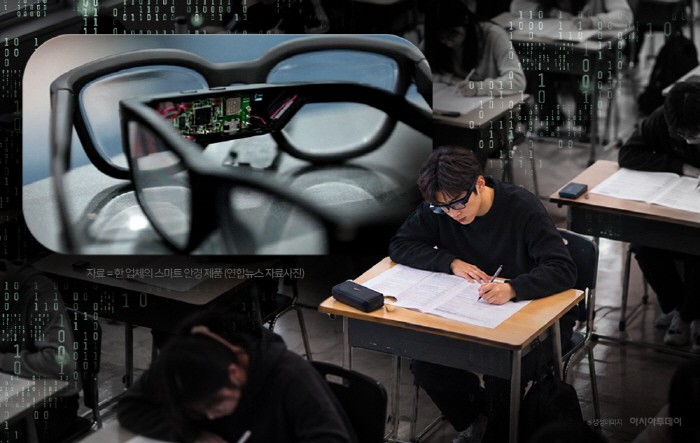 |
| Source: Yonhap News Agency / Graphic by Park Jong-gyu (AI-generated image) |
With the 2027 College Scholastic Ability Test (CSAT) approaching, smart glasses equipped with artificial intelligence (AI) capabilities have emerged as a new means of cheating, raising concerns over exam supervision. Although the Ministry of Education has established procedures for checking students suspected of wearing smart glasses, eight out of 10 teachers say the measures are ineffective because the devices are difficult to distinguish from ordinary glasses.
In particular, concerns are growing over the need for a specialized identification system and measures to protect teachers, as incorrectly identifying a student as a suspected cheater could lead to complaints and disputes, while failing to detect cheating could expose supervisors to accusations of negligence.
According to a survey of 2,716 middle and high school teachers nationwide conducted by the Korean Teachers and Education Workers Union (KTU) and released on Oct. 27, 82.3% of respondents said it would be difficult to identify students wearing smart glasses under the Ministry of Education's current supervision procedures. Of those surveyed, 58.7% said they would be "completely unable to identify" the devices, while only 3.5% said identification would be possible.
The online survey was conducted from Oct. 21 to 27, and 91.4% of respondents had experience supervising the CSAT.
The Ministry of Education recently added procedures for checking students suspected of wearing smart glasses to its "2027 CSAT Manual for Responding to Major Situations." However, teachers have pointed out that smart glasses equipped with AI and cameras closely resemble ordinary glasses, making them difficult for supervisors to identify through visual inspection.
The biggest concern among teachers was "complaints and disputes arising from mistaking ordinary glasses for smart glasses," cited by 64.4% of respondents. This was followed by the burden of identifying students as suspects (48.0%) and the possibility of being held responsible for inadequate supervision if smart glasses go undetected (45.9%).
Accordingly, 64.8% of respondents said the Ministry of Education should prioritize establishing a system staffed by specialists capable of identifying suspicious devices. Many also called for clear identification criteria and response manuals for different situations (53.4%), as well as institutional support for handling complaints and providing legal assistance (49.9%).
The KTU proposed installing specialized screening checkpoints for electronic devices, including smart glasses, at the entrances to examination centers, with dedicated experts responsible for making final determinations about suspicious devices. The union argued that an exam-wide management system should be established rather than leaving individual supervising teachers responsible for detecting cheating based on their own judgment.
There were also strong calls to improve working conditions for teachers supervising the CSAT. Some 97.6% of respondents supported increasing supervision allowances, while 94.6% said more supervisors should be assigned so that each teacher would be limited to supervising no more than two exam sessions per day.
The KTU pointed out that CSAT supervision lasts more than 12 hours, beginning early in the morning, and that the legal burden arising from disputes during the examination is concentrated on individual teachers.
"To respond to new forms of cheating that are difficult to detect with the naked eye, the authorities must immediately establish a specialized system for detecting and identifying smart glasses and introduce safeguards to prevent teachers from bearing unfair legal responsibility for problems arising during exam supervision," the KTU urged.
As advances in AI technology make methods of cheating increasingly sophisticated, improving the examination management system to ensure fair testing opportunities for students while preventing excessive responsibility from falling on supervising teachers has emerged as a major challenge.
In response, the Ministry of Education said it would seek support measures through active communication with teachers' organizations and other relevant groups.
Park Ji-sook
Most Read
-
1
Celltrion nears additional contract with major U.S..

-
2
Putin proposes trilateral U.S.-China-Russia summit..

-
3
U.S. weighs dropping MOAB, world's most powerful n..

-
4
"Aren't those foreigners on welfare?": M..

-
5
Attention centers on APEC for possible Trump-Xi-Pu..

-
6
U.S., Israel plan to resume strikes on Iran after..

-
7
China tightens grip on boosting domestic demand an..

PEOPLE







-
Address : In-Young Bldg., 34, Uisadang-daero 1-gil, Yeongdeungpo-gu, Seoul
Copyright by ASIATODAY CO., LTD. All rights resereved