



S. Korea's greenhouse gas levels exceed global average
Oct 28, 2026, 09:17 am


 |
Global concentrations of major greenhouse gases, including carbon dioxide, methane and nitrous oxide, all reached record highs last year. South Korea's background greenhouse gas concentrations also exceeded global averages, underscoring the growing need for continued monitoring of climate change.
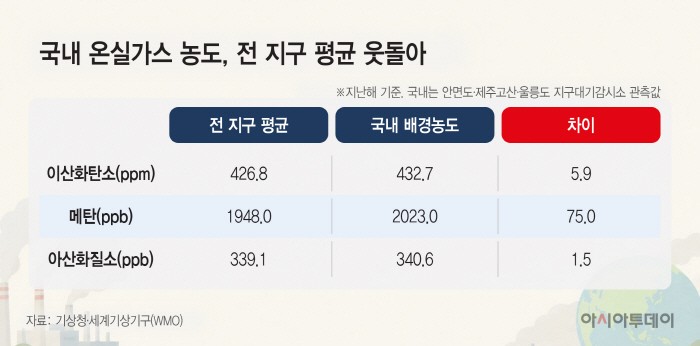
On Oct. 27, the Korea Meteorological Administration (KMA) said the global average carbon dioxide concentration reached 426.8 parts per million (ppm) last year, equivalent to 153% of the pre-industrial level of 278.3 ppm in 1750, according to the World Meteorological Organization's (WMO) recently released Greenhouse Gas Bulletin. Methane and nitrous oxide concentrations reached 1,948 parts per billion (ppb) and 339.1 ppb, respectively, representing 267% and 126% of their pre-industrial levels.
The annual increase in carbon dioxide concentrations slowed to 2.8 ppm from 3.5 ppm the previous year. The WMO attributed the slowdown mainly to the recovery of terrestrial carbon sinks following the strong El Niño of 2023–2024 and reduced carbon emissions from wildfires.
Methane concentrations rose by 6 ppb from the previous year, below the average annual increase of 10 ppb over the past decade. Nitrous oxide concentrations increased by 1.1 ppb, roughly in line with the average annual increase over the past decade.
South Korea's greenhouse gas concentrations were higher than global averages. According to the KMA's analysis of observations from three atmospheric monitoring stations in Anmyeondo, Jeju Gosan and Ulleungdo, the country's background carbon dioxide concentration stood at 432.7 ppm last year, 5.9 ppm above the global average. Methane and nitrous oxide concentrations reached 2,023 ppb and 340.6 ppb, respectively, exceeding global averages by 75 ppb and 1.5 ppb.
However, because domestic measurements and global averages cover different geographical areas, the concentration differences do not necessarily mean that South Korea produces more greenhouse gas emissions.
The WMO also highlighted the climate impacts of sulfur hexafluoride and hydrogen in its latest bulletin. In particular, sulfur hexafluoride, which is used as an insulating gas in electrical equipment, has a global warming effect approximately 24,300 times greater than that of an equivalent amount of carbon dioxide over a 100-year period. Its concentration also recorded the largest annual increase since observations began.
KMA Administrator Lee Mi-sun said, "Greenhouse gas observation data accumulated over many years provide an important scientific basis for understanding the causes and trends of climate change." She added, "We will deepen scientific understanding of changes in greenhouse gases both globally and in South Korea and support the country's carbon neutrality policies."
The KMA began continuous monitoring of sulfur hexafluoride in Anmyeondo in 2007 and expanded its monitoring to Jeju Gosan and Ulleungdo in 2017. In 2012, it was designated by the WMO as the World Calibration Centre for sulfur hexafluoride and has since conducted international comparison experiments, observer training and assessments of observation suitability. Through these activities, the agency is helping improve the reliability of greenhouse gas observation data worldwide and establish a monitoring system that allows comparisons between countries.
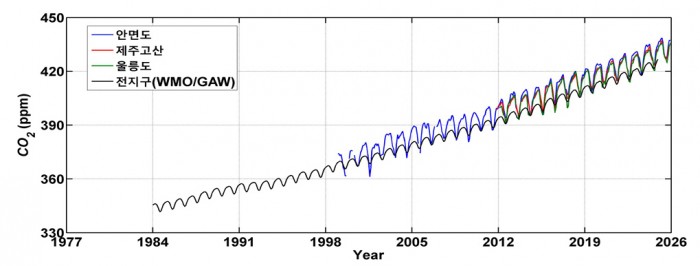 |
| Background carbon dioxide (CO2) concentrations worldwide and at Anmyeondo, Jeju Gosan and Ulleungdo. / Korea Meteorological Administration |
Jeong Moon-kyung
Most Read
-
1
Celltrion nears additional contract with major U.S..

-
2
Putin proposes trilateral U.S.-China-Russia summit..

-
3
U.S. weighs dropping MOAB, world's most powerful n..

-
4
"Aren't those foreigners on welfare?": M..

-
5
Attention centers on APEC for possible Trump-Xi-Pu..

-
6
U.S., Israel plan to resume strikes on Iran after..

-
7
China tightens grip on boosting domestic demand an..

PEOPLE






-
Address : In-Young Bldg., 34, Uisadang-daero 1-gil, Yeongdeungpo-gu, Seoul
Copyright by ASIATODAY CO., LTD. All rights resereved