



Kakao open-sources two in-house vision encoders
Oct 21, 2026, 09:31 am


 |
| /Kakao |
Kakao has released two types of internally developed vision encoders as open source, which act as the "eyes" of multimodal artificial intelligence (AI). By permitting commercial use so they can be leveraged for Korean document understanding and image-based question answering, the company is stepping up efforts to expand its proprietary multimodal AI ecosystem.
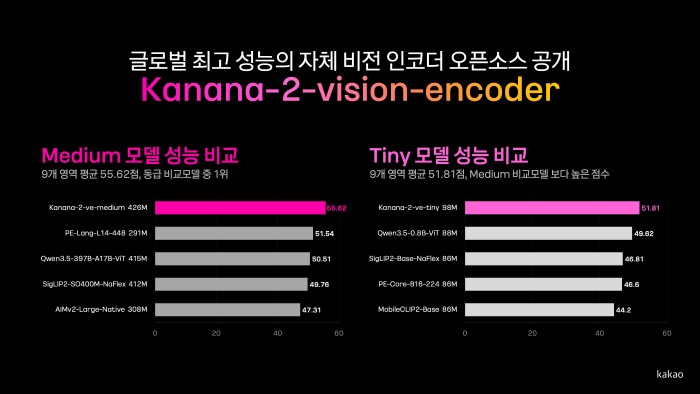
According to Kakao on the 21st, the newly unveiled "Kanana-2-vision-encoder" comes in two versions: "medium" with 426 million parameters and "tiny" with 98 million parameters. The models are available via the global AI development platform Hugging Face.
A vision encoder is a technology that extracts visual features—such as objects, text, locations, and shapes within an image—and transfers them to a language model. It serves as a core component dictating the image understanding performance of multimodal AI, enabling tasks such as reading dishes and prices from menus, identifying document content and layout, and describing situations shown in photographs.
Kakao evaluated performance across 42 benchmarks spanning nine domains, including general visual question answering, English and Korean text recognition and document understanding, in-image localization, and fine-grained recognition. The company explained that both models posted higher performance than comparison models such as Google's SigLIP 2, Meta's Perception Encoder, Apple's AIMv2, and Alibaba's Qwen3.5-ViT.
In particular, the tiny model demonstrated competitiveness against comparison models with over 400 million parameters despite being a lightweight model with fewer than 100 million parameters. Performance differences stood out prominently in in-image localization, Korean standardized tests, Korean text recognition, and document understanding.
Kakao utilized its proprietary language model "Kanana-2" to train the vision encoders, boosting training efficiency by roughly fourfold compared to previous approaches. The company stated that by adopting an architecture tailored for processing high-resolution images, processing latency was reduced by more than 60% compared to leading global vision encoders. Applying knowledge distillation and lightweighting techniques, it also developed the tiny model with on-device environments in mind.
Both models are licensed under the "Kanana Open License," permitting commercial applications as well as research and development. Kakao plans to enable domestic and global researchers and enterprises to utilize the models in multimodal AI research and service development, such as Korean document understanding and image-based question answering.
Kakao is internally developing components that constitute its omni-language model "Kanana-o," including vision encoders, language models, and vision-audio processing modules. It plans to sequentially release additional components down the road.
Noh Byung-seok, unified foundation model performance leader at Kakao, said, "With 'computer use' technology that directly understands and navigates PC and mobile screens gaining attention, the role of vision encoders that accurately analyze high-resolution images is growing," adding, "While sharpening the competitiveness of our proprietary AI models, we will contribute to advancing the AI ecosystem by making relevant technologies public."
Son Kang-hoon
Most Read
-
1
Putin proposes trilateral U.S.-China-Russia summit..

-
2
U.S., Israel plan to resume strikes on Iran after..

-
3
Ukraine halts strikes on Russian oil refineries un..

-
4
China's fifth plenum to conclude amid expectations..

-
5
ASEAN to discuss Myanmar's return next month

-
6
AI-discovered PHP flaw triggers global cybersecuri..

-
7
UK court orders worldwide asset freeze on Vietnam'..

PEOPLE







-
Address : In-Young Bldg., 34, Uisadang-daero 1-gil, Yeongdeungpo-gu, Seoul
Copyright by ASIATODAY CO., LTD. All rights resereved