



[Exclusive] U.S. military steel frame work at Gwangju Airport casts cloud over planned semiconductor industrial complex
Oct 21, 2026, 09:21 am


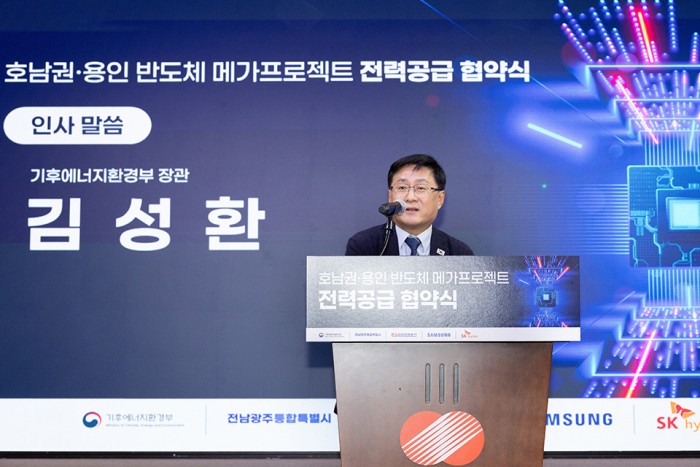 |
| Minister of Climate, Energy and Environment Kim Sung-whan signed the Honam Region-Yongin Semiconductor Industrial Complex Power Supply Agreement with Samsung Electronics, SK Hynix, and Korea Electric Power Corporation (KEPCO) in August. / Ministry of Climate, Energy and Environment |
The U.S. military is carrying out facility construction at Gwangju Military Airport, where the development of a mega-project semiconductor industrial complex is planned. With infrastructure construction intended for long-term operation proceeding in parallel alongside repairs to existing facilities, concerns are emerging that this could impact plans to create the semiconductor cluster.
According to the construction industry in the Gwangju and South Jeolla region on the 20th, heavy equipment was deployed until recently on the Gwangju Military Airport site used by the U.S. military, with steel structure installation work underway. An official from a company that took part in the construction said, "The scale was too large to be called simple construction, and it did not look like a temporary structure for brief use," adding, "It made me question whether the project would proceed as announced by the government."
In this regard, Asia Today, together with the office of People Power Party Representative Yoo Yong-won, sought confirmation from the Ministry of National Defense regarding the U.S. military's steel construction on the Gwangju Military Airport grounds, but the ministry responded, "It is difficult to disclose as it contains matters related to diplomatic relations and military security under the Korea-U.S. Special Measures Agreement (SMA)."
The construction in question is presumed to be linked to storage facility repairs or refueling facility construction projects. According to the Annual Report released in April this year by the Far East District of the U.S. Army Corps of Engineers, three major facility construction projects at Gwangju Air Base were specified: storage facility repair (B-246), aviation fuel supply facility construction, and steel water tank repair. The total project cost stands at 43.7 million dollars (about 58 billion won).
Among these, the storage facility repair work will continue until next year. For the storage facility, plans call for replacing the exterior walls, floors, roofs, and structural members of existing buildings and overhauling electrical, plumbing, communications, and fire-fighting equipment through late April next year.
The aviation fuel supply facility is a large-scale project modifying existing fuel storage tanks and reconfiguring refueling equipment on the aircraft ramp. Long-term operational facilities, including control, generator, and filtration equipment buildings, refueling vehicle facilities, and a fuel test laboratory, will also be constructed.
Additional facility investment plans were also confirmed. In the Fiscal Year 2027 Construction Program List released by the Air Force Civil Engineer Center (AFCEC), repair plans for two unaccompanied personnel housing buildings (B-241 and B-243) at Gwangju Air Base were included. Fire protection system installations and base sewage facility repair projects were also budgeted.
The problem is that the government's military airport relocation timeline meshes with the U.S. military's facility investment plans. In the mega-project plan announced in June, the government designated roughly 8.2 million square meters around the Gwangju Military Airport site as a candidate location for the semiconductor complex and decided to pursue a provisional relocation of the military airport before September 2028.
However, specific consultation details regarding the return of the granted land used by the U.S. Air Force have not been made public. Currently, among the Gwangju Airport site, the military airport parcel covers roughly 6.13 million square meters. The dedicated U.S. military zone within the military airport spans 742,000 square meters, while the joint Korea-U.S. use zone, including runways, amounts to roughly 960,000 square meters.
Such military infrastructure work could disrupt the construction of the mega-project power supply network. The government has announced that it will build phase-one power transmission lines to supply electricity to the semiconductor cluster starting in late 2028. However, if the U.S. granted land is not returned, the installation schedule or design for the power facilities may need to be altered.
In this regard, the Ministry of Climate, Energy and Environment stated, "We are aware that the U.S. military is carrying out steel construction at Gwangju Airport," adding, "We plan to consult with relevant agencies, including the Ministry of National Defense, so that there will be no disruption to power supply construction."
Kim Deok-ho
Most Read
-
1
Celltrion nears additional contract with major U.S..

-
2
Putin proposes trilateral U.S.-China-Russia summit..

-
3
"Aren't those foreigners on welfare?": M..

-
4
U.S. weighs dropping MOAB, world's most powerful n..

-
5
Houthis launch successive attacks on Saudi airport..

-
6
Saudi Arabia, Iran hold first diplomatic talks to..

-
7
Saudi airport in Riyadh struck again, leaving at l..

PEOPLE






HEADLINE NEWS
- [Exclusive] U.S. military steel frame work at Gwangju Airport casts cloud over planned semiconductor industrial complex
- Elon Musk formalizes review of SpaceX-Tesla merger
- [Exclusive] 10 SNUs pledged, but three regional universities take half the..
- Saudi Arabia postpones 'Davos in the Desert' amid airport strikes

-
Address : In-Young Bldg., 34, Uisadang-daero 1-gil, Yeongdeungpo-gu, Seoul
Copyright by ASIATODAY CO., LTD. All rights resereved