



[Exclusive] 10 SNUs pledged, but three regional universities take half the funds
Oct 21, 2026, 09:11 am


 |
| Office of Representative Lee Ju-young / AI-generated image |
Concerns are turning into reality that the government's project to create 10 Seoul National Universities, pursued to boost the competitiveness of flagship national universities for balanced national development, could instead deepen polarization among national universities and reinforce a new institutional hierarchy. In particular, critics point out that the gap with the remaining six flagship national universities could widen further, as three institutions—Pusan National University, Chonnam National University, and Chungnam National University—selected as package support universities this past September, accounted for nearly half of the total financial support allocated to all flagship national universities.
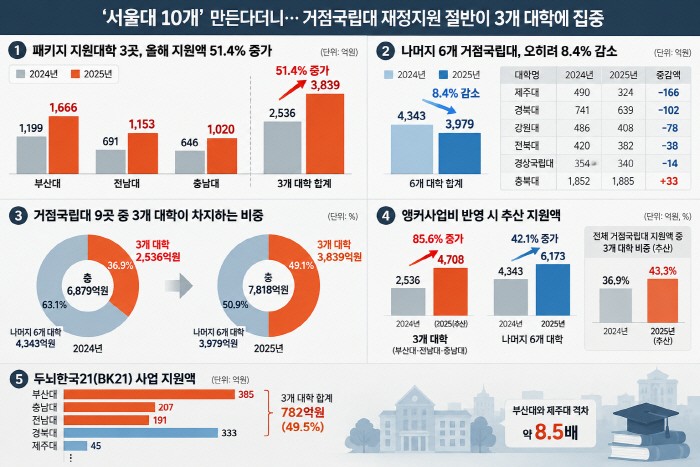
According to an analysis of data including Major University Financial Support Status for Fiscal Years 2024–2026 submitted by the Ministry of Education to Representative Lee Ju-young of the Reform Party, a member of the National Assembly's Education Committee, on the 20th, the financial support for major projects allocated this year to Pusan National University, Chonnam National University, and Chungnam National University totaled 383.9 billion won. This represents an increase of 130.3 billion won (51.4%) from 253.6 billion won last year, accounting for 49.1%, or nearly half, of the total funding allocated to all nine flagship national universities.
Assuming that anchor project funding under the Regional Innovation System & Education (RISE) framework, which was not included in this year's data, is provided this year at the same level as last year, the support allocated to the three selected universities would reach 470.8 billion won, an 85.6% jump year on year.
Excluding Seoul National University, there are nine flagship national universities: Kangwon National University, Kyungpook National University, Gyeongsang National University, Pusan National University, Chonnam National University, Jeonbuk National University, Jeju National University, Chungnam National University, and Chungbuk National University. The government selected three of these institutions as package support universities and decided to provide each with approximately 70 billion won annually for five years starting this year.
By university, total financial support this year was highest for Pusan National University at 166.6 billion won. It was followed by Chonnam National University at 115.3 billion won and Chungnam National University at 102.0 billion won. Based on the data submitted last year, support stood at 119.9 billion won for Pusan National University, 69.1 billion won for Chonnam National University, and 64.6 billion won for Chungnam National University.
In contrast, funding for the remaining six flagship national universities actually decreased by 36.4 billion won (8.4%), dropping from 434.3 billion won last year to 397.9 billion won this year. Funding declined by 16.6 billion won for Jeju National University, 10.2 billion won for Kyungpook National University, 7.8 billion won for Kangwon National University, 3.8 billion won for Jeonbuk National University, and 1.4 billion won for Gyeongsang National University, while Chungbuk National University was the only one to see an increase, rising by 3.3 billion won.
As a result, the share accounted for by the three selected universities among the major project support funds across the nine flagship national universities rose from 36.9% last year to 49.1% this year. Pusan National University's funding this year (166.6 billion won) reached 5.1 times that of Jeju National University (32.4 billion won).
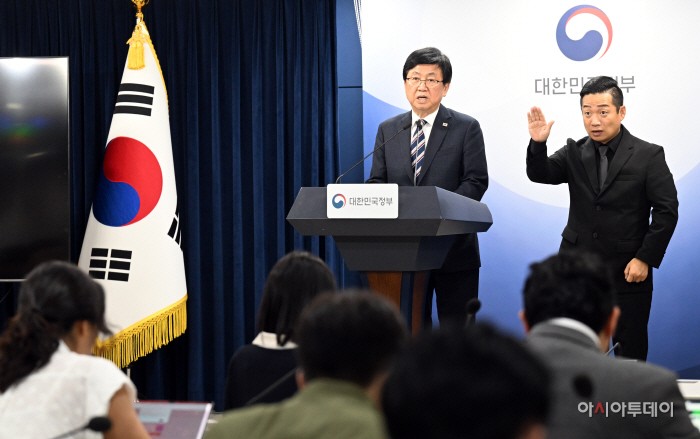 |
| Minister of Education Choi Kyo-jin announces the selection results of package support universities among flagship national universities for the initiative to foster 10 Seoul National Universities at a joint briefing room in the Government Complex Seoul in Jongno-gu, Seoul, on September 1. / Reporter Park Sung-il |
Three selected universities absorb 49.1% of state funds, stoking concerns over new institutional hierarchy instead of balanced regional development
In contrast, funding for the six unselected universities was estimated to rise 42.1% to 617.3 billion won. In effect, the growth rate of funding for the selected universities was roughly double that of the unselected institutions. Under such assumptions, the share accounted for by the three selected universities out of the total funding for all nine flagship national universities rises from 36.9% last year to 43.3% this year.
Disparities were also confirmed in the Brain Korea 21 (BK21) project, aimed at fostering graduate research talent. This year, BK21 support for the nine flagship national universities stood at approximately 158 billion won, with the three selected universities taking 78.2 billion won (49.5%). Pusan National University received the largest share at 38.5 billion won, followed by Kyungpook National University at 33.3 billion won, Chungnam National University at 20.7 billion won, and Chonnam National University at 19.1 billion won. The gap between Pusan National University and Jeju National University (4.5 billion won) stood at roughly 8.5 times.
The BK21 initiative is a separate project from package support where funding allocations vary according to factors such as the scale of existing research groups selected. However, amid already wide disparities in research funds, concerns are mounting that concentrating massive fiscal resources on specific universities could further exacerbate imbalances in educational and research environments.
A professor at a flagship national university pointed out, "While supporting flagship national universities to a certain degree is necessary in line with government efforts to foster core industries such as semiconductors and AI, a wide gap with other universities ultimately strays from the primary goal of revitalizing regions." The professor added, "If funding disparities widen amid the crisis of regional extinction, it could generate yet another layer of polarization."
The Ministry of Education maintains that fostering 10 Seoul National Universities is a policy designed to strengthen the competitiveness of all flagship national universities. However, regarding additional selections of package support universities, the ministry stated that discussions could proceed only through consultations with relevant ministries and the National Assembly budget review process, leaving whether more institutions will be selected next year unclear. As a result, critics argue that if fostering leading models promoted by the government fails to lead to shared growth among other flagship national universities, it could entrench a new hierarchy among national universities instead of balanced regional development.
Representative Lee Ju-young criticized, "What the government ended up creating after pledging to build 10 Seoul National Universities is merely another hierarchy: three privileged universities and six alienated ones."
She went on to emphasize, "If a policy advanced in the name of balanced development worsens the gap between the rich and the poor within flagship national universities and inflicts yet another sense of defeat on the regional higher education ecosystem, it represents a blatant policy failure." She added, "To ensure that universities left behind under the pretext of selection and concentration are not marginalized, the government must comprehensively reexamine the validity of budget allocations and swiftly formulate workable models for sharing education and research infrastructure alongside measures to mitigate disparities."
Park Ji-sook
Most Read
-
1
Celltrion nears additional contract with major U.S..

-
2
Putin proposes trilateral U.S.-China-Russia summit..

-
3
"Aren't those foreigners on welfare?": M..

-
4
U.S. weighs dropping MOAB, world's most powerful n..

-
5
Houthis launch successive attacks on Saudi airport..

-
6
Saudi Arabia, Iran hold first diplomatic talks to..

-
7
Saudi airport in Riyadh struck again, leaving at l..

PEOPLE






HEADLINE NEWS
- [Exclusive] U.S. military steel frame work at Gwangju Airport casts cloud over planned semiconductor industrial complex
- Elon Musk formalizes review of SpaceX-Tesla merger
- [Exclusive] 10 SNUs pledged, but three regional universities take half the..
- Saudi Arabia postpones 'Davos in the Desert' amid airport strikes

-
Address : In-Young Bldg., 34, Uisadang-daero 1-gil, Yeongdeungpo-gu, Seoul
Copyright by ASIATODAY CO., LTD. All rights resereved