



In run-up to election, Netanyahu's rule put to test amid divided public sentiment
Oct 19, 2026, 04:45 pm


 |
With Israel's general election about a week away, whether Prime Minister Benjamin Netanyahu will succeed in maintaining his coalition government to extend his long rule, or whether the opposition will take power and bring change to Israel's policies, has emerged as a major variable in Middle East affairs.
With final polls showing conflicting results depending on the polling agency and both camps facing uncertainty in securing a majority of seats, predicting the outcome of the election is difficult.
The faction standing against the ruling Likud party is the Yashar party led by Gadi Eisenkot. Eisenkot, a former Chief of Staff of the Israel Defense Forces, is seeking a change of government on the back of his national security experience accumulated while serving as defense minister and a war cabinet minister in the Netanyahu administration.
According to poll tracking data released on the 18th (local time) by Petek, a non-partisan Israeli election guide website, the Likud party and the Yashar party are each projected to win 22 seats, showing a neck-and-neck race.
According to U.S. Jewish news agency JTA on the 19th, in most polls conducted over recent days, the opposition has led Prime Minister Netanyahu's ruling coalition, but neither camp was found to have secured enough seats to command a majority in the Knesset.
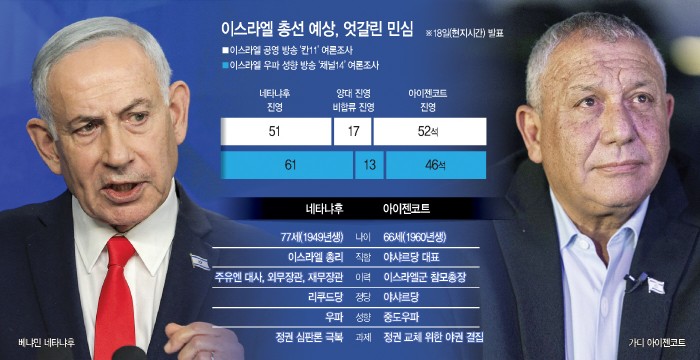
In a poll released on the 18th by Israeli public broadcaster Kan 11, the Eisenkot camp was tallied at 52 seats, taking one more seat than the Netanyahu camp.
By party, the Yashar party ranked first with 23 seats, followed closely by the Likud party with 21 seats. Parties belonging to neither of the two major camps took 17 seats.
In a poll by right-leaning Israeli broadcaster Channel 14 released on the same day, the Netanyahu camp significantly led the Eisenkot camp with 61 seats to 46 seats. The Likud party led the pack with 29 seats, followed by the Yashar party with 22 seats. Factions outside either camp took 13 seats.
This election marks the first general election held since the outbreak of the war in the Palestinian Gaza Strip in October 2023. Depending on the outcome, whether the widening multi-front war in the Middle East can come to an end is drawing keen attention.
British magazine The Week interpreted the vote as the first opportunity for voters to pass judgment on the government's failure to prevent the surprise attack by Palestinian militant group Hamas and its subsequent conduct in expanding the war to Gaza, Lebanon, and Iran. It also noted that the election could serve as an opportunity for Israel to reset relations with allies that have criticized the Netanyahu government.
In particular, for Prime Minister Netanyahu, who has held power continuously since 2009 with the exception of about a year and a half, the election could mark the starting point of political downfall for Israel's longest-serving prime minister. Netanyahu, who governed from 2009 to 2021, returned to the premiership in 2022 and is aiming to extend his rule once again this year.
However, even if power changes hands, it remains uncertain whether there will be a shift in the trajectory of the Middle East conflict. While the opposition criticizes Prime Minister Netanyahu's handling of the war, it maintains that a hard-line stance against hostile nations should be sustained.
Because Israel employs a proportional representation system where votes are cast for nationwide party lists, even the party with the most seats rarely exceeds 35 seats, making coalitions with other parties essential to secure a 61-seat majority in the 120-seat Knesset and form a government.
The largest party, Likud, currently holds 32 seats. To remain in power, it must maintain alliances with pro-Netanyahu ultra-Orthodox parties Shas (11 seats) and United Torah Judaism (UTJ, 7 seats), the ultra-nationalist Religious Zionist Party (7 seats), the far-right Otzma Yehudit (6 seats), and the center-right New Hope (4 seats).
U.S. President Donald Trump publicly endorsed Prime Minister Netanyahu's reelection on the 18th.
In a post titled "To the Great People of Israel" on social media that day, he praised Netanyahu, calling him a "great warrior prime minister" and a "terrific partner for peace" in the fight against Iran, which has shouted "Death to Israel, Death to the U.S., and Destroy the Little and Big Satan" for 51 years.
President Trump emphasized, "Unless Iran changes course quickly, we will soon finish the job," adding, "If Israel ends up with the wrong leader—meaning anyone other than Netanyahu—the U.S. would have to do the job itself, and I have no desire to do that."
He continued, "The U.S. has done a lot for Israel," adding, "Through this letter, I express my complete endorsement of Netanyahu in the upcoming Israeli prime ministerial election."
Kim Hyun-min
Most Read
-
1
Celltrion nears additional contract with major U.S..

-
2
"Aren't those foreigners on welfare?": M..

-
3
U.S. weighs dropping MOAB, world's most powerful n..

-
4
Houthis launch successive attacks on Saudi airport..

-
5
Saudi Arabia, Iran hold first diplomatic talks to..

-
6
Saudi airport in Riyadh struck again, leaving at l..

-
7
Five ASEAN countries welcome Myanmar coup leader

PEOPLE






HEADLINE NEWS
- Trump's approval rating hits low of 33% as public turns back over soaring inflation
- Trump says Hyundai announced 748.6-billion-won investment in Georgia
- China tightens grip on boosting domestic demand and expanding anti-graft dr..
- Food prices jump 35% over 10 years, fueling massive protests by 800,000 acr..

-
Address : In-Young Bldg., 34, Uisadang-daero 1-gil, Yeongdeungpo-gu, Seoul
Copyright by ASIATODAY CO., LTD. All rights resereved