



Cracks in U.S. AI investment boom wipe 1 trillion dollars from chip stock market cap
Oct 19, 2026, 02:15 pm


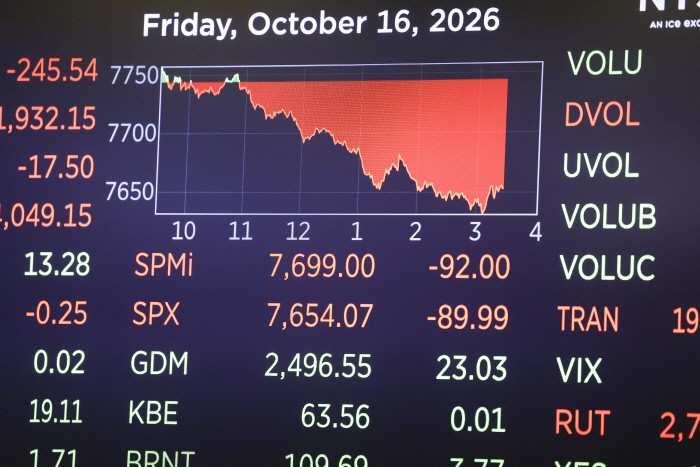 | ||||
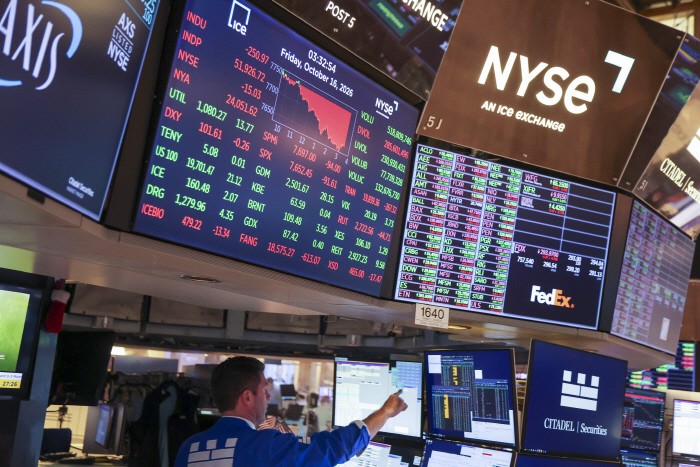
Real-time market data is displayed on an electronic board inside the trading floor before the closing bell at the New York Stock Exchange (NYSE) in New York, U.S., on the 16th (local time). While the three major indices of the U.S. stock market closed higher the previous day on the 15th, all three fell on the 16th under the impact of soaring international oil prices. / EPA, Yonhap
[Article Summary]
1. As the market capitalization of U.S. semiconductor companies fell by more than 1 trillion dollars last week and CoreWeave shares plunged 24%, concerns over the sustainability of AI investments spread widely.
2. The Wall Street Journal warned that if AI investment contracts, earnings at semiconductor and equipment firms will take a hit, and even if investments proceed as planned, massive capital could be wasted if they fail to generate sufficient returns.
3. While U.S. AI investments through 2032 are estimated at 9 trillion to 10 trillion dollars, 47 large-scale data center projects encountered setbacks this year, and the feasibility of planned projects was assessed at roughly 35%.
4. Amid CoreWeave's credit default swap spreads surging to 1,102 basis points, Gartner projected that AI revenues will fall short of covering investment costs, while Wall Street views diverged over whether a bubble is forming.
Driven by rising U.S. inflation, surging interest rates, and concerns regarding the profitability of artificial intelligence (AI) investments, the market capitalization of U.S. semiconductor companies dropped by more than 1 trillion dollars (1,335.4 trillion won) last week. As share prices of data center operator CoreWeave plummeted 24% and credit risk surged, the sustainability of the AI investment boom—estimated to exceed 9 trillion to 10 trillion dollars through 2032—emerged as a major point of contention. U.S. daily The Wall Street Journal reported on the 18th (local time) that the current AI infrastructure investment boom has yet to prove it can avoid the pitfalls experienced by past massive capital expenditures, such as railways and the internet. ◇ AI stocks plunge as U.S. chipmakers lose 1 trillion dollars in market cap in one week The market capitalization of U.S. semiconductor companies dropped by more than 1 trillion dollars in just one week, German business daily Handelsblatt reported, citing data from Bloomberg News. Dutch bank ING defined the drop as an "AI correction." On the New York stock market, the tech-heavy Nasdaq 100 index fell 2% on the 14th, marking its steepest single-day drop since late July. For the week as a whole, it fell 5.5%. In Asia, memory chipmakers SK Hynix and Samsung Electronics fell more than 10% each on the 15th. Handelsblatt reported that their corporate values also dropped more than 50% and 40%, respectively, compared to their year-to-date peaks. At their yearly highs, both companies had exceeded 1 trillion dollars in market capitalization each. On a weekly basis, CoreWeave dropped 24% and U.S.-based Micron declined 11%. Samsung Electronics and SK Hynix fell 17.8% and 24.3%, respectively, recording their worst weekly declines since the 2008 financial crisis. Thomas Altmann, portfolio manager at asset management firm QC Partners, explained that "if it had been typical profit-taking, the pace of selling would have been much slower," noting that investor caution regarding elevated stock prices and corporate valuations is mounting. However, major AI-related stocks including Dell, HP, SK Hynix, NetApp, and Samsung Electronics continue to maintain substantial gains year-to-date even after this correction. According to Handelsblatt, Dell was up more than 300% from the start of the year, while HP was up over 150%. Although Dutch semiconductor equipment maker ASML and Taiwan's TSMC, the world's largest contract chipmaker, announced quarterly earnings topping market expectations last week, investment sentiment failed to reverse. Handelsblatt analyzed that investor focus has shifted from current chip demand toward whether AI investments can deliver long-term profitability.
Questions over sustainability of corporate earnings linger In a column published on the 18th titled "A Reminder From the AI Stock Wobble: This Time Isn't Different," WSJ columnist James Mackintosh analyzed that two opposing risks exist in AI investment. If investment in AI infrastructure contracts, earnings at suppliers of semiconductors, equipment, and power will take a hit. Conversely, even if investments proceed according to plan, massive sums of capital could be wasted if AI technology fails to generate sufficient economic value. Citing investor John Templeton's remark that "this time is different" are the four most dangerous words in investing, Mackintosh assessed that there is no evidence the current AI investment boom is exempt from past issues of overinvestment. The boom in data center construction has driven up revenues and pricing power for suppliers of semiconductors, cooling systems, cables, backup generators, and turbines. According to data from financial information firm LSEG, the 12-month forward net profit margin of S&P 500 companies on the New York stock market has climbed from the 8% range in 2011 to roughly 16.8% recently. However, Mackintosh pointed out that once data center construction is completed, capital expenditures could drop precipitously because maintenance, repair, and upgrade costs are lower than new construction. Investors are also questioning the sustainability of corporate earnings. While 12-month forward expected earnings of S&P 500 companies increased by more than 30% this year, the index gained only in the low 10% range. The forward price-to-earnings (P/E) ratio based on projected earnings fell from about 22.4 times to around 19 times. Nvidia shares rose 15%, but its forward P/E fell from 23 times to 15 times. Micron's forward P/E remained below 5 times even after its share price tripled. Rob Almeida, global investment strategist at MFS Investment Management, remarked, "The market's issue is not the P (price), but the E (earnings)." The Wall Street Journal reported that some market participants believe a bubble exists in current corporate earnings, and that elevated valuations could be laid bare if future profits decline. According to Gerard Minack, head of Minack Advisors, projected earnings for eight major AI companies—Amazon, Alphabet, Broadcom, Meta, Microsoft, Nvidia, Oracle, and Palantir—along with the "next 11" AI firms were revised upward by 700 billion dollars (934.15 trillion won) year-to-date. In contrast, the increase for the remaining S&P 500 companies fell short of 500 billion dollars (667.25 trillion won). Mackintosh cited 1840s British railway construction and dot-com era fiber-optic network investments as historical examples. While those investments brought immense benefits to society as a whole, they failed to meet investor expectations due to delayed returns and intensifying competition, he explained.
|
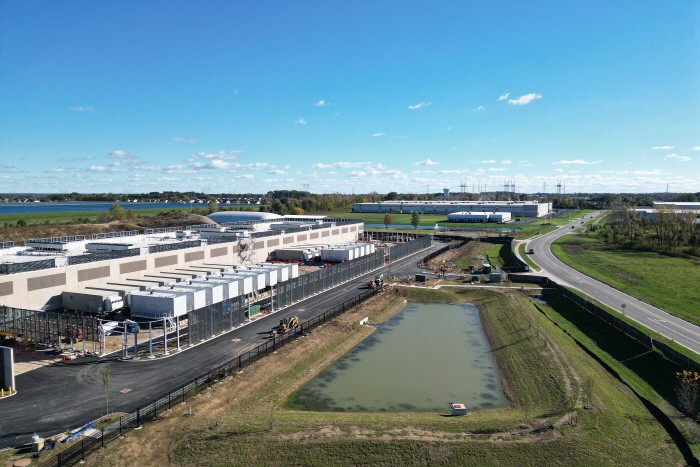 |
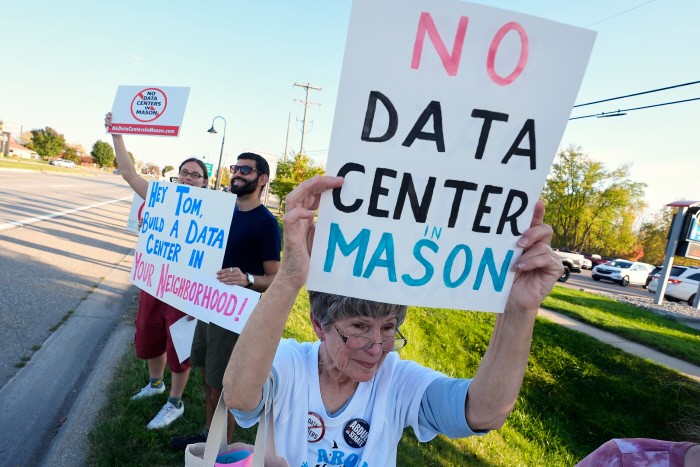
| A photograph taken on the 17th (local time) showing a Cologix data center under construction in Lewis Center, Ohio. The $1 billion data center being built in Orange Township received one of the last tax incentives approved by Ohio before the state paused new tax breaks for data centers for further review. As opposition to data center construction spreads across the U.S., it has emerged as a major issue in the November midterm elections. Ohio is home to around 200 data centers, ranking fourth in the nation by the number of data centers. / AFP, Yonhap |
FT reports 47 data center projects face setbacks, with feasibility of planned projects at 35%
Massive investment plans are facing hurdles during actual data center construction. The FT reported, citing data from regulatory intelligence firm RegLayer, that at least 47 large-scale data center projects in the U.S. have been delayed, canceled, or blocked this year. This is a conservative estimate tallied around the largest-scale facilities.
Investment bank Bernstein estimated this month that only about 35% of planned data center projects in the U.S. are feasible. An FT investigation found that more than 1,000 U.S. communities have attempted to introduce moratoriums or restrictions on AI infrastructure construction this year.
OpenAI's $500 billion (667.3 trillion won) Stargate project has also run into permitting setbacks, construction delays, and high-level executive departures. Sachin Katti, head of compute at OpenAI, also left the company last week.
According to data center industry officials, instances have also emerged where utility regulators refuse grid connections unless operators supply their own power.
Construction delays lead to risks of large contract cancellations. This is because Big Tech firms and AI labs include clauses allowing them to walk away from contracts with data center operators that fail to meet delivery deadlines.
Anthropic could walk away from a $45 billion (60.057 trillion won) contract if British cloud infrastructure startup Nscale fails to meet financing or delivery conditions for its West Virginia project in the U.S.
Nscale is pursuing a listing on the New York Stock Exchange targeting a valuation of $35 billion (46.711 trillion won), but banking circles assessed that an IPO in the near term is difficult due to volatile market conditions.
As of August, advanced AI chips actually operated by Nscale stood at 25,000 units, representing just 5% of its planned target of roughly 500,000 units. Conversely, Nvidia CEO Jensen Huang praised Nscale's rapid growth in London last week, remarking, "Last year it was zero," and adding that it could become the most valuable company founded in the UK in the past decade.
Cypher, formerly a cryptocurrency miner, agreed to shoulder initial cost overruns of $359 million (479.4 billion won) when revising a lease agreement for its Texas data center last month. Business modifications required about $750 million (1.002 trillion won) in additional equity, leading the company to issue $850 million (1.1356 trillion won) in convertible bonds in connection with the changes.
SB Energy, in which SoftBank Chairman Masayoshi Son holds a majority stake, requires $174 billion (232.3248 trillion won) to fulfill $430 billion (574.136 trillion won) in future revenue contracts. However, it has yet to complete a single data center, and it has postponed plans for an IPO targeting a $50 billion (66.755 trillion won) valuation.
Nebius CEO Arkady Volozh stated at a Citi conference last month that building its planned 5-gigawatt (GW) data center capacity will require roughly $250 billion (333.775 trillion won), but only about 20% has been secured to date.
According to the FT, a data center industry executive remarked, "People don't just jump at data centers anymore," noting that securing financing has become far more difficult than before.
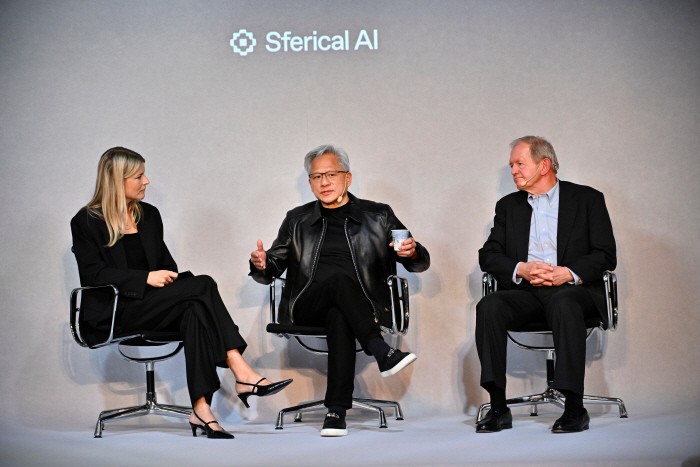 |
| Jenny Nordlöw, CEO of Sferical AI (from left), Nvidia CEO Jensen Huang, and Marcus Wallenberg, chair of Sweden's SEB Bank and defense firm Saab, engage in a discussion at the "Sferical One" event held at Eric Ericsonhallen in Stockholm, Sweden, on the 15th (local time). / TT News Agency, AP, Yonhap |
Financial risks facing AI companies have also become clearly visible in the corporate bond and credit default swap (CDS) markets. According to five-year CDS spreads presented by Handelsblatt citing data from LSEG and Bloomberg, CoreWeave's spread climbed to 1,102 basis points (1 bp = 0.01 percentage point), whereas Oracle stood at 283 bps, Meta at 103 bps, Amazon at 74 bps, and Alphabet at 72 bps.
The price of CoreWeave's corporate bonds maturing in 2032 fell to 77% of par value, while the yield rose to 15%. Handelsblatt described bond prices falling below 80% of par value as a warning sign.
The FT reported that one of CoreWeave's unsecured corporate bonds fell into territory considered distressed debt last week. A $1.1 billion (1.4682 trillion won) bond issued for the construction of a data center in Virginia, U.S., leased to CoreWeave also dropped about 5% just three weeks after issuance.
While CoreWeave's projected capital expenditure for this year stands at $35 billion to $39 billion (46.7145 trillion to 52.0884 trillion won), projected revenue is limited to $12.4 billion to $13.2 billion (16.5614 trillion to 17.6299 trillion won). As of June 30, its cash and cash equivalents also stood at approximately $5.5 billion (7.3458 trillion won).
Analytics firm S3 Partners assessed CoreWeave's business model as "taking on debt, buying Nvidia graphics processing units (GPUs), and then leasing out computing power."
Chris Turner, an analyst at ING, observed that the decline in CoreWeave's bond prices raises questions about investors' willingness to finance AI infrastructure expansion.
U.S. market research firm Gartner estimated that data center operators would need cumulative revenues of $8.5 trillion (11,356 trillion won) by 2030 to cover investment costs and achieve a 12% return. However, it projected that AI-related revenue over the same period is unlikely to exceed $3.6 trillion (4,808.16 trillion won).
Gartner analyst Bill Sommer emphasized, "Our survey findings suggest that AI revenue from enterprise and individual customer segments will not be sufficient to generate a profit."
Gartner also cited the short lifespan of high-performance AI computers as a risk factor. It analyzed that due to the burden of replacing them with newer systems, projects totaling $3.5 trillion (4,674.6 trillion won) will face depreciation risks by 2030. In particular, it projected that 80% of neocloud companies—emerging AI cloud infrastructure startups—will shut down or be acquired over the coming years.
On the other hand, it evaluated that large data center operators such as Amazon, Google, and Microsoft generate sufficient earnings from other business lines to sustain their current pace of investment.
Enterprises' ability to forecast AI spending also appeared limited. A survey of 396 companies by consulting firms Mavvrik and Benchmarkit revealed that only 11% of companies projected AI spending within a 10% margin of error of actual figures. Companies showing an 11% to 25% margin of error stood at 39%, 26% to 50% at 35%, and over 50% at 13%.
Sixty-two percent of companies altered business decisions due to unexpected AI costs. One in four companies postponed or canceled AI projects. Eighty-one percent of surveyed companies responded that AI expenses had a moderate or greater impact on their gross margin. In the survey, 63% of respondents also reported that their gross margins declined by 6 to 15 percentage points.
Torsten Sløk, chief economist at Apollo Global Management, pointed out that "in the end, we are still waiting for the return on investment from AI," noting that controlling unexpected costs is becoming increasingly difficult.
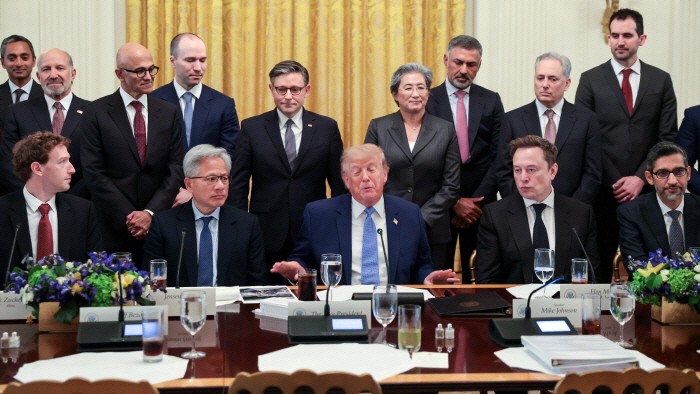 |
| U.S. House Speaker Mike Johnson (fifth from left, back row), U.S. Secretary of Commerce Howard Lutnick (second), Meta CEO Mark Zuckerberg (front row, left), SpaceXAI founder and CEO Elon Musk (second from right, front row), Nvidia President and CEO Jensen Huang (second from left, front row), OpenAI President Greg Brockman (fourth from left, back row), Google CEO Sundar Pichai (front row, right), and AMD CEO Lisa Su (fourth from right, back row), among others, attend a luncheon with tech leaders hosted by U.S. President Donald Trump (center, front row) in the East Room of the White House in Washington, D.C., on September 29 (local time). / Reuters, Yonhap |
Investments hedging against U.S. stock plunge rise
A growing number of investors are preparing for the possibility that the sell-off that began in AI-related companies could spread across the broader U.S. stock market. According to Bloomberg, the S&P 500 had not fallen by 1% or more for 53 consecutive trading sessions prior to the 14th, marking its longest streak since January 2020.
However, on the 16th, the Chicago Board Options Exchange (CBOE) Volatility Index (VIX) rose 3.5 points while the S&P 500 dropped about 1.1%. Intraday, the VIX surged by 6 points as the index tumbled roughly 1.5%.
According to Bank of America (BofA) strategists, investors' cumulative open interest in VIX call options increased to roughly 2 million contracts, nearing levels seen in the summer of 2024.
They explained that if dealers who sold options buy additional VIX futures to hedge risk from rising prices, it could trigger a "gamma squeeze" that amplifies volatility spikes.
In particular, they estimated that if front-month VIX futures spike by 10 points, the volume of futures dealers must purchase to maintain risk neutrality could reach about 90% of the daily average VIX futures trading volume.
Jeremy Bean, managing partner at Viewpoint Capital Management, cited rising U.S. Treasury yields, energy prices, the midterm elections, and geopolitical risks, warning that it is only a matter of time before major cracks appear in the U.S. stock market.
BofA strategists pointed to the intraday slide in Nasdaq 100 futures immediately after OpenAI reported lower-than-expected revenue on the 8th, noting that this served as an example of how markets might react if growth in the AI sector slows.
Assessments over whether the stock market is in a bubble also remain divided. Bloomberg reported that the Cyclically Adjusted Price-to-Earnings (CAPE) ratio, commonly known as the Shiller P/E, calculated based on inflation-adjusted earnings over the past 10 years, stood at roughly 41 times, approaching the peak of 44 times recorded in 1999.
The share of the top three U.S. companies by market capitalization—Nvidia, Apple, and Microsoft—in the total market capitalization of the S&P 500 also reached about 21%. In October 1999, it took approximately 10 companies to make up a comparable share.
Conversely, the average forward P/E of the top five tech stocks in the S&P 500 currently stands at around 23 times, significantly lower than the roughly 65 times seen one month before the peak of the dot-com bubble in 2000.
Michael O'Rourke, chief market strategist at JonesTrading, pointed out that declining P/E ratios among Big Tech firms reflect massive borrowing undertaken to build out AI infrastructure. Citing structures where semiconductor suppliers provide financing for purchases of their own products, he criticized, "We have taken vendor financing to an entirely new level."
On the other hand, Howard Marks, co-chairman of Oaktree Capital Management who foresaw the peak of the dot-com market in 2000, took a cautious stance on deeming the current market a bubble. While defining a bubble as "irrational exuberance and heedlessness," he emphasized that investors remain conscious of the risks.
Co-Chairman Marks said, "If enough people are questioning whether there is a bubble in a certain sector, it is reasonable to think that even if there is one, it will be limited."
The next test lies in upcoming earnings reports from large U.S. technology companies, including Nvidia. Bloomberg reported that investors will evaluate the sustainability of AI investments through the earnings and share price reactions of the "Magnificent Seven" companies.
The Wall Street Journal warned that if AI investment contracts, profits for semiconductor and equipment suppliers will shrink, and even if investment persists, massive capital expenditures could lead to investor losses if AI services fail to generate sufficient revenue. It noted that the benefits AI technology brings to the overall economy and the actual returns reaped by companies investing in that technology are two distinct matters.
Ha Man-joo
Most Read
-
1
Celltrion nears additional contract with major U.S..

-
2
"Aren't those foreigners on welfare?": M..

-
3
U.S. weighs dropping MOAB, world's most powerful n..

-
4
Houthis launch successive attacks on Saudi airport..

-
5
Saudi Arabia, Iran hold first diplomatic talks to..

-
6
Saudi airport in Riyadh struck again, leaving at l..

-
7
Five ASEAN countries welcome Myanmar coup leader

PEOPLE






HEADLINE NEWS
- Trump's approval rating hits low of 33% as public turns back over soaring inflation
- Trump says Hyundai announced 748.6-billion-won investment in Georgia
- China tightens grip on boosting domestic demand and expanding anti-graft dr..
- Food prices jump 35% over 10 years, fueling massive protests by 800,000 acr..

-
Address : In-Young Bldg., 34, Uisadang-daero 1-gil, Yeongdeungpo-gu, Seoul
Copyright by ASIATODAY CO., LTD. All rights resereved