



Cost-of-living protests spread across Europe, reaching Belgium, Italy, and Portugal after France
Oct 19, 2026, 10:10 am


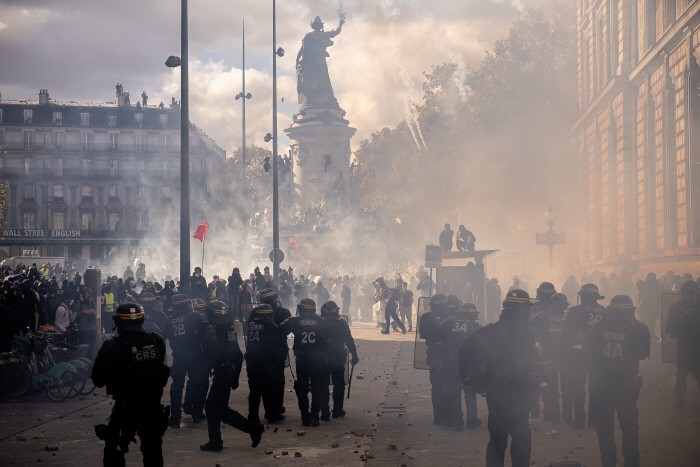 |
| Protesters and police face off during demonstrations held in Paris, France, on the 17th (local time). / Xinhua, Yonhap |
Massive demonstrations protesting soaring living costs and deteriorating public services erupted simultaneously across European nations, including France. In France, with up to 800,000 people taking to the streets, the situation escalated into arson, looting, and clashes with police, leaving around 1,200 people arrested.
According to major foreign media outlets including AFP, Reuters, and Le Monde, roughly 550,000 people according to government estimates and approximately 800,000 according to the General Confederation of Labor (CGT) participated in rallies held across France on the 17th (local time).
While most participants maintained peaceful marches, physical clashes broke out between some radical groups and the police, followed by arson attacks on public buildings and looting of shops.
Student protests sparked by demands for teacher shortages to be addressed and educational facilities to be improved in high schools in northern Paris interlocked with inflation, rising oil prices, and economic inequality, spreading into nationwide anti-government demonstrations.
Severe turmoil unfolded across major cities, including Marseille, Lyon, Nice, Toulouse, Bordeaux, Strasbourg, and Lille.
In Limoges, a city hall building with some 140 years of history was heavily damaged by fire, while protesters stormed the city hall in Marseille and a tourist information office was burned in Lyon. In major cities including Paris, banks and stores were looted and vehicles were set on fire in succession.
Casualties also followed in succession. Clashes between protesters and police left more than 150 police officers injured, alongside massive arrests.
French Prime Minister Sébastien Lecornu announced on that day that approximately 1,200 people were arrested nationwide.
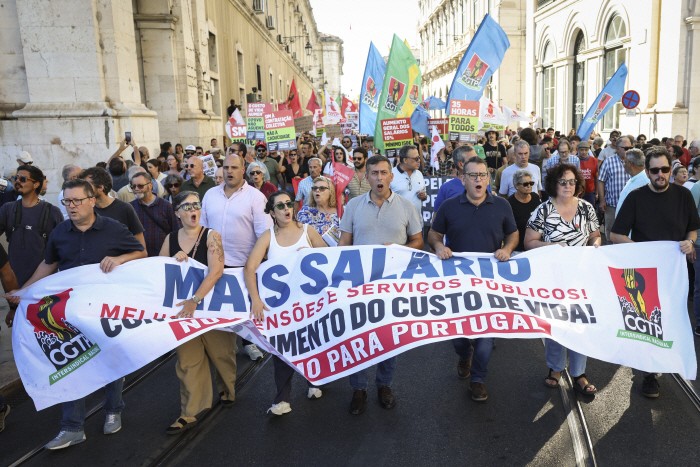 |
| Participants gather at a rally organized by the General Confederation of Portuguese Workers (CGTP-IN) in Lisbon, Portugal, on the 17th (local time). Protesters demanded wage increases, pension improvements, and the expansion of public services. / EPA, Yonhap |
Political sparring surrounding the protests also continues. French President Emmanuel Macron stated that perpetrators of violence would be prosecuted and punished, while Prime Minister Lecornu singled out far-left factions and criminal groups as the primary culprits behind the violence.
Marine Le Pen of the far-right National Rally (RN) criticized the breakdown of public order and the justification of violence by far-left parties, while Jean-Luc Melenchon of the far-left La France Insoumise (LFI) defended the legitimacy of the demonstrations while distancing himself from acts of looting.
The "Yellow Vest" movement, which shook the Macron government in 2018 in protest against fuel tax hikes, also joined this round of protests.
Protests also erupted simultaneously in other European countries.
In Lisbon, Portugal, tens of thousands took to the streets to protest surging housing and living costs alongside low wages. Housing prices in Portugal have more than doubled since 2017, and rents on new contracts have nearly doubled as well. The consumer inflation rate also recorded 3.6% last month, with fuel prices climbing 15% compared to a year ago.
In Brussels, Belgium, hundreds of young people demonstrated against rising education costs and education reforms that could diminish access to higher education. As some protesters clashed with police, officers deployed tear gas and water cannons, while student demonstrations were also held in Liege.
In Milan, Italy, a rally protesting rising living costs escalated into clashes, looting, and arson, prompting police to deploy tear gas and water cannons, leaving two police officers injured and about 50 demonstrators detained. Clashes between protesters and police also broke out in Bologna.
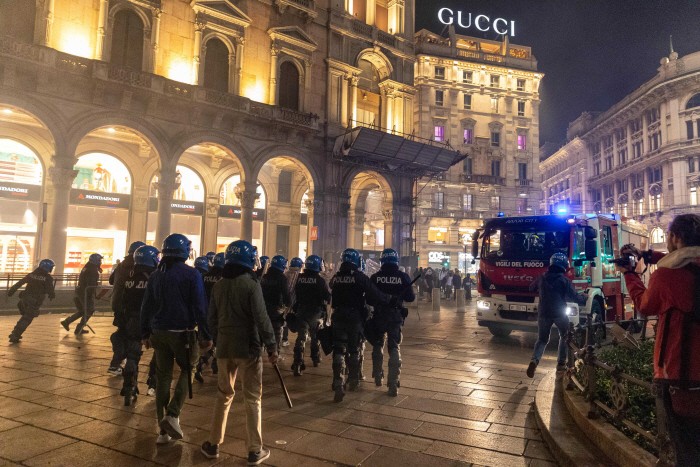 |
| Police officers form a cordon and confront protesters in Milan, Italy, on the 17th (local time). / AP, Yonhap |
Experts analyzed that although the protests across countries are not coordinated with one another, common drivers include high inflation, housing cost burdens, cuts to education and welfare, and employment insecurity among young people.
Alberto Alemanno, a professor at HEC Paris, told Al Jazeera that signs of protests are also emerging in Greece, Germany, Austria, and elsewhere, raising the possibility of a full-scale further spread starting next week.
In particular, with elections scheduled to take place across major nations including Spain, France, Italy, and Poland over the next 12 months, analysts point out that discontent over living costs and public services is likely to emerge as a major variable in European politics.
Lee Jeong-eun
Most Read
-
1
Celltrion nears additional contract with major U.S..

-
2
"Aren't those foreigners on welfare?": M..

-
3
U.S. weighs dropping MOAB, world's most powerful n..

-
4
Houthis launch successive attacks on Saudi airport..

-
5
Saudi Arabia, Iran hold first diplomatic talks to..

-
6
Saudi airport in Riyadh struck again, leaving at l..

-
7
Five ASEAN countries welcome Myanmar coup leader

PEOPLE






HEADLINE NEWS
- Trump's approval rating hits low of 33% as public turns back over soaring inflation
- Trump says Hyundai announced 748.6-billion-won investment in Georgia
- China tightens grip on boosting domestic demand and expanding anti-graft dr..
- Food prices jump 35% over 10 years, fueling massive protests by 800,000 acr..

-
Address : In-Young Bldg., 34, Uisadang-daero 1-gil, Yeongdeungpo-gu, Seoul
Copyright by ASIATODAY CO., LTD. All rights resereved