



Korean Railway Workers' Union pushes for December general strike
Oct 19, 2026, 09:28 am


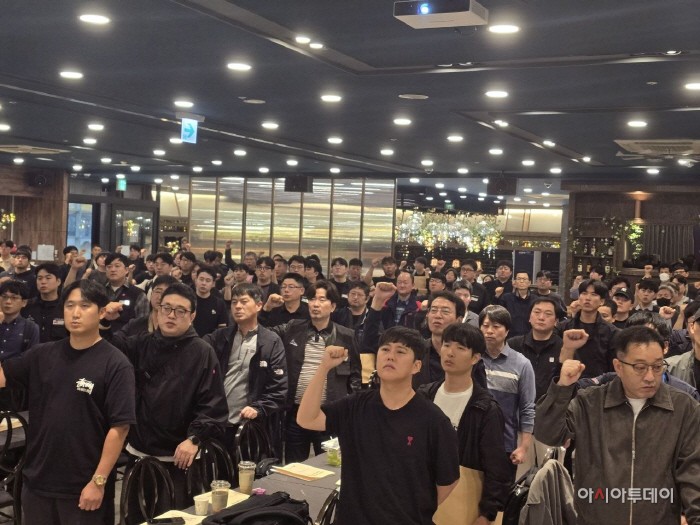 |
| The Korean Railway Workers' Union unanimously resolved to declare a labor dispute during its third extraordinary delegates' meeting of 2026 held at Gwangmyeong Station on the 15th. / Korean Railway Workers' Union |
Concerns over transportation disruptions following the integration of high-speed rail operations are mounting as the railway union enters dispute procedures ahead of a year-end general strike. Amid uncertainties over how effectively the compensatory transport functions previously handled by SR as a separate operator during past strikes can be maintained, and with minimum service standards left unraised, concerns are growing over potential restrictions on the public's right to mobility.
According to the railway union's struggle plan for the second half of the year on the 18th, the union resolved to declare a labor dispute during an extraordinary delegates' meeting on the 15th. Demanding solutions to promotion backlogs and the hiring of additional safety personnel, the union is moving to stage a general strike in December following a strike vote scheduled for early November.
During the 2024 strike, the Ministry of Land, Infrastructure and Transport formulated an emergency transportation plan to maintain overall high-speed rail operations at around 75% by operating KTX trains at about 67% of normal levels and running SRT trains normally. The framework deployed substitute personnel to meet Korail's KTX minimum service operation rate of 56.9%, while SR, operating as an independent company, made up for the shortfall in transport capacity.
However, the operational structure changed as Korail and SR merged last September. The government reviewed measures such as raising minimum service levels to prepare for the possibility that the compensatory transport role previously played by a separate operator would weaken, but failed to reach an agreement between labor and management. Until a new agreement is reached, each company's existing minimum service agreement will apply separately.
The transport ministry maintains that because the existing SR union structure remains intact, disruptions from a strike can still be partially mitigated even after the merger. A ministry official explained, "Given that the existing union framework is maintained, we do not believe the anticipated worst-case scenarios will materialize as feared," adding, "Integrating and utilizing substitute personnel that were previously run separately by both companies could also improve strike response capabilities."
However, personnel required to maintain the operation of existing SR trains must be distinguished from staff that can be additionally deployed to other routes. Since the same personnel cannot be assigned to both duties simultaneously, the actual capacity to respond to a strike depends on job categories designated for minimum services, the scope of strike participation, and the number of additional personnel that can be mobilized. Even during the parliamentary audit of Korail on the 13th, specific emergency operation rates for the entire integrated high-speed rail network were not presented.
Changes to the maintenance framework for newly built high-speed rolling stock also pose a variable going forward. Korail is renegotiating a 515-billion-won maintenance contract with Hyundai Rotem that it inherited from SR. Consultations are underway toward having Korail carry out the maintenance directly instead of contracting it out to the manufacturer. If the contract revisions are finalized, maintenance operations previously designated for an outside manufacturer could become concentrated inside Korail.
Korail emphasizes efficiency gains from in-house maintenance. Korail President Kim Tae-seung explained during the parliamentary audit, "This is an alternative to achieve economies of scale in rolling stock maintenance," adding, "As rolling stock expands, the scope of train maintenance must also expand." Although he stated that the necessity and effectiveness of maintenance integration had been reviewed internally, he did not present concrete comparative findings regarding costs, safety, and operating rates between manufacturer maintenance and in-house maintenance.
A railway industry insider explained, "Even if train drivers are secured, actual operating rates can fall if rolling stock maintenance is delayed," noting, "Contracting out maintenance for newly built train sets to an outside manufacturer allows maintenance operations to be maintained independently of internal strikes at Korail, which could significantly assist strike response efforts."
Jeong Soon-young
Most Read
-
1
Celltrion nears additional contract with major U.S..

-
2
"Aren't those foreigners on welfare?": M..

-
3
U.S. weighs dropping MOAB, world's most powerful n..

-
4
Houthis launch successive attacks on Saudi airport..

-
5
Saudi Arabia, Iran hold first diplomatic talks to..

-
6
Saudi airport in Riyadh struck again, leaving at l..

-
7
Five ASEAN countries welcome Myanmar coup leader

PEOPLE






HEADLINE NEWS
- Trump's approval rating hits low of 33% as public turns back over soaring inflation
- Trump says Hyundai announced 748.6-billion-won investment in Georgia
- China tightens grip on boosting domestic demand and expanding anti-graft dr..
- Food prices jump 35% over 10 years, fueling massive protests by 800,000 acr..

-
Address : In-Young Bldg., 34, Uisadang-daero 1-gil, Yeongdeungpo-gu, Seoul
Copyright by ASIATODAY CO., LTD. All rights resereved