



Retail investors reel as 1-trillion-won leverage bet backfires
Oct 19, 2026, 09:24 am


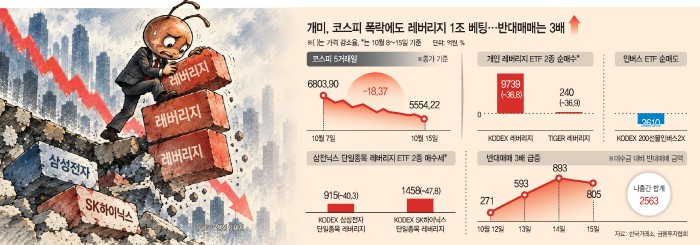 |
Although the KOSPI plunged more than 18% over five trading sessions, retail investors net purchased nearly 1 trillion won worth of two leveraged exchange-traded funds (ETFs) that track twice the daily gain of the benchmark index. Conversely, they sold off more than 260 billion won worth of inverse ETFs tracking market declines, betting against the market trend.
In particular, hundreds of billions of won in buying poured into single-stock leveraged ETFs for Samsung Electronics and SK Hynix, whose prices plummeted more than 40%, fueling mounting concerns over expanding losses. With forced liquidations stemming from margin trading surging more than threefold in just three days and the shock of the market crash spreading, financial authorities held an emergency review meeting to urge caution against excessive credit-based investing and to order investor protection.
According to the Korea Exchange on the 18th, retail investors net bought 973.9 billion won of KODEX Leverage and 24 billion won of TIGER Leverage over the past five trading days (8th to 15th). The combined net purchase amount of the two products stood at 997.9 billion won, meaning nearly 1 trillion won flocked solely to the two products that track twice the daily return of the KOSPI 200 index.
However, the price of KODEX Leverage dropped 36.8% through the 15th compared to the closing price on the 7th. An investor who bought at the closing price on the 7th would need the price to surge more than 58% from the level on the 15th just to recover their principal. Because leveraged ETFs track twice the daily return, compounding volatility when the index fluctuates means cumulative returns diverge from simply doubling the index gain, making principal recovery difficult by structure.
Conversely, retail investors net sold 261 billion won of KODEX 200 Futures Inverse 2X, which seeks double the return when the index falls, over the same period. Even as the KOSPI plummeted 18.37% from 6,803.90 to 5,554.22 and circuit breakers were triggered on the 15th, retail investors focused on buying in anticipation of a rebound rather than hedging against further declines.
This buying spree expanded beyond index-tracking funds to single-stock leveraged products. Over the same period, retail investors net purchased 145.8 billion won of KODEX SK Hynix Single Stock Leverage and 91.5 billion won of KODEX Samsung Electronics Single Stock Leverage. They bought 237.3 billion won worth of these two products even as their prices plunged 47.8% and 40.3%, respectively. In particular, with the price of the SK Hynix single-stock leveraged ETF falling nearly in half, the loss burden on investors betting on a rebound grew proportionally heavier.
Retail investors have bought into leveraged ETFs to aim for rebounds whenever the stock market plunged this year, only to bear heavy loss burdens as markets dropped further afterward. Citigroup Global Markets estimated in July that domestic retail investors had accumulated approximately 56.3 trillion won in losses from leveraged ETF investments. This serves as the backdrop for warnings that losses could widen further for retail investors who placed bets on leveraged products expecting a market bounce in the current downturn.
As the stock market plunged day after day, forced liquidations from margin trading also mounted rapidly. According to the Korea Financial Investment Association, the volume of forced sales against receivables at domestic securities firms surged from 27.1 billion won on the 12th to 89.3 billion won on the 14th, before recording 80.5 billion won on the 15th. Forced liquidations over the four-day period alone amounted to 256.3 billion won worth of shares. Brokerage receivables also climbed 49.5% from 931.6 billion won on the 7th to 1.3926 trillion won on the 15th.
Notably, while forced liquidations on the 15th dropped about 10% from the previous day, brokerage receivables grew by 35.1 billion won. Even though forced sales declined slightly, unsettled balances continued to pile up. Under margin transactions, securities brokerages can forcefully liquidate held shares if investors fail to settle payments by the settlement date, prompting concerns that selling pressure from forced sales and investor losses could escalate further if the stock market suffers additional declines.
In response, financial authorities stepped in to review investment risks arising from the stock market crash. The Financial Services Commission held an emergency review meeting on the 15th presided over by Chairman Lee Eog-weon, warning against sharp investment herding amid widening market volatility while instructing financial institutions to manage margin financing risks and protect investors.
At the meeting, Chairman Lee stated, "Investing reliant on excessive debt and margin credit is dangerous, and risk management is all the more critical during times like this," adding, "Financial firms should refrain from indiscriminate credit extension and make every effort to protect clients and manage risk."
Han Hye-sung
Most Read
-
1
Celltrion nears additional contract with major U.S..

-
2
"Aren't those foreigners on welfare?": M..

-
3
U.S. weighs dropping MOAB, world's most powerful n..

-
4
Houthis launch successive attacks on Saudi airport..

-
5
Saudi Arabia, Iran hold first diplomatic talks to..

-
6
Saudi airport in Riyadh struck again, leaving at l..

-
7
Five ASEAN countries welcome Myanmar coup leader

PEOPLE






HEADLINE NEWS
- Trump's approval rating hits low of 33% as public turns back over soaring inflation
- Trump says Hyundai announced 748.6-billion-won investment in Georgia
- China tightens grip on boosting domestic demand and expanding anti-graft dr..
- Food prices jump 35% over 10 years, fueling massive protests by 800,000 acr..

-
Address : In-Young Bldg., 34, Uisadang-daero 1-gil, Yeongdeungpo-gu, Seoul
Copyright by ASIATODAY CO., LTD. All rights resereved