



'Chainsaw austerity' Milei ranks 14th in Latin America favorability
Oct 14, 2026, 03:37 pm


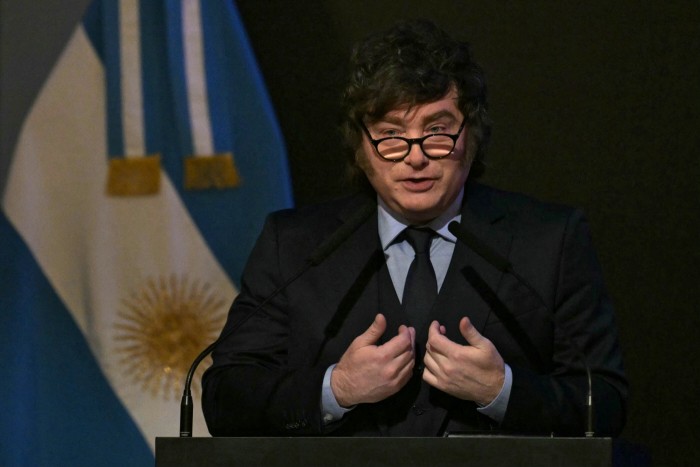 |
Argentine President Javier Milei delivers a speech at the Americas Society/Council of the Americas 'Political and Economic Outlook' conference in Buenos Aires on August 20 local time. / AFP, Yonhap
Argentine President Javier Milei lingered near the bottom in a favorability survey of major Latin American leaders, having failed to spur an economic recovery despite his aggressive austerity drive.
Analysts suggest that while he succeeded in turning a fiscal deficit into a surplus and curbing runaway inflation, mounting recession fears have cost him public support. In contrast, Mexican President Claudia Sheinbaum recorded the highest favorability rating among leaders across the region.
According to local outlets including América TV on the 13th local time, consulting firm CB Global Data conducted a presidential favorability poll from the 5th to the 8th across 18 Latin American countries—including Argentina, Brazil, and Mexico—surveying 1,959 to 3,911 adults aged 18 and older per nation (95% confidence level, margin of error of ±1.6 to 2.2 percentage points). In the poll, President Milei placed 14th in the lower tier with a favorability (positive evaluation) rating of 36.1%.
In the survey assessing President Milei, out of 3,089 Argentine respondents, 24.9% answered with a "very good image" and 11.2% with a "good image." Meanwhile, 43.9% responded with a "very bad image," and 15.1% cited a "bad image." Those who answered "don't know" or gave no response stood at 4.9%.
Argentine media noted that presidents with high disapproval ratings generally have specific reasons behind them, such as worsening public safety or failures to resolve political turmoil. In Milei's case, they reported, he faces criticism for failing to revitalize the economy through the aggressive fiscal tightening known as his "chainsaw reform."
Local press analyzed that while President Milei produced results by shifting the public sector balance from deficit to surplus and breaking the back of inflation through relentless austerity, he could not revive the broader real economy. With assessments indicating that the nation has slipped into recession, public opinion has turned decidedly cool toward him.
According to a recent report by Argentine think tank Center for Political Economy (CEPA), the number of employer enterprises creating jobs in Argentina dropped 6.3% from 512,357 in November 2023, just before Milei took office, to 480,067 in July of this year.
Trailing behind him were Nicaraguan President Daniel Ortega (35.7%), Uruguayan President Yamandú Orsi (35.2%), and Venezuelan Interim President Delcy Rodríguez (32.3%). Guatemalan President Bernardo Arévalo, described as an autocrat, ranked lowest at 31.0%.
The leader with the highest favorability rating in Latin America was Mexican President Claudia Sheinbaum at 69.3%. Behind her first-place finish were positive public appraisals of her expanded social welfare policies and improvements in public security.
Carrying forward the policy framework of her predecessor, former President Andrés Manuel López Obrador, President Sheinbaum has yielded tangible results by bolstering welfare, expanding the National Guard, and strengthening federal-state coordination to step up investigations and enforcement in areas with frequent violent crime.
Elsewhere, Salvadoran President Nayib Bukele ranked second by a narrow margin with 68.3%, while Dominican Republic President Luis Abinader placed third with 51.9%.
Brazilian President Luiz Inácio Lula da Silva, who is eyeing an unprecedented fourth presidential term, ranked eighth with a 45.3% positive evaluation rate, and Peruvian President Keiko Fujimori ranked seventh with 46.3%. Fujimori, of Japanese descent, became Peru's first female president after prevailing in a June runoff election on her fourth bid for the presidency.
Son Young-sik |
Most Read
-
1
Kia Sportage outperforms Mazda CX-5 in German auto..

-
2
Houthis launch successive attacks on Saudi airport..

-
3
Saudi Arabia, Iran hold first diplomatic talks to..

-
4
Saudi airport in Riyadh struck again, leaving at l..

-
5
U.S. deploys carrier, 10,000 more troops to Middle..

-
6
Five ASEAN countries welcome Myanmar coup leader

-
7
Putin's ally visits China on the 8th ahead of APEC..

PEOPLE






HEADLINE NEWS
- New White House Press Secretary links $54 billion from Seoul to Alaska LNG in first briefing
- Industrial Bank of Korea launches local subsidiary in Vietnam
- Saudi-Houthi clashes over oil facilities escalate, hitting 24 vessels in Ho..
- Bin Salman underestimates Houthi offensive, imperiling Saudi economic refor..

-
Address : In-Young Bldg., 34, Uisadang-daero 1-gil, Yeongdeungpo-gu, Seoul
Copyright by ASIATODAY CO., LTD. All rights resereved