



Saudi-Houthi clashes over oil facilities escalate, hitting 24 vessels in Hormuz including S. Korean tankers
Oct 14, 2026, 09:43 am


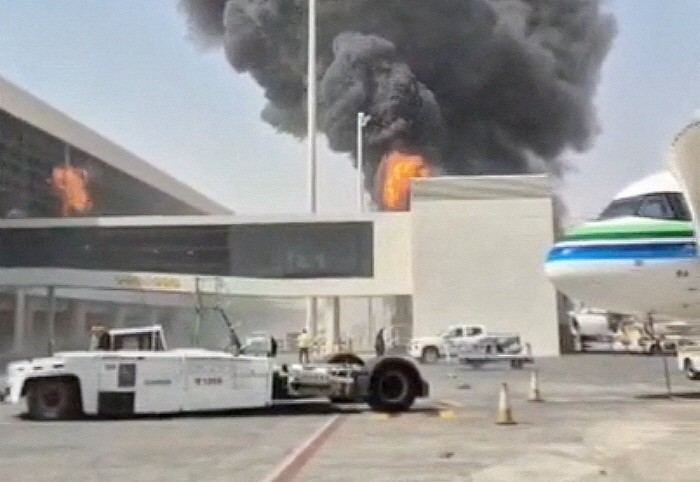 |
| Smoke and flames billow from King Khalid International Airport in Riyadh, Saudi Arabia, on the 8th (local time). Yemen's pro-Iran Houthi rebels claimed they attacked the airport. Social media video capture. / Reuters, Yonhap |
[Article Summary]
1. The Saudi-led coalition launched airstrikes on fuel and military facilities in Sanaa and other parts of Yemen on the 13th, while the Houthis struck the Aramco headquarters complex in Dhahran, Saudi Arabia, with ballistic missiles.
2. The top three floors of the Aramco office building were damaged, and the Saudi Ministry of Energy stated that a fire broke out in the building but there were no injuries.
3. President Trump warned the Houthis of potential retaliation after the midterm elections, but the U.S. withheld direct airstrikes while supporting Saudi Arabia's military operations.
4. Twenty-four vessels were struck in the Strait of Hormuz over a two-week span, marking the highest two-week tally since the outbreak of the war, and a crude oil tanker belonging to South Korea's Sinokor Merchant Marine was also attacked.
As the Saudi Arabia-led coalition launched airstrikes on the 13th (local time) targeting fuel and military support facilities in Sanaa, the capital held by Yemen's pro-Iran Houthi rebels, a Houthi ballistic missile struck the headquarters complex of Saudi state-run oil company Aramco, damaging the top three floors of an office building, Reuters reported, citing company officials.
U.S. President Donald Trump warned the Houthis of possible retaliation after the November U.S. midterm elections, but the U.S. is withholding direct airstrikes. With Iranian attacks on vessels in the Strait of Hormuz also surging, the two major energy transit routes in the Middle East are facing threats simultaneously.
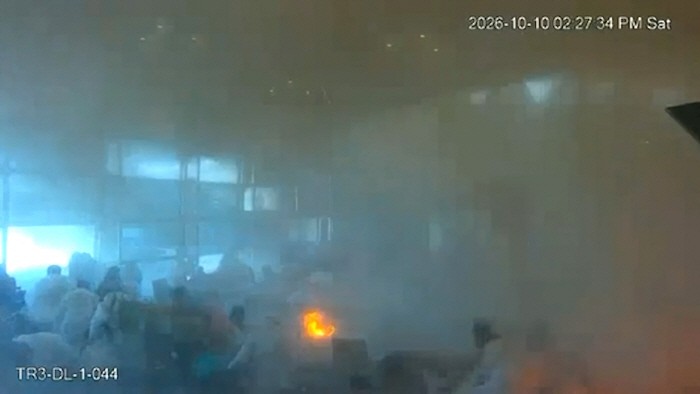 |
| Closed-circuit television (CCTV) footage released by the Saudi Arabian government on the 11th (local time) captures the moment King Khalid International Airport in Riyadh came under attack by Yemen's Houthi rebels the previous day. The attack killed 12 people and injured hundreds, marking the heaviest casualty toll among attacks on Saudi territory in roughly a decade. The Saudi-led coalition vowed a resolute response against the Houthis on the 11th. The strike comes as part of an unprecedented series of attacks following the collapse in July of a truce between the Houthis and the Saudi-backed Yemeni government. / AFP, Yonhap |
Saudi strikes Houthi fuel and military facilities; Houthi missile hits top 3 floors of Aramco HQ
The Saudi-led coalition announced on the 13th that it struck major fuel and military support facilities to curb the Houthis' war-fighting capabilities. Turki al-Malki, spokesperson for the coalition, claimed that the Houthis were using civilian facilities for military purposes. Targets included the central Al-Sabaha base and underground fuel storage facilities in Sanaa, along with fuel storage tanks and docks in Hodeidah and Dhamar.
Ahead of the airstrikes, the coalition released strike maps on X (formerly Twitter), urging civilians to evacuate. The Houthi-run Al-Masirah television confirmed the strike on the Al-Sabaha base but reported that no petroleum products were stockpiled there. However, vehicles queued at some gas stations in Sanaa amid fears of fuel shortages, the Associated Press reported.
The Houthis declared Aramco facilities legitimate targets and vowed retaliation. Yahya Saree, military spokesperson for the Houthis, singled out Aramco headquarters in Dhahran and a refinery in Riyadh, warning of a "firm and painful" response.
Later that night, an office building within the Aramco headquarters complex was struck by a ballistic missile, damaging its top three floors and igniting a fire, company officials told Reuters. The complex houses key operational centers managing oil fields, pipelines, refineries, and export terminals.
The Saudi Ministry of Energy announced that a contained fire broke out in an administrative building within the complex, but reported no casualties. The Saudi coalition stated that it intercepted a missile over Dhahran, with debris falling in residential neighborhoods.
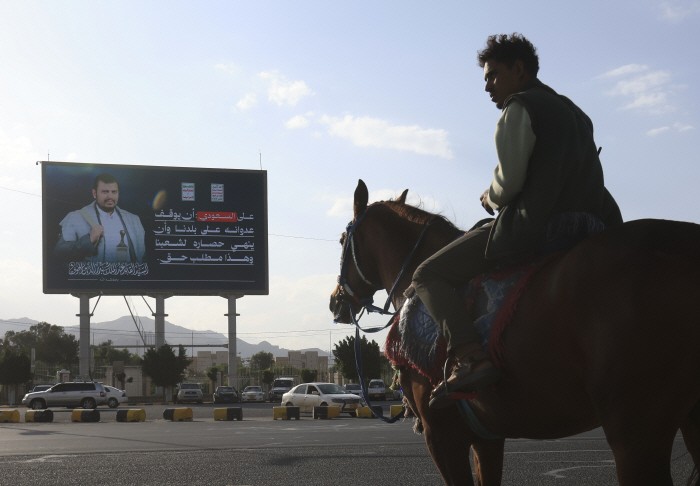 |
| A citizen rides a horse past a digital billboard displaying a photo of Yemeni Houthi rebel leader Abdul-Malik al-Houthi and Arabic text on the 10th (local time). The billboard reads, "Saudi Arabia must halt its aggression against our country and lift the blockade on our people." That day, Yahya Saree, military spokesperson for the Houthis, repeatedly warned airlines to avoid using Saudi airports after a missile attack on King Khalid International Airport in Riyadh, Saudi Arabia, killed 12 people—including four Saudis and eight foreigners—and halted airport operations. / EPA, Yonhap |
Riyadh airport struck four times, leaving 13 dead; Saudi air defenses fail to intercept and flights are halted
Over the past week, the Houthis launched concentrated attacks on major Saudi airports and oil facilities. King Khalid International Airport in Riyadh was struck four times, with the attack on the 10th leaving at least 13 dead and more than 300 injured. It marks the heaviest casualty toll among attacks on Saudi territory in roughly a decade.
The Saudi Civil Defense stated that debris from two interceptor missiles fell in residential areas of Riyadh, injuring four residents and damaging 15 homes. The Cabinet, chaired by Saudi Crown Prince Mohammed bin Salman, warned that the Houthis would be made to pay a price for the attacks.
The Saudi military is investigating why its air defense network failed to completely block the attacks, the AP reported. Saudi Energy Minister Abdulaziz bin Salman emphasized on the 12th, "The events of recent weeks are grave, and our response must be just as grave."
Thomas Juneau, a security analyst at the University of Ottawa in Canada, assessed that Saudi territory is so vast that sustained, airtight defense is difficult. Etihad Airways and Gulf Air canceled their Riyadh routes, while Delta Air Lines postponed the launch of its non-stop service between Atlanta and Riyadh scheduled for the 23rd.
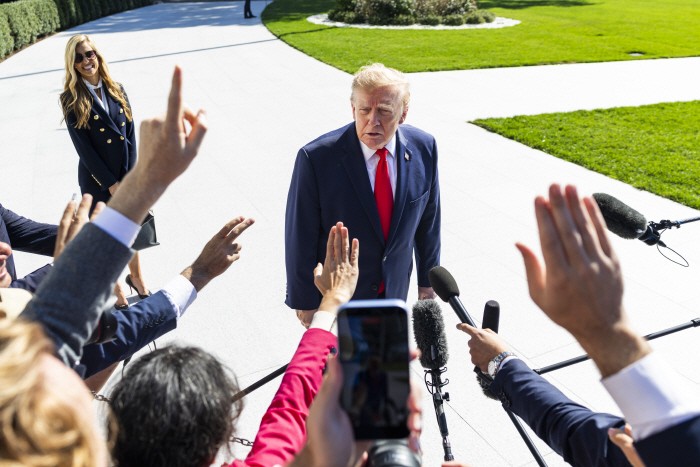 |
| U.S. President Donald Trump takes questions from reporters at the White House in Washington, D.C., before departing for Alaska on the 13th (local time). President Trump is visiting Alaska to support the campaign of Republican Senator Dan Sullivan, who is seeking reelection in the November midterm elections. / EPA, Yonhap |
Trump warns Houthis he will never forget after elections
On Truth Social on the 13th, President Trump claimed that the Houthis, acting on instructions from Iran, are intentionally attempting to drive up international oil prices ahead of the U.S. midterm elections. Remarking that "the Houthis are behaving very badly," he criticized the group for attacking Saudi Arabia again after remaining quiet following U.S. airstrikes last year. He then warned, "I will be there after the elections, and I will never forget!"
Asked at the White House about the possibility of requesting Turkish President Recep Tayyip Erdogan to join in strikes against the Houthis, President Trump replied, "Could be," adding he believes President Erdogan would comply with the request.
The U.S. supported Saudi Arabia with intelligence sharing, target selection, and operational planning, but withheld direct airstrikes. Over recent months, President Trump rejected five plans for large-scale military operations against Iran or the Houthis, while the U.S. Department of Defense prepared options including a three-day high-intensity strike proposal, the U.S. daily The New York Times reported.
Saudi Arabia and Syria are discussing plans to deploy 10,000 to 20,000 Syrian troops to operations aimed at defeating the Houthis, and the Trump administration is not opposed in principle, U.S. online news outlet Axios reported. Mohammed al-Bukhaiti, a member of the Houthi political bureau, warned via AFP that should the U.S. intervene, they will launch a swift and painful response targeting U.S. interests in the region.
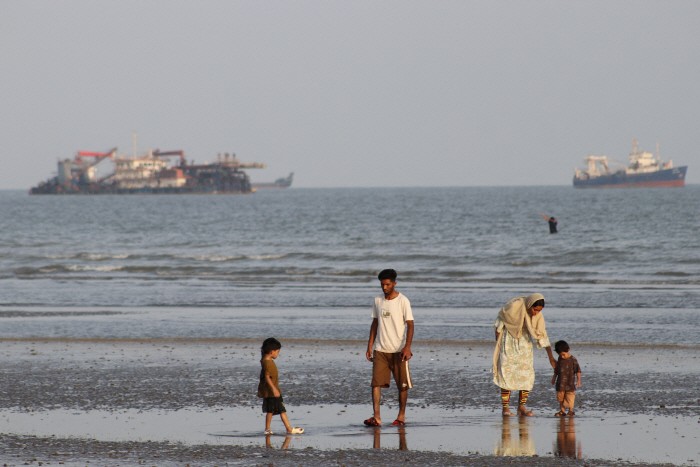 |
| People spend time on a beach near Bandar Abbas, Iran, on the 13th (local time). Vessels float in the Strait of Hormuz beyond the beach. / Reuters, Yonhap |
24 vessels hit in Hormuz over two weeks, including South Korean tanker; oil shipments fall 43%
As armed clashes between Saudi Arabia and the Houthis intensify, Iranian attacks on vessels in the Strait of Hormuz have also surged. The British daily Financial Times (FT) reported on the 13th that an analysis of data from the United Kingdom Maritime Trade Operations (UKMTO) and European security authorities showed 24 vessels were attacked in and around the Strait of Hormuz in the two weeks leading up to the 11th. This marks the highest two-week tally since the outbreak of the war on February 28, surpassing the previous peak of 13 vessels during the first two weeks of March.
On the 11th alone, six vessels were struck. According to maritime security firm Vanguard, the targets included three refined product tankers, two crude oil tankers linked to China's New Treasure Shipping and South Korea's Sinokor Merchant Marine, and an Indian container ship. Two Indian crew members from a refined product tanker were reported missing.
The Institute for the Study of War (ISW), a U.S. think tank, raised the possibility that Iran may be developing anti-ship missile capabilities to enhance its vessel-strike capacity.According to energy intelligence firm Kpler, Gulf oil exports averaged 15.5 million barrels per day in September, the highest level since the war began, but volume transiting Hormuz dropped to 2.9 million barrels on the 11th, marking a monthly low. The average transit volume over the past seven days fell by approximately 43% compared to pre-war levels.Some vessels turned back from the Fujairah anchorage in the United Arab Emirates (UAE), while others are heading to ports in the U.S. Gulf Coast to secure cargo, the FT reported.
According to shipbroking firm Clarksons, global average daily earnings for very large crude carriers (VLCCs) reached a record high of $805,000 on the 9th. Clarksons estimated that demand for tankers rose by roughly 13% due to rerouting and ship-to-ship transfers.
Tanker day rates hit record $805,000
Saudi Arabia resumed military operations in support of the Yemeni government last month after the Houthis advanced along the Red Sea coast toward the Bab el-Mandeb Strait. Following Iran's blockade of the Strait of Hormuz in February, Bab el-Mandeb had emerged as a major alternative energy transit route.
Yemeni government forces pushed the Houthis back from areas closest to the strait, but the Houthis remained nearby and advanced toward the Taiz region. Fierce battles are underway in the Kahboub mountainous area overlooking both Bab el-Mandeb and Aden, the Yemeni government's interim capital, the AP reported, citing a commander of the Saudi-backed forces.
Yemen's Ministry of Interior announced on the 13th that Houthi attacks on Taiz left six dead and 18 injured. UN spokesperson Stephane Dujarric stated that the fighting has caused large-scale displacement and shortages of essential goods, with cooking gas virtually unavailable and food prices reported to have surged by roughly 50%.
Iranian Foreign Minister Abbas Araghchi expressed willingness on the 11th to mediate between Saudi Arabia and the Houthis. Egyptian Foreign Minister Badr Abdelatty urged an end to Houthi attacks on Saudi Arabia and called for a diplomatic solution between the U.S. and Iran during a phone call with Araghchi on the 13th.
UN High Commissioner for Human Rights Volker Türk expressed dismay over the repeated attacks against Saudi Arabia while calling for restraint from both sides. "If the fighting continues, it will only bring greater suffering with no end in sight," he warned.
Ha Man-ju
Most Read
-
1
Kia Sportage outperforms Mazda CX-5 in German auto..

-
2
Houthis launch successive attacks on Saudi airport..

-
3
Saudi Arabia, Iran hold first diplomatic talks to..

-
4
Saudi airport in Riyadh struck again, leaving at l..

-
5
U.S. deploys carrier, 10,000 more troops to Middle..

-
6
Five ASEAN countries welcome Myanmar coup leader

-
7
Putin's ally visits China on the 8th ahead of APEC..

PEOPLE






HEADLINE NEWS
- New White House Press Secretary links $54 billion from Seoul to Alaska LNG in first briefing
- Industrial Bank of Korea launches local subsidiary in Vietnam
- Saudi-Houthi clashes over oil facilities escalate, hitting 24 vessels in Ho..
- Bin Salman underestimates Houthi offensive, imperiling Saudi economic refor..

-
Address : In-Young Bldg., 34, Uisadang-daero 1-gil, Yeongdeungpo-gu, Seoul
Copyright by ASIATODAY CO., LTD. All rights resereved