



New Yalu River Bridge between China and N. Korea scheduled to open on the 15th
Oct 14, 2026, 02:19 pm


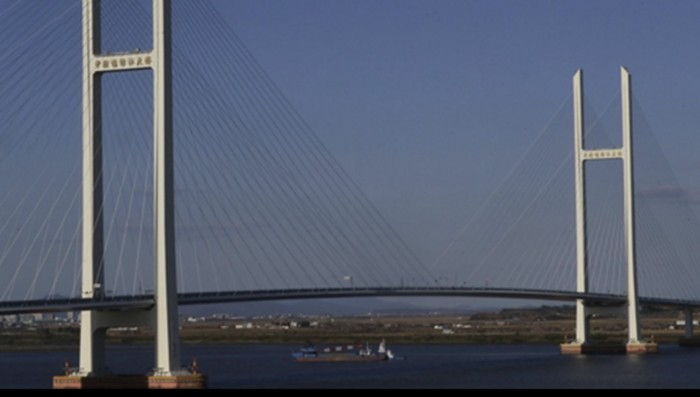 |
| A vessel passes under the New Yalu River Bridge in Dandong, Liaoning Province, China, on the afternoon of October 5. The bridge, which connects Dandong, China, with Sinuiju, North Korea, was completed in 2014, but its opening has been delayed for about 12 years. / Yonhap |
The new bridge over the Yalu River connecting North Korea and China, stalled for 12 years, is finally opening.
As North Korean State Affairs Commission President Kim Jong Un, who has been strengthening military cooperation with Russia, broadens economic cooperation with China in earnest, shifts are emerging in North Korea's foreign strategy. The expansion of the overland transport network linking North Korea, China, and Russia has emerged as a new variable in the security landscape of the Korean Peninsula.
In a report from Shenyang at 10 a.m. on the 14th, China's state-run Xinhua News Agency stated, "Under consultations between North Korea and China, the New Yalu River Bridge will officially open on the 15th, with the two nations holding a joint opening ceremony." Connecting Dandong in China's Liaoning Province and Sinuiju in North Korea's North Pyongan Province, the bridge is set for its official opening 12 years after its completion in 2014.
The New Yalu River Bridge is a large four-lane bridge with a total length of about 3,026 meters. Although completed with China covering construction costs, it was virtually abandoned for an extended period as work on North Korea's access roads and customs facilities stalled. North Korea's nuclear tests, international sanctions against Pyongyang, and deteriorating relations between North Korea and China are cited as factors behind the opening's delay.
This opening is viewed as a symbolic event restoring economic relations between North Korea and China, going beyond merely normalizing a cross-border bridge. This is because it disperses freight transport previously concentrated on the existing Yalu River Bridge and establishes a new corridor to expand the flow of Chinese raw materials, machinery, and consumer goods into North Korea.
Indeed, China's exports to North Korea last year stood at roughly 2.3 billion dollars, up 25% from the previous year to reach the highest level in six years. However, this still falls short of levels seen before the UN tightened sanctions against North Korea in 2017. The extent to which the opening of the New Yalu River Bridge impacts North Korea's economic recovery hinges on actual customs clearance volumes and traded items.
The military and security implications are also significant. With the Russia-Ukraine war as a catalyst, North Korea has been strengthening military cooperation with Russia while seeking to secure combat experience and military technology. If its logistics network with China also expands on top of this, North Korea will likely double down on a foreign strategy pursuing military cooperation with Russia and economic cooperation with China in parallel.
In particular, following the opening of a road bridge connecting North Korea to Russia, putting the New Yalu River Bridge with China into operation is expected to elevate logistics connectivity across the border regions of North Korea, China, and Russia. However, it is difficult to interpret this expansion of transport networks as an immediate strengthening of a trilateral military alliance.
What the South Korean government must pay close attention to is the effectiveness of sanctions against North Korea. Beyond regular trade and people-to-people exchanges across the New Yalu River Bridge, authorities must scrutinize the potential movement of dual-use goods that could be diverted for military purposes. While opening the bridge itself does not violate sanctions, issues surrounding the international community's enforcement of sanctions could arise depending on the items cleared through customs.
The political restoration of North Korea-China relations also warrants attention. Chairman Kim Jong Un and Chinese President Xi Jinping agreed at their June Pyongyang summit to advance bilateral relations to a strategic level and expand exchanges. The opening of this bridge can be seen as a step translating that agreement into reality across the economic and logistics sectors.
Ultimately, the opening of the New Yalu River Bridge has the potential to serve as a turning point where North Korea broadens its economic cooperation with China alongside its military cooperation with Russia. For South Korea, now is the time to accurately assess the realities of North Korea-China-Russia cooperation without exaggerating or underestimating them, closely analyzing how shifts in Pyongyang's procurement capabilities and external economic activities could impact its military buildup.
Ku Pil-hyun
Most Read
-
1
Kia Sportage outperforms Mazda CX-5 in German auto..

-
2
Houthis launch successive attacks on Saudi airport..

-
3
Saudi Arabia, Iran hold first diplomatic talks to..

-
4
Saudi airport in Riyadh struck again, leaving at l..

-
5
U.S. deploys carrier, 10,000 more troops to Middle..

-
6
Five ASEAN countries welcome Myanmar coup leader

-
7
Putin's ally visits China on the 8th ahead of APEC..

PEOPLE






HEADLINE NEWS
- New White House Press Secretary links $54 billion from Seoul to Alaska LNG in first briefing
- Industrial Bank of Korea launches local subsidiary in Vietnam
- Saudi-Houthi clashes over oil facilities escalate, hitting 24 vessels in Ho..
- Bin Salman underestimates Houthi offensive, imperiling Saudi economic refor..

-
Address : In-Young Bldg., 34, Uisadang-daero 1-gil, Yeongdeungpo-gu, Seoul
Copyright by ASIATODAY CO., LTD. All rights resereved