



Virgin Trains aims to break Channel Tunnel monopoly, but faces hurdles ahead of 2030 launch
Oct 14, 2026, 09:53 am


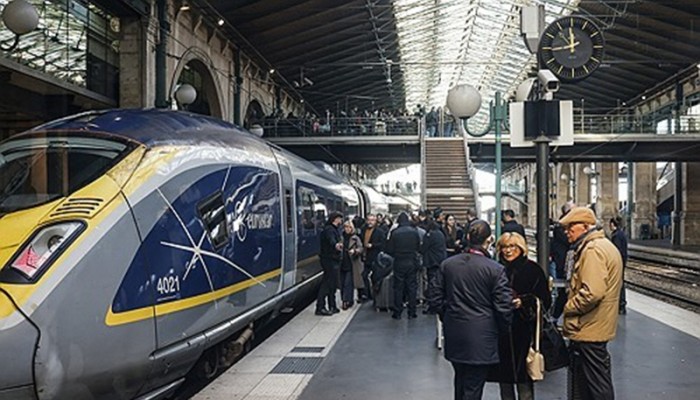 |
| Passengers disembark from a Eurostar train at Gare du Nord in Paris, France, on December 30 of last year (local time). / EPA, Yonhap |
The UK's Virgin Group stepped forward to challenge passenger rail services through the Channel Tunnel, which are virtually monopolized by international high-speed rail operator Eurostar, but numerous constraints have clouded the realization of its goal.
French media outlet BFM Business reported on the 12th (local time) that Virgin Group's plan to run high-speed trains linking Paris, France, and London, the UK, starting in 2030 will likely be unfeasible.
Virgin Group, a multinational conglomerate operating across telecommunications, air transport, and the space industry, announced last year that it would operate cross-Channel high-speed trains starting in 2030 through its subsidiary Virgin Trains.
Under the so-called Project Bullet, Virgin Trains planned to operate 13 daily round trips on the Paris-London route to provide 4.75 million seats annually, before later adding routes between London and Brussels, Belgium, and London and Amsterdam, the Netherlands, to supply a combined 7.5 million seats a year across the cross-Channel corridor.
With roughly four years remaining until its targeted launch date, Virgin Group is understood to have not yet obtained even the train type approval essential for operating across the Channel.
The high-speed trains designed by Virgin Group are currently certified for speeds of 250 km/h. To run across the Channel, they must receive fresh certification for 300 km/h.
Although rail manufacturer Alstom is handling this procedure, experts project that approval will only be feasible around 2031 to 2032.
Tunnel access approval granted by Getlink, the operator of the Channel Tunnel, also remains outstanding. Getlink will review upcoming filings submitted by Virgin Group to verify its financial soundness and evaluate whether it meets safety and operational guarantees for high-speed train operations, with a decision on approval due this December.
Beyond administrative procedures, contracts for the high-speed trains practically needed for passenger transport have also yet to be finalized. Virgin Group signed a deal worth between 650 million and 700 million euros (approx. 969 billion to 1.043 trillion won) with French train builder Alstom for 12 high-speed trains and 30 years of maintenance services.
This deal is reported to be at the level of a strategic agreement. In order to firm up the contract with Alstom, financing and regulatory approvals must be completed.
In a press release, Alstom, which manufactures France's high-speed TGV trains, stated, "We are working closely to formalize Virgin Group's order, and any information regarding commercial agreements will be released at the appropriate time."
Josh Bayliss, CEO of Virgin Group, said, "While everything is twice as hard given the unique conditions of the tunnel, we will take delivery of one train per month starting in 2030."
However, significant delays have hit the manufacturing of the TGV M, the fifth-generation high-speed train that France's state rail operator SNCF originally planned to roll out starting in 2024, and custom specifications added by Virgin Group are expected to prolong train manufacturing even further.
Even if all essential stages are cleared, further procedures still remain. Jean de Rougemont, a consultant specializing in rail transport, explained, "The plan to start operations in 2030 is more of a tool for Virgin Group to put pressure on stakeholders," adding, "Given the delays with the TGV M, securing trains, obtaining train approvals, establishing maintenance frameworks, expanding stations to match that scale, and installing border security facilities is highly unrealistic."
Meanwhile, Eurostar has maintained a monopoly on the London-Paris and London-Brussels routes for more than 30 years since the Channel Tunnel opened in 1994.
Lim Yu-jung
Most Read
-
1
Kia Sportage outperforms Mazda CX-5 in German auto..

-
2
Houthis launch successive attacks on Saudi airport..

-
3
Saudi Arabia, Iran hold first diplomatic talks to..

-
4
Saudi airport in Riyadh struck again, leaving at l..

-
5
U.S. deploys carrier, 10,000 more troops to Middle..

-
6
Five ASEAN countries welcome Myanmar coup leader

-
7
Putin's ally visits China on the 8th ahead of APEC..

PEOPLE






HEADLINE NEWS
- New White House Press Secretary links $54 billion from Seoul to Alaska LNG in first briefing
- Industrial Bank of Korea launches local subsidiary in Vietnam
- Saudi-Houthi clashes over oil facilities escalate, hitting 24 vessels in Ho..
- Bin Salman underestimates Houthi offensive, imperiling Saudi economic refor..

-
Address : In-Young Bldg., 34, Uisadang-daero 1-gil, Yeongdeungpo-gu, Seoul
Copyright by ASIATODAY CO., LTD. All rights resereved