



Trump signals meeting with Kim, prompting Lee to launch national interest-driven diplomacy
Oct 14, 2026, 09:19 am


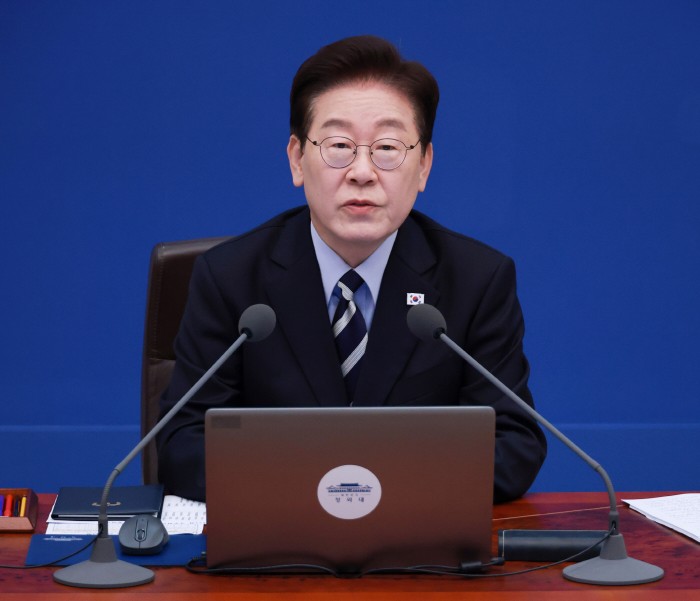 |
| President Lee Jae-myung speaks during a Cabinet meeting held at the Blue House on the 13th. / Yonhap |
Attention is focusing on whether the clock on North Korea-U.S. dialogue will begin moving in earnest as U.S. President Donald Trump left open the possibility of meeting North Korean leader Kim Jong-un during his trip to Asia next month. President Lee Jae-myung, who previously expressed intent to lay the stepping stone for dialogue between Washington and Pyongyang, emphasized pragmatic national interest diplomacy on the 13th, anchoring foreign policy on the South Korea-U.S. alliance while managing relations with neighboring countries based on national interests.
Asked by reporters at the White House on the 12th (local time) whether he plans to meet Chairman Kim during his visit to Asia, President Trump answered, "Could be." If realized, the meeting would mark the first North Korea-U.S. summit of President Trump's second term and their fourth meeting across his first and second administrations.
President Trump is scheduled to visit Asia to attend the Asia-Pacific Economic Cooperation (APEC) summit held in Shenzhen, China, from the 18th to the 19th of next month. He has repeatedly expressed his desire to meet Chairman Kim within the year.
President Lee also stated at the United Nations General Assembly last month that he would lay the groundwork for an early resumption of North Korea-U.S. talks. The concept envisions that once direct talks between North Korea and the U.S. commence, South Korea will play a role in connecting them to inter-Korean dialogue and Korean Peninsula peace discussions built on South Korea-U.S. coordination. In this process, managing relations with neighboring nations such as China, alongside close coordination with the U.S., is expected to be a major task.
In particular, the pragmatic national interest diplomacy emphasized by President Lee at the Cabinet meeting that day is seen as an extension of this stance. While reaffirming the importance of the South Korea-U.S. alliance, President Lee stressed that bilateral differences should be adjusted and managed in accordance with the national interest rather than escalated into fundamental issues of the alliance itself.
President Lee remarked, "The South Korea-U.S. alliance serves as a crucial axis of our diplomacy," while adding, "On the other hand, managing relations with the surrounding major powers remains equally important." He continued, "In state-to-state relations, we must reject submissive or subservient attitudes," emphasizing that "the most important factor is the national interest of the Republic of Korea."
Regarding differences between nations, he stated, "We need to minimize differences, and such differences must remain within a manageable scope," adding, "The very existence of differences cannot be treated as a problem."
These remarks also tie into the current backdrop, in which intelligence cooperation issues between Seoul and Washington have not been fully settled and negotiations continue over follow-up projects tied to strategic investments in the U.S. The remarks are interpreted as an intention to address individual pending issues through case-by-case consultations, securing both bilateral coordination and the national interest.
The Blue House likewise maintains the policy of preserving the South Korea-U.S. alliance as its diplomatic anchor while seeking solutions that serve the national interest through issue-specific negotiations.
Park Young-hoon
Most Read
-
1
Kia Sportage outperforms Mazda CX-5 in German auto..

-
2
Houthis launch successive attacks on Saudi airport..

-
3
Saudi Arabia, Iran hold first diplomatic talks to..

-
4
Saudi airport in Riyadh struck again, leaving at l..

-
5
U.S. deploys carrier, 10,000 more troops to Middle..

-
6
Five ASEAN countries welcome Myanmar coup leader

-
7
Putin's ally visits China on the 8th ahead of APEC..

PEOPLE






HEADLINE NEWS
- New White House Press Secretary links $54 billion from Seoul to Alaska LNG in first briefing
- Industrial Bank of Korea launches local subsidiary in Vietnam
- Saudi-Houthi clashes over oil facilities escalate, hitting 24 vessels in Ho..
- Bin Salman underestimates Houthi offensive, imperiling Saudi economic refor..

-
Address : In-Young Bldg., 34, Uisadang-daero 1-gil, Yeongdeungpo-gu, Seoul
Copyright by ASIATODAY CO., LTD. All rights resereved