



IMF-World Bank annual meetings open in Bangkok, focusing on Middle East war and debt crisis
Oct 13, 2026, 10:10 am


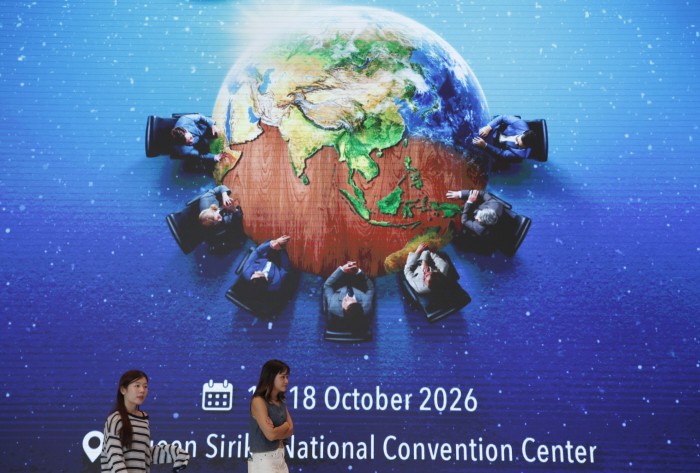 |
| People walk past a logo for the 2026 Annual Meetings of the International Monetary Fund (IMF) and the World Bank at the Queen Sirikit National Convention Center in Bangkok, Thailand, on the 8th (local time). / EPA, Yonhap |
The Annual Meetings of the International Monetary Fund (IMF) and the World Bank opened in Bangkok, Thailand, on the 12th (local time), as the war pitting the U.S. and Israel against Iran stretches into its eighth month. Running through the 18th, the summit is being held outside Washington, D.C. for the first time in three years since the October 2023 gathering in Morocco.
Reuters reported that the Middle East conflict and resulting inflationary pressures will dominate not only the formal agenda but also sidelines discussions. Finance officials from around the world have convened at a time when energy supply shocks and high interest rates threaten an already sluggish global economic expansion. IMF Managing Director Kristalina Georgieva noted that 18,000 participants have registered, up by 4,000 from the Morocco meetings.
Despite the expanded attendance, several finance ministers were notably absent. According to U.S. government officials, U.S. Treasury Secretary Scott Bessent dispatched two senior aides in his stead, citing domestic commitments. Bessent will also skip the Group of 20 (G20) meetings, for which the U.S. holds the presidency this year. Georgieva explained that while several other finance ministers are absent due to domestic obligations like budget reviews and elections, most central bank governors are attending. Federal Reserve Chair Kevin Warsh is scheduled to appear in a public forum with Georgieva on the 16th.
World Bank President Ajay Banga warned in an interview with Reuters that economic headwinds are intensifying once again. He explained that while global growth held up better than feared when Iran blocked the Strait of Hormuz—halting approximately 20% of the world's crude oil supply—diesel and fertilizer prices are now soaring alongside an approaching "Super El Niño." Experts estimate that Super El Niño could trigger up to 450,000 heat-related deaths. Banga stressed that the true peril lies not in El Niño alone, but in the simultaneous compounding of fertilizer prices, energy costs, and mounting sovereign debt.
Banga projected that these mounting pressures could drive more nations to seek World Bank financing in the coming months. The World Bank is currently in talks with 30 to 40 countries over crisis support. The 25 billion dollar emergency facility established in late February right after the war began saw fewer applications than anticipated, as the global economy proved relatively resilient thanks to surging AI investments and crude supply-demand rebalancing. Banga stated that an initial 50 billion to 60 billion dollars could be deployed by repurposing 35 billion dollars from previously approved project funds, adding that this could be scaled up to 100 billion dollars if conditions worsen—exceeding the 70 billion dollars disbursed during the COVID-19 pandemic.
Strategic petroleum reserve releases are also continuing in an effort to rein in energy costs. The Group of Seven (G7) agreed to release 100 million barrels of diesel and crude from emergency stockpiles amid pressure from U.S. President Donald Trump to lower gasoline prices ahead of the November elections. On the 9th, Trump announced a deal with Russia to inject additional diesel supplies into global markets in exchange for temporary sanctions waivers, drawing swift criticism from Ukrainian President Volodymyr Zelenskyy. Since the war began on February 28, more than 1 billion barrels of oil have been drained, primarily from onshore commercial stockpiles. Industry executives warn that dwindling commercially available inventories are leaving markets increasingly vulnerable and driving up price volatility.
The IMF issued a similar warning. In a speech delivered ahead of the summit last week, Georgieva declared that "winter is coming." The IMF signaled that it will likely leave its 3% global growth forecast for this year largely unchanged while slightly raising next year's projection. However, growth figures are set to be downgraded for nations like Ukraine, now in its fifth year of war, as well as Gulf states hammered by Iranian attacks and steep drops in energy exports.
A major headache for policymakers remains sovereign public debt, which is eroding growth and exacerbating inflationary pressures. According to the IMF, global public debt has reached its highest level since World War II and is projected to surpass 100% of global GDP before 2030. While debt-to-GDP ratios are highest across advanced economies including the U.S., emerging markets and low-income nations are particularly vulnerable due to capital outflows chasing high U.S. interest rates, compounded by El Niño and a shortfall in AI investment. The World Bank estimates that developing nations owe approximately 400 billion dollars to external creditors this year, one-third of which is interest. Debt service payments already consume more than 10% of their fiscal revenues on average.
Even so, there is little momentum behind debt service suspension initiatives for the poorest nations akin to the early days of COVID-19. G20 diplomats note that elevated debt loads and political headwinds pose a much stiffer obstacle this time around. Many low-income countries fear that the IMF’s new policy recommendations—urging fewer but more stringent structural conditionality terms on loans—could trigger painful austerity measures.
"Countries are already slashing spending due to escalating debt service obligations and IMF conditionality," said Iolanda Fresnillo, who handles debt policy at the European Network on Debt and Development. "There is serious concern that this conditionality review will only exacerbate the situation." She pointed out that while Kenya avoided debt restructuring by cutting public expenditure and raising taxes, it sparked widespread domestic unrest, particularly among younger citizens.
Jeong Ri-na
Most Read
-
1
Kia Sportage outperforms Mazda CX-5 in German auto..

-
2
Houthis launch successive attacks on Saudi airport..

-
3
Saudi Arabia, Iran hold first diplomatic talks to..

-
4
U.S. deploys carrier, 10,000 more troops to Middle..

-
5
Saudi airport in Riyadh struck again, leaving at l..

-
6
Putin's ally visits China on the 8th ahead of APEC..

-
7
Chinese military support and training center opens..

PEOPLE






HEADLINE NEWS

-
Address : In-Young Bldg., 34, Uisadang-daero 1-gil, Yeongdeungpo-gu, Seoul
Copyright by ASIATODAY CO., LTD. All rights resereved