



All 14 satellites successfully deployed by Nuri rocket establish ground contact
Oct 13, 2026, 09:57 am


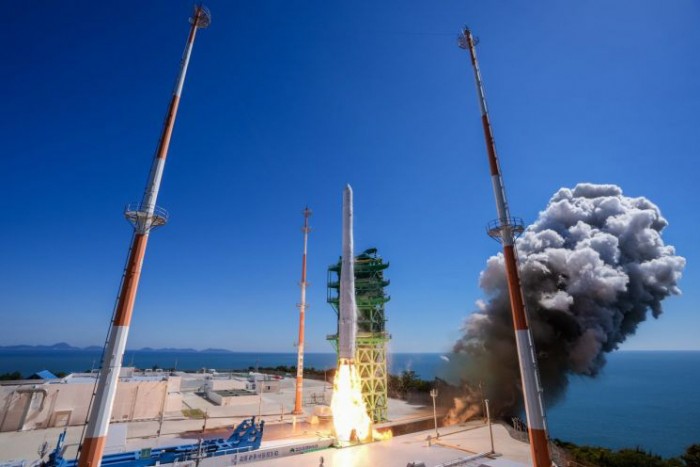 |
| The South Korean space launch vehicle Nuri lifts off from the Naro Space Center in Goheung at 12:25 p.m. on the 7th. / Korea Aerospace Research Institute (KARI) |
All 14 satellites successfully deployed from South Korea’s homegrown space launch vehicle Nuri have established communication with ground stations and are now preparing to carry out their missions.
The Korea AeroSpace Administration (KASA) and the Korea Aerospace Research Institute (KARI) announced that all nine secondary satellites launched aboard the fifth Nuri flight at 12:25 p.m. on the 7th have successfully made contact.
During the launch on the 7th, nine of the ten secondary satellites on board were deployed, with the exception of Quaternion's PERSAT-02. KASA explained that all nine successfully separated satellites have established communication and are undergoing checkouts ahead of operational duties.
Eight of these satellites made initial contact on the afternoon of launch day. SpaceLinTech's BEE-1012 achieved two-way communication on its first attempt and is conducting system checks for its primary mission.
KARI’s Domestic Components Space Verification Platform 2 completed bus system checks and is currently inspecting its payload, while the Unmanned Exploration Laboratory's ULYSSES confirmed that its payload remains in good condition following satellite diagnostics.
On the same day, SD-1Sat's Space&Bean received data including GPS log records, while Chosun University’s optical communications verification satellite received beacon signals and established two-way communication around 11:00 p.m., securing telemetry and operational data while downlinking imagery.
ONB Space's SLEDGE initially detected beacon signals on the 7th and successfully downlinked data on the 9th, confirming the normal deployment of solar panels and antennas, with ground stations now attempting uplinks to establish two-way communication.
Cosmoworks' JACK-007 and KAIST's GBSAT also received beacon signals on their first attempts on the 7th.
Daejeon Metropolitan City's DaejeonSat-1 established two-way communication around 11:00 p.m. on the 8th, confirming normal operating conditions including the proper deployment of its solar panels.
Following preliminary health checks through ground contact, the secondary satellites will undergo early-stage commissioning to verify all onboard systems before commencing full-scale missions.
KASA’s announcement confirmed that all 14 satellites successfully deployed during the fifth Nuri launch have established contact. All five Earth observation microsatellites deployed on the 7th have connected with ground stations. Unit 6 made initial contact with the King Sejong Station in Antarctica around 1:08 p.m., followed sequentially by Units 4, 3, and 2 connecting with domestic and overseas ground stations. Unit 5 also established contact with King Sejong Station at 5:52 p.m. that evening, completing initial communications for all five units.
"In this fifth Nuri launch, communication with the CubeSats was achieved in far less time than in the fourth launch," said KASA Administrator Oh Tae-seog. "This milestone was accomplished because the launch vehicle placed the satellites into their target orbits with greater precision and delivered sophisticated orbital positioning data, demonstrating a clear step forward in technological maturity."
Seo Byung-joo
Most Read
-
1
Kia Sportage outperforms Mazda CX-5 in German auto..

-
2
Houthis launch successive attacks on Saudi airport..

-
3
Saudi Arabia, Iran hold first diplomatic talks to..

-
4
U.S. deploys carrier, 10,000 more troops to Middle..

-
5
Saudi airport in Riyadh struck again, leaving at l..

-
6
Putin's ally visits China on the 8th ahead of APEC..

-
7
Chinese military support and training center opens..

PEOPLE






HEADLINE NEWS

-
Address : In-Young Bldg., 34, Uisadang-daero 1-gil, Yeongdeungpo-gu, Seoul
Copyright by ASIATODAY CO., LTD. All rights resereved