



[Exclusive] Series of security issues fuels wartime OPCON debate in Washington
Oct 12, 2026, 01:23 pm


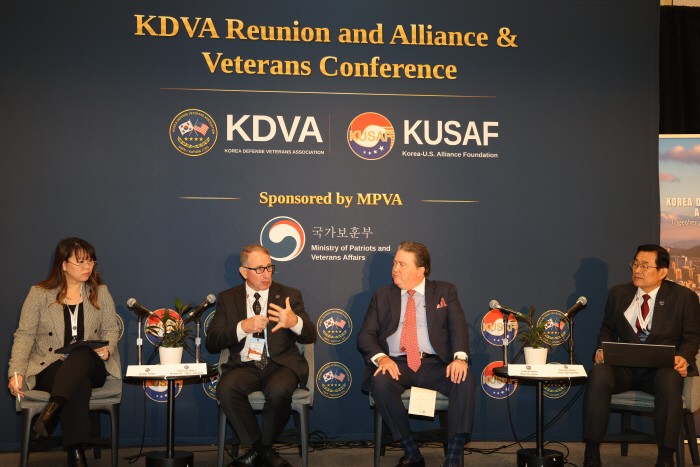 |
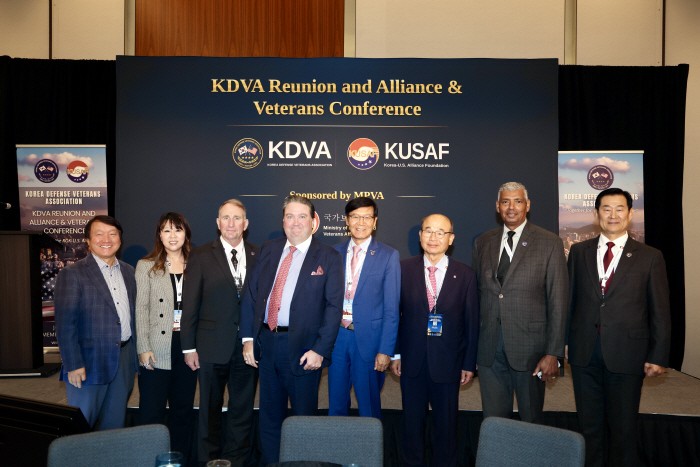
| Jenny Town, senior fellow at the Stimson Center and director of 38 North (from left); Robert Abrams, former commander of United States Forces Korea; Marc Knapper, former charge d'affaires at the U.S. Embassy in Seoul (former U.S. ambassador to Vietnam); and Choi Byung-hyuk, former deputy commander of the ROK-U.S. Combined Forces Command (former South Korean ambassador to Saudi Arabia), discuss the transition of wartime operational control (OPCON) during the "Defense and Diplomacy Dialogue" hosted by the Korea Defense Veterans Association (KDVA) in Washington, D.C., on the 10th (local time). / Washington Correspondent Ha Man-ju |
[Article Summary]
1. Robert Abrams, former commander of United States Forces Korea, assessed that "accelerating" the OPCON transition is interpreted by some South Korean policymakers as accepting unmet conditions and taking risks, whereas from the U.S. perspective, it means moving up the timeline while strictly maintaining 100% condition fulfillment.
2. Abrams pointed out that deficiencies still remain regarding the transition conditions—which include securing 26 core military capabilities—and noted that no progress has been made on several particularly critical items.
3. Choi Byung-hyuk, former deputy commander of the ROK-U.S. Combined Forces Command, defined OPCON as a matter of military effectiveness rather than sovereignty, emphasizing that South Korean leadership must not mean defending the country alone.
4. Marc Knapper, former charge d'affaires at the U.S. Embassy in Seoul, described the OPCON transfer as the "ultimate defense burden sharing," stressing that extended deterrence, strategic asset deployments, and combined exercises must continue even after the transition.
Robert Abrams, former commander of United States Forces Korea, stated on the 10th (local time) that there is a discrepancy between how certain South Korean policymakers interpret the "acceleration" of wartime operational control (OPCON) transition and how it is viewed from the American perspective.
Speaking at the "Defense and Diplomacy Dialogue" hosted by the Korea Defense Veterans Association (KDVA) in Washington, D.C., he characterized this as "a clear case where a language barrier really exists." Abrams pointed out that shortcomings still persist in meeting the transition conditions, which require securing 26 critical military capabilities.
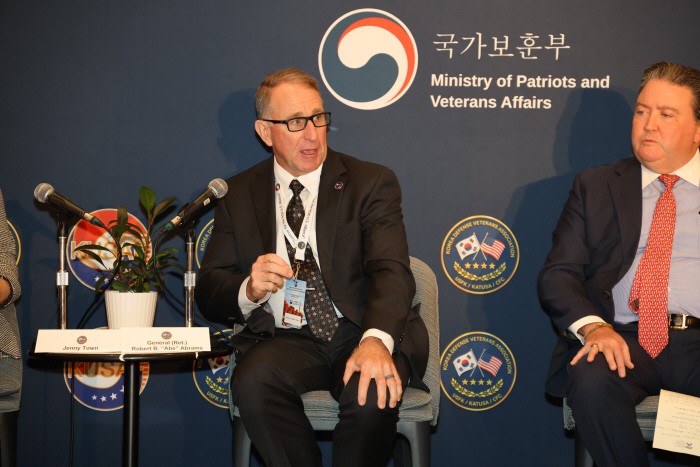 |
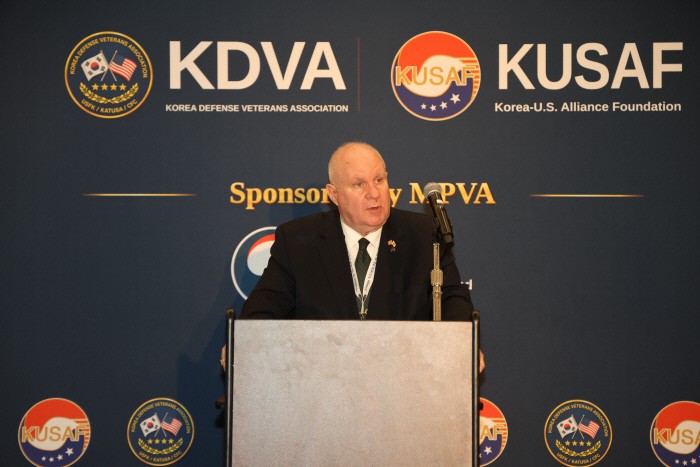
| Robert Abrams, former commander of United States Forces Korea, speaks during a panel on the transition of wartime operational control (OPCON) at the "Defense and Diplomacy Dialogue" hosted by the Korea Defense Veterans Association (KDVA) in Washington, D.C., on the 10th (local time). / Washington Correspondent Ha Man-ju |
"Even in wartime, OPCON of ROK and U.S. forces is vested in combined commander, not a single nation," former USFK commander Abrams says
The KDVA held a panel discussion on wartime operational control (OPCON) during the 2026 Reunion and Alliance & Veterans Conference that day. Former Commander Abrams (retired general, chairman and president of the KDVA), former ROK-U.S. Combined Forces Command (CFC) Deputy Commander Choi Byung-hyuk (former South Korean ambassador to Saudi Arabia), and former Chargé d'Affaires at the U.S. Embassy in Seoul Marc Knapper (former U.S. ambassador to Vietnam) participated in the discussion. Jenny Town, senior fellow at the Stimson Center and director of 38 North who moderated the session, characterized OPCON as a core issue in alliance management where military readiness, shared responsibility, and trust intersect.
Abrams urged that terminology be made accurate first. He explained that during peacetime, the Chairman of the South Korean Joint Chiefs of Staff holds command authority and operational control over all South Korean military forces, and the Commander of United States Forces Korea holds the same authority over all U.S. forces. Peacetime CFC does not command or exercise operational control over any units, operating strictly as an independent headquarters, he stated.
When a crisis arises, allied forces are governed by three bilaterally consulted and approved documents, he explained. The three documents—the strategic directive, terms of reference defining authorities and missions, and the crisis management memorandum of agreement—stipulate when the forces of both nations are placed under the operational control of the CFC commander.
Abrams emphasized that this decision is made not through a unilateral judgment by either side, but through bilateral consultative mechanisms. The declaration of hostilities and adjustments to defense readiness conditions are also joint decisions made by the national command authorities of both nations, he stated.
"In wartime, operational control over South Korean and U.S. forces does not go to either single country," Abrams explained, stating that it is granted to the combined commander. He said assertions that the U.S. controls South Korean forces before the transition, and South Korea will control U.S. forces after it, are not true. He pointed out that even during wartime, both nations retain command authority over their respective militaries.
Citing the International Security Assistance Force (ISAF) in Afghanistan as an example, Abrams noted that while several countries placed forces under the operational control of the ISAF commander, they maintained command authority over their own troops and defined the scope of their actions through caveats.
Former Deputy Commander Choi explained that the future Combined Forces Command will also maintain the existing combined command structure, with only the roles of top leadership changing. Abrams introduced Choi as having served as CFC deputy commander when the Initial Operational Capability (IOC) partial evaluation was conducted in August 2019 and when the IOC evaluation was completed in August 2020.
Abrams explained that the conditions-based transition plan is designed to go through a series of assessments, including Initial Operational Capability, Full Operational Capability (FOC), and Full Mission Capability (FMC).
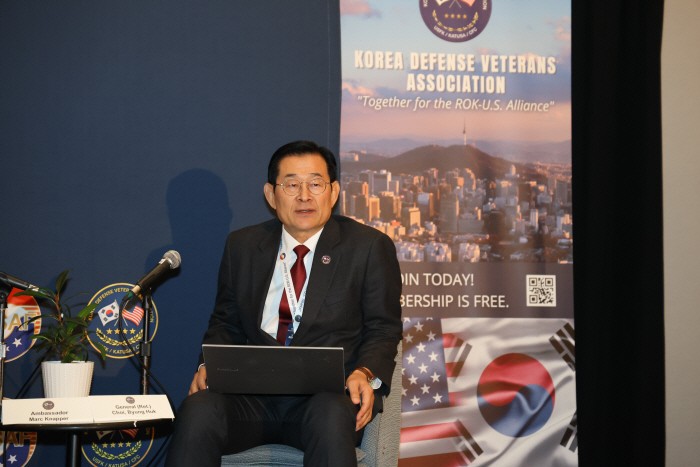 |
| Choi Byung-hyuk, former deputy commander of the ROK-U.S. Combined Forces Command (former South Korean ambassador to Saudi Arabia), speaks during a panel on the transition of wartime operational control (OPCON) at the "Defense and Diplomacy Dialogue" hosted by the Korea Defense Veterans Association (KDVA) in Washington, D.C., on the 10th (local time). / Washington Correspondent Ha Man-ju |
Former CFC Deputy Commander Choi Byung-hyuk says, "OPCON is a matter of military effectiveness, not sovereignty" and "ROK-led does not mean ROK-only defense"
Town noted that OPCON is often framed as an issue of sovereignty in South Korea and asked whether that is an appropriate framing. Abrams viewed this as the result of overlapping factors: misunderstandings surrounding terminology and actual shifts in the transition plan itself. He explained that the initial concept envisioned wartime operational control of South Korean forces falling under South Korea's national command authority with the U.S. military assuming a supporting role, but the plan later shifted to a future Combined Forces Command framework that preserves the combined structure.
"I don't think everybody got that message," Abrams said, emphasizing that for military professionals, this was not a subtle distinction but a significant change. He stated that in his view, "sovereignty" is not an appropriate framework because the currently agreed transition model is not an independent command structure for the South Korean military, but a future Combined Forces Command system that maintains the ROK-U.S. combined command structure.
He shared that during a recent visit to South Korea, he sensed an inclination to associate sovereignty with unilateral South Korean decision-making authority rather than ROK-U.S. joint decision-making. "I respect 100% wanting to determine your own destiny as a sovereign nation," he said, while pointing out that doing so could mean departing from proven bilateral procedures and a bilateral command and governance structure. He assessed that the concept around 2007 to 2009 leaned in that direction and was workable, but personally viewed it as the least effective option and one that increases military risk.
Former Deputy Commander Choi also drew a line against framing OPCON as a matter of sovereignty. "From the perspective of a professional military officer and strategy, OPCON is not an issue of sovereignty, but purely a matter of military effectiveness," he said. He pointed out that granting operational control to the CFC commander is itself a choice made by two sovereign nations, South Korea and the U.S. Stressing that the core essence lies in military utility and warfighting capability, he emphasized, "ROK-led should not mean ROK-only defense."
Former Ambassador Knapper assessed that controversies over sovereignty have persisted throughout the alliance's existence. Tracing the issue back to 1950 when President Syngman Rhee transferred operational command of South Korean forces to UN Commander Douglas MacArthur, he explained that the command structure evolved through multiple phases, including the establishment of the CFC in 1978 and the transfer of peacetime operational control in 1994. He noted that while a transition timeline was established under President Roh Moo-hyun, the plan was revised or delayed past milestones such as 2010 and 2014.
Knapper pointed out that among certain segments of South Korean society that are less favorable to the alliance, a perception emerged that the U.S. was moving the goalposts and seeking to undermine South Korea's sovereignty and its capacity to manage its own defense independently. He noted that this perception is reflected even in language, pointing out that the Korean term commonly used, "hwansu," carries the nuance of "retrieving" or "taking back," whereas the official bilateral concept is "transition." Drawing a comparison to NATO's combined command structure, he emphasized, "While there may be disagreements over speed and tempo, we share the same vision and the same destination."
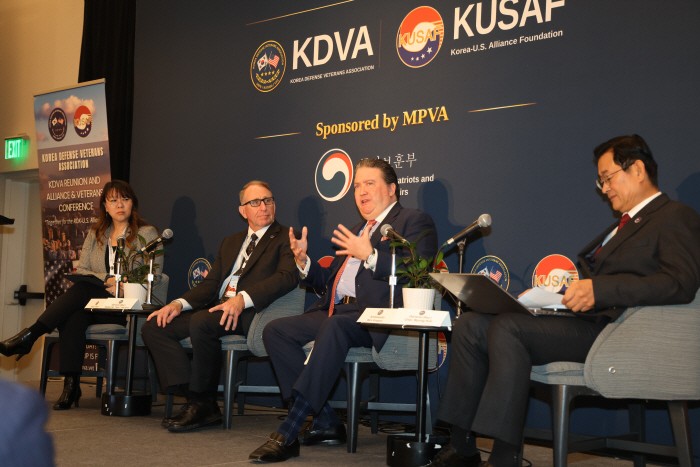 |
| Jenny Town, senior fellow at the Stimson Center and director of 38 North (from left); Robert Abrams, former commander of United States Forces Korea; Marc Knapper, former charge d'affaires at the U.S. Embassy in Seoul (former U.S. ambassador to Vietnam); and Choi Byung-hyuk, former deputy commander of the ROK-U.S. Combined Forces Command (former South Korean ambassador to Saudi Arabia), discuss the transition of wartime operational control (OPCON) during the "Defense and Diplomacy Dialogue" hosted by the Korea Defense Veterans Association (KDVA) in Washington, D.C., on the 10th (local time). / Washington Correspondent Ha Man-ju |
Former Commander Abrams says that there is a discrepancy in interpreting "acceleration"—some in South Korea accept risk, while the U.S. perspective insists on 100% condition fulfillment
Abrams pointed to the term "accelerate," which resurfaced recently at the Korea-U.S. Integrated Defense Dialogue (KIDD), as an issue. He noted that the same phrasing had also been used at the ROK-U.S. Security Consultative Meeting (SCM) held in Washington, D.C., in October 2018.
He stated that from the perspective of South Korean policymakers, "acceleration" can be understood as accepting an incomplete fulfillment of conditions and taking on a certain level of risk. In contrast, from the U.S. standpoint, "acceleration" means moving up the timeline while strictly maintaining 100% condition fulfillment by prioritizing the acquisition, development, deployment, operational fielding, and training of critical military capabilities, along with the defense budget required for them. In explaining this, Abrams cited the approach of prioritizing the procurement of core military capabilities and the budgets necessary to support them.
Citing South Korea's additional procurement of F-35s as an example, he said, "The F-35 is not among the 26 critical military capabilities." Emphasizing that required core capabilities must be secured first, he questioned, "Why spend money on the F-35 when you should be buying other things?"
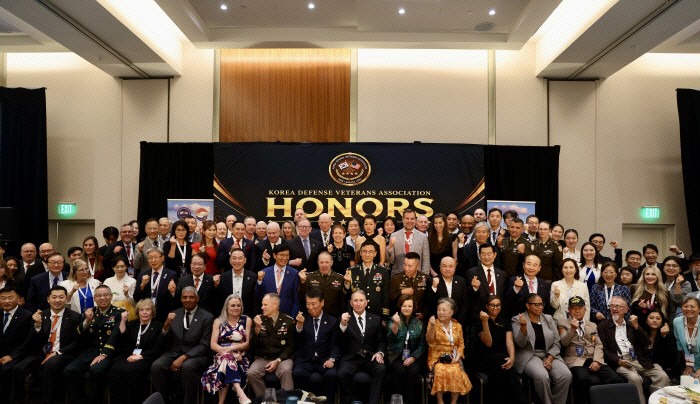 |
| Attendees of the 2026 Reunion and Alliance & Veterans Conference, hosted by the Korea Defense Veterans Association (KDVA) in Washington, D.C., on the 10th (local time), pose for a commemorative photograph. / Washington Correspondent Ha Man-ju |
"Transition conditions still unmet," former Commander Abrams says, emphasizing securing and validating 26 critical military capabilities
Abrams shared that the current plan was formulated in 2013–2014 and signed in 2015. He explained that Condition 1 involves demonstrating the South Korean military's capability to lead the combined defense, which includes acquiring and deploying 26 critical military capabilities along with U.S. bridging capabilities provided temporarily until South Korea fields its own. Securing and training with these capabilities requires both budget and time, he stressed, adding that "you cannot just snap your fingers and have them."
Mentioning that he recently received a classified briefing in South Korea, Abrams noted that while the specifics remain classified and cannot be disclosed, "there are still numerous shortfalls" and "there is still a ways to go." He pointed out that there has been zero progress on several particularly vital items, adding that publicly elaborating on them is difficult because doing so could expose military vulnerabilities. Still, he added that if they could be explained publicly, public attention might help drive better outcomes.
Refuting claims that the U.S. is "moving the goalposts" on the transition conditions, Abrams maintained that this never occurred during his tenure as USFK commander. He explained that mechanisms were in place allowing him and his South Korean counterpart to jointly review the evaluations throughout the process. Adding new requirements would open the U.S. up to criticism of imposing additional conditions to delay the transition, and he stressed that "we must not do that."
Former Deputy Commander Choi identified North Korea's development of hypersonic missiles and nuclear-powered submarines, along with the diversification of its nuclear delivery vehicles, as primary threats. Abrams observed that while the plan drafted in 2015 could not have anticipated North Korea's subsequent military modernization, the 26 critical military capabilities remain essential for deterrence and defense today.
He noted that the North Korean threat has evolved significantly since his departure from South Korea in 2021, citing real-world combat experience gained from the Russia-Ukraine war and technology transfers resulting from the North Korea-Russia strategic partnership. Pointing to drones, drone swarms, and counter-drone capabilities, he explained that real-world operational feedback is also accumulating for North Korea's ballistic missile operations. However, he emphasized, "That does not mean we should change the plan. We have to stick to the plan."
Earlier, on a Center for Strategic and International Studies (CSIS) podcast on the 5th, Abrams stated that "a time-based plan fundamentally increases risk." At the time, he argued that operational shortcomings still remain within the South Korean military and that condition fulfillment must remain the benchmark for transition. Addressing the South Korean government's claim in 2020 that 92% of the transition conditions had been met, he said, "To be clear, that is not true. Back then, that figure was far below 92%."
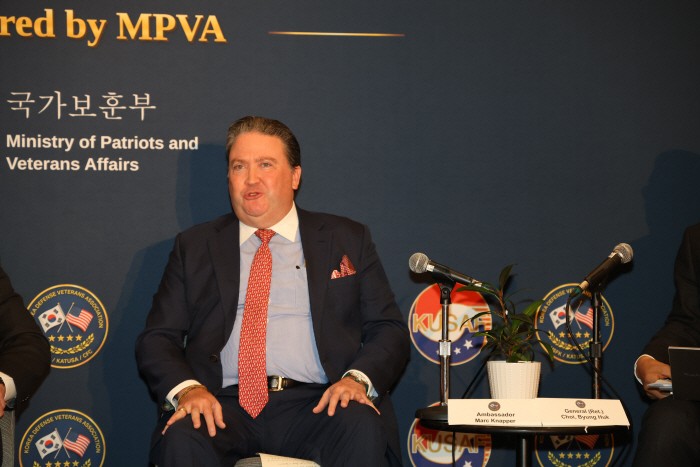 | ||||
Marc Knapper, former charge d'affaires at the U.S. Embassy in Seoul (former U.S. ambassador to Vietnam), speaks during a panel on the transition of wartime operational control (OPCON) at the "Defense and Diplomacy Dialogue" hosted by the Korea Defense Veterans Association (KDVA) in Washington, D.C., on the 10th (local time). / Washington Correspondent Ha Man-ju
Addressing the issue of scaling back combined exercises, Abrams compared the four adjustment levers—scale, scope, type, and public messaging—to a radio dial. While acknowledging the importance of harmonizing military objectives with diplomatic circumstances, he stated that "if scaled back, it is simply not as effective."
He stressed that a 12-day exercise is designed around training objectives meant to be achieved over that duration, meaning that arbitrarily trimming five days makes it impossible to achieve the same number of objectives at the same proficiency level. He explained that during the March 2019 exercise, conducted after a roughly one-year hiatus of combined field training on the Korean Peninsula, both South Korean and U.S. forces were "rusty," resulting in friction and operational gaps.
"Personally, I do not believe combined exercises truly bother North Korea," Abrams said, adding that "North Korea demands it because they know it disrupts the U.S. military." Pointing out that North Korea continues its routine summer and winter training cycles, he emphasized that the ROK-U.S. alliance must harmonize diplomatic approaches while reassuring the South Korean public and maintaining force readiness.
Knapper underscored that differences between Seoul and Washington should not be exposed during the transition process, as doing so would signal gaps in the alliance to North Korea, China, and Russia. He called for maintaining U.S. extended deterrence, the nuclear umbrella, bilateral nuclear consultations, regional deployments of strategic assets, and rigorous combined exercises even after the transfer. He suggested that both governments and militaries jointly communicate major milestones, combined drills, and condition fulfillment status before, during, and after the transition.
Knapper defined the OPCON transition as "ultimately an issue of burden sharing." Assessing that "this is the ultimate burden sharing story," he noted that it demonstrates South Korea is a "model ally." He added that it can be presented to the American public and Congress as a process in which South Korea steps up to take a leading role in future combined defense while procuring the necessary capabilities.
Abrams noted that the U.S. Department of Defense and State Department, when explaining alliance modernization, have consistently used the phrase that the U.S. will provide "critical but limited capabilities" after the transition. Calling this a "significant phrase," he evaluated that the core issue lies not in the movement of operational control itself, but in the shift of responsibility regarding who provides the required military capabilities. He stressed that these capabilities must not exist merely on paper, but must be practically fielded, trained, and operated.
Former Commander Abrams says, "OPCON and strategic flexibility are separate issues" while Maxwell suggests considering rotating ROK and U.S. commanders every three years Abrams pointed out that linking the OPCON transition to the strategic flexibility of U.S. Forces Korea is misguided. USFK is a sub-unified command under the U.S. Indo-Pacific Command, answering to the U.S. National Command Authority, and strategic flexibility has existed in the past as well, he explained. He noted that during the War on Terror and recent operations in the Middle East, U.S. assets stationed in South Korea were deployed to other regions. While stating that publicly making definitive assertions about hypothetical scenarios such as a Taiwan contingency is inappropriate, he affirmed that the U.S. retains the right to employ its own forces when necessary, and the same applies to South Korea. Emphasizing that the OPCON transfer and strategic flexibility are "mutually distinct matters," he stressed the need to enhance strategic communication to minimize misconceptions that bundle the two together. Characterizing ROK-U.S. strategic communication, he observed that it is "slow, ponderous, and not proactive." As a benchmark for determining whether the transition is successful 5 to 10 years from now, Abrams pointed to "whether we continue to deter North Korea so that it does not misunderstand or miscalculate the actual strength of the alliance and allied forces." He explained that the core issue is whether both militaries can continue to stand shoulder-to-shoulder and conduct combined operations seamlessly in an actual crisis, just as they do today. Former Deputy Commander Choi stated that for the South Korean military to lead the combined defense, it must possess capabilities in command and control, intelligence, surveillance, and reconnaissance (ISR), and countering North Korean nuclear and missile threats. He urged that these capabilities be validated through exercises in realistic operational environments rather than merely on paper. Stressing that the most critical element is not who occupies the commander's seat, but whether the future Combined Forces Command can effectively command and fight with integrated ROK-U.S. forces, Choi noted that this requires an integrated headquarters, interoperable command and control systems, operational plans, intelligence sharing, and a clear division of missions between the two nations. David Maxwell, vice president of the Center for Asia Pacific Strategy (EAPS), told Asia Today that day that "the wartime OPCON transition is a myth." Because the CFC is a combined headquarters equally accountable to both nations through the bilateral Military Committee, the U.S. does not hold national command authority over South Korean forces, nor would a South Korean general commanding the future CFC hold national command authority over U.S. forces. He said this should not be viewed through the lens of sovereignty since both nations retain command authority over their respective militaries. Maxwell stressed that OPCON itself does not guarantee automatic U.S. military intervention in the event of war on the Korean Peninsula. While the presence of USFK and the ROK-U.S. Mutual Defense Treaty substantiate the U.S. defense commitment, responses under the treaty require both nations to follow their respective constitutional processes, he explained. Arguing that rather than clinging to current OPCON transfer procedures, the focus should be on discussing how to organize combined ROK-U.S. forces most effectively, he suggested that a new combined command structure—where South Korean and U.S. generals rotate the CFC commander post every three years—could be considered. He explained that in scenarios involving military operations in North Korea or a North Korean collapse, a structure where a South Korean general directs operations would be appropriate to avoid perceptions that the U.S. is occupying North Korea and to ensure the legitimacy of the political outcome: a free and unified Korea. Observing that the character of warfare is changing with drones and precision-guided munitions, Maxwell emphasized, "Instead of arguing over which general should be in command, we should discuss how to organize combined forces most effectively." Ha Man-ju |
Most Read
-
1
Kia Sportage outperforms Mazda CX-5 in German auto..

-
2
Houthis launch successive attacks on Saudi airport..

-
3
Saudi Arabia, Iran hold first diplomatic talks to..

-
4
Saudi airport in Riyadh struck again, leaving at l..

-
5
U.S. deploys carrier, 10,000 more troops to Middle..

-
6
Five ASEAN countries welcome Myanmar coup leader

-
7
Putin's ally visits China on the 8th ahead of APEC..

PEOPLE






HEADLINE NEWS
- New White House Press Secretary links $54 billion from Seoul to Alaska LNG in first briefing
- Industrial Bank of Korea launches local subsidiary in Vietnam
- Saudi-Houthi clashes over oil facilities escalate, hitting 24 vessels in Ho..
- Bin Salman underestimates Houthi offensive, imperiling Saudi economic refor..

-
Address : In-Young Bldg., 34, Uisadang-daero 1-gil, Yeongdeungpo-gu, Seoul
Copyright by ASIATODAY CO., LTD. All rights resereved