



SKC bets on Vietnam again, expands semiconductor materials and AI infrastructure
Oct 07, 2026, 10:11 am


 |
SKC is scaling up the production base of its semiconductor business to keep pace with the expansion of the artificial intelligence (AI) semiconductor market. This comes as the company injects fresh capital into ISC's Vietnamese manufacturing subsidiary amid a prolonged recovery in profitability for its secondary battery materials business, weighed down by slowing electric vehicle demand.
SKC, which has steadily invested in its semiconductor business since acquiring ISC in 2023, is now seen expanding its overseas mass-production footprint as well.
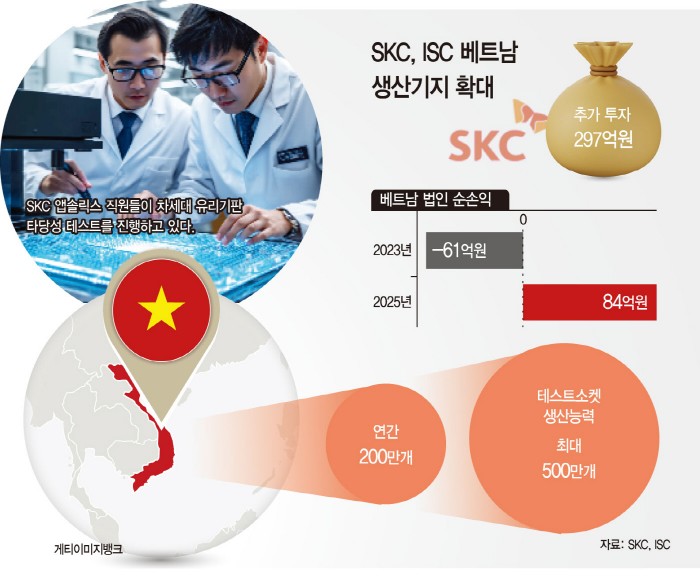
According to industry sources on the 6th, ISC will inject 22 million dollars into its Vietnamese manufacturing subsidiary, ISC VINA, on the 7th. Applying the foreign exchange rate on the 28th of last month, when the investment decision was made, the amount translates to 29.744 billion won, representing 5.54 percent of ISC's total equity.
ISC holds a 100 percent stake in the entity. The invested funds will be deployed to secure an additional manufacturing base and fund infrastructure investments.
ISC also injected around 44 billion won into the Vietnamese subsidiary last year. While that round aimed at bolstering operational efficiency through balance sheet improvements, this year's investment scope has expanded to securing additional production bases and financing infrastructure.
The performance of the Vietnamese entity is also improving. Revenue grew from 27.4 billion won in 2023 to 39.3 billion won in 2024, reaching 51.5 billion won last year. Net profit turned around from a net loss of 6.1 billion won in 2023 to a narrowed loss of 200 million won in 2024, before swinging to a net profit of 8.4 billion won last year. Observers note that the production base's improving track record has laid the groundwork for this follow-on investment.
Alongside the expanded investment, the role of the Vietnamese production base is also expected to grow.
ISC operates a bifurcated manufacturing framework where Vietnam handles high-volume mass production while domestic facilities in South Korea concentrate on research and development as well as high-complexity manufacturing. The company plans to scale its test socket production capacity progressively from the current level of approximately 2 million units per year up to 5 million units.
ISC's flagship test sockets are deployed in backend semiconductor packaging to inspect the electrical characteristics and performance of chips. With growth across high-performance computing chips such as AI graphics processing units (GPUs), server central processing units (CPUs), and application-specific integrated circuits (ASICs), demand for high-specification test sockets has also been climbing.
Industry insiders note that as the high-performance semiconductor market expands, testing complexity is escalating. Consequently, demand for advanced test sockets is tracking a similar upward trajectory.
SKC acquired ISC in October 2023 to enter the market for critical backend semiconductor consumables. Since then, it has restructured its legacy backend semiconductor equipment operations around ISC and broadened its semiconductor materials portfolio. Financial results for the semiconductor materials division are also improving. In the first half of this year, the semiconductor materials segment posted a net profit of 12.2 billion won, up roughly fivefold from 2.4 billion won logged in the same period last year. Over the same timeframe, revenue rose around 24 percent from 141.1 billion won to 174.9 billion won.
In contrast, the secondary battery materials business, where SKC has been prioritizing profitability recovery, remains mired in red ink. In the first half of this year, the secondary battery materials division recorded a net loss of 134.4 billion won.
Across the entire company, SKC posted an operating loss of 43.2 billion won in the first half. Although it narrowed its operating deficit compared to 142.5 billion won recorded in the same period last year, a swing to profitability has yet to materialize.
Lee Seo-yeon
Most Read
-
1
Alteogen secures European patent for Keytruda SC,..

-
2
Trump shares map on social media labeling Strait o..

-
3
Celltrion seeks rheumatoid arthritis indication ex..

-
4
Kia Sportage outperforms Mazda CX-5 in German auto..

-
5
U.S. deploys carrier, 10,000 more troops to Middle..

-
6
Trump rejects Iran's offer to open Strait of Hormu..

-
7
N. Korea conducts first swarm attack drill with dr..

PEOPLE






HEADLINE NEWS
- Pyongyang calls DMZ explosion Seoul's fabrication and grave provocation
- U.S. Department of Defense completely halts use of blacklisted Anthropic AI
- 2026 Nobel Prize in Physics awarded to Francis Halzen for neutrino research
- French students take to streets, expressing frustration over economy, educa..

-
Address : In-Young Bldg., 34, Uisadang-daero 1-gil, Yeongdeungpo-gu, Seoul
Copyright by ASIATODAY CO., LTD. All rights resereved