



[Exclusive] False reports mobilize 2,868 police officers
Oct 07, 2026, 09:51 am


 |
In August, a 112 emergency call reported that a woman next door was repeatedly being beaten at a multi-family residence in Seo-gu, Gwangju. When no one answered from inside, police and firefighters forced the front door open, but the unit was empty, and no signs of assault were found. The caller even denied making the report, but when officers dialed the calling number, his cell phone rang. On the 2nd, the Gwangju Seobu Police Station referred the man in his 40s to the prosecution without detention on charges of obstruction of justice by hierarchy.
While police are filing civil damages claims in cases where false emergency reports trigger massive deployments of law enforcement personnel, actual recoveries have fallen short of 20 percent of finalized award amounts.
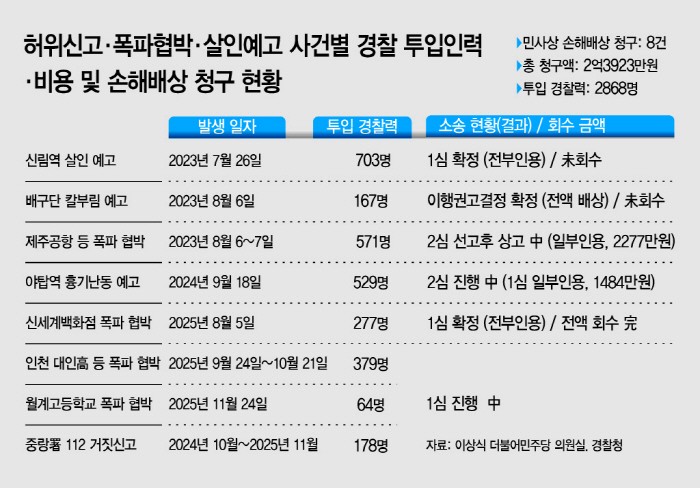
According to data submitted by the National Police Agency to Representative Lee Sang-sik of the Democratic Party of Korea, a member of the National Assembly's Public Administration and Security Committee, on the 6th, police have filed civil suits for damages in eight cases between July 2023 and September of this year where false 112 reports, bomb threats, or murder threats prompted large-scale police mobilizations. These cases involved 2,868 deployed officers, with total damages claimed by police reaching 239.23 million won. Because a single false report leads to substantial staffing commitments for fact-checking, scene control, and searches, police are calculating incurred operational costs in select cases to hold perpetrators civilly liable.
To date, liability has been finalized in three cases, totaling 68.83 million won in finalized damages. However, actual recovered funds stand at just 12.56 million won, or 18.2 percent, leaving 56.27 million won uncollected. In the July 2023 Sillim Station murder threat incident, where 703 officers were mobilized, a ruling ordering full compensation of 43.70 million won was finalized, yet the amount remains uncollected. In a stabbing threat targeting a volleyball team that same year, 167 officers were dispatched and a compensation order of 12.57 million won was finalized, but it also remains unrecovered. The only case resulting in full recovery is a bomb threat against Shinsegae Department Store last year, which yielded 12.56 million won.
The remaining cases are still working their way through the courts. In a bomb threat incident targeting facilities including Jeju International Airport, where 571 officers were deployed, police sought 32.53 million won; the appellate court awarded 22.77 million won, and the case is currently before the Supreme Court. In a stabbing spree threat targeting Yatap Station, 529 officers were mobilized and 55.05 million won was claimed, but the first-instance court recognized only 14.84 million won, sending the matter to an appellate court.
Police do not seek damages for every false report. Out of 27 cases reviewed separately, authorities decided against filing suit in 13 and plan to proceed with litigation in 14. Unfiled cases mainly involved incidents where disruption did not rise to the level of halting administrative functions, or where callers were deemed to lack legal capacity, such as minors or individuals with intellectual disabilities.
Lee Geon-soo, a professor of police science at Baekseok University, noted that false reports compromise police capacity to respond to other emergency calls, ultimately harming the public, and emphasized the need to firmly establish the principle of demanding actual restitution for incurred costs alongside criminal penalties for malicious false reports.
Representative Lee Sang-sik also stressed that false reporting is a criminal offense that squanders vast public resources and creates security voids, underscoring the urgent need for effective and robust sanctions.
Seol So-young
Most Read
-
1
Alteogen secures European patent for Keytruda SC,..

-
2
Trump shares map on social media labeling Strait o..

-
3
Celltrion seeks rheumatoid arthritis indication ex..

-
4
Kia Sportage outperforms Mazda CX-5 in German auto..

-
5
U.S. deploys carrier, 10,000 more troops to Middle..

-
6
Trump rejects Iran's offer to open Strait of Hormu..

-
7
N. Korea conducts first swarm attack drill with dr..

PEOPLE






HEADLINE NEWS
- Pyongyang calls DMZ explosion Seoul's fabrication and grave provocation
- U.S. Department of Defense completely halts use of blacklisted Anthropic AI
- 2026 Nobel Prize in Physics awarded to Francis Halzen for neutrino research
- French students take to streets, expressing frustration over economy, educa..

-
Address : In-Young Bldg., 34, Uisadang-daero 1-gil, Yeongdeungpo-gu, Seoul
Copyright by ASIATODAY CO., LTD. All rights resereved