



German retail giant Metro exits Kazakhstan after 17 years
Oct 07, 2026, 09:39 am


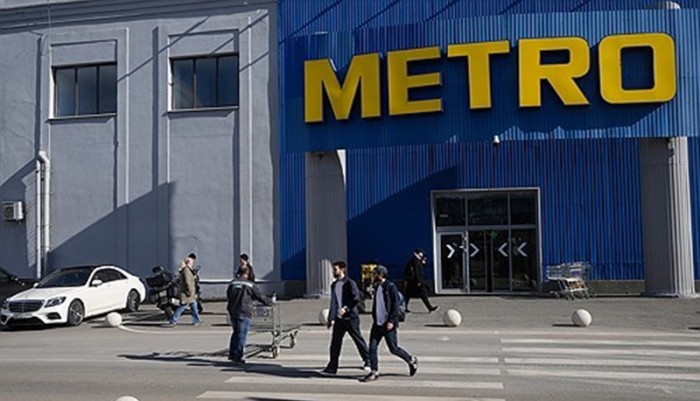 |
| People walk past a store of global retailer Metro Cash & Carry in Moscow, Russia, on the 29th of last month (local time). / AP, Yonhap |
German global wholesale retailer METRO is winding down its local operations in Kazakhstan after 17 years. Exiting even as the retail market continues to grow, the move stands as a case highlighting the limitations of traditional wholesale models.
Kazakh news outlet Kazinform reported on the 5th that METRO will phase out its six stores and delivery services currently operating in Kazakhstan by the end of March next year.
Entering Kazakhstan in October 2009 as the market's first international wholesale distributor, METRO supplied food and daily necessities to hotels, restaurants, and cafes (HoReCa) as well as small retailers.
Since then, it has operated both brick-and-mortar stores and delivery services, carrying on business as a specialized business-to-business (B2B) wholesale distributor.
While METRO runs stores similar in format to conventional hypermarkets, its primary customer base comprises business operators—such as restaurants, cafes, hotels, and retail shops—rather than individual consumers.
At its core is the so-called "Cash & Carry" model, where businesses visit large-format stores to purchase needed goods in bulk in person.
METRO had maintained steady growth in Kazakhstan. Employing roughly 650 workers, it operated stores across six cities, with METRO Kazakhstan posting sales of approximately 143 million euros (approx. 215 billion won) for the 2024–2025 fiscal year.
The company recently expanded into delivery services to bolster its local wholesale operations, but explained that it ultimately struggled to secure a foundation for sustainable growth.
In particular, with its customer base dispersed across an expansive territory, establishing a stable footing for growth through its legacy wholesale model proved challenging.
In other words, rather than demand in the wholesale market evaporating, weight is added to the view that METRO's existing business model failed to align with the local market structure even as the broader sector expanded.
The local business community pointed to Kazakhstan's geographic characteristics and structural shifts in the retail market as key drivers behind the exit.
Dauren Autalipov, head of trade at Kazakhstan's National Chamber of Entrepreneurs "Atameken," emphasized that the traditional European "Cash & Carry" model is no longer an attractive market strategy in Kazakhstan.
Observers note that in Kazakhstan, where consumer markets are concentrated in a few major metropolitan areas such as Almaty and Astana, setting up large-scale stores across multiple regions and relying solely on businesses visiting in person to buy in bulk runs into structural limits when trying to efficiently capture widely dispersed clients.
Recently, the Kazakh retail market has increasingly shifted away from relying on single, large offline wholesale hubs for logistics and sales, transitioning toward multi-format models that integrate retail storefronts, online ordering, and delivery.
Kim Min-gyu
Most Read
-
1
Alteogen secures European patent for Keytruda SC,..

-
2
Trump shares map on social media labeling Strait o..

-
3
Celltrion seeks rheumatoid arthritis indication ex..

-
4
Kia Sportage outperforms Mazda CX-5 in German auto..

-
5
U.S. deploys carrier, 10,000 more troops to Middle..

-
6
Trump rejects Iran's offer to open Strait of Hormu..

-
7
N. Korea conducts first swarm attack drill with dr..

PEOPLE






HEADLINE NEWS
- Pyongyang calls DMZ explosion Seoul's fabrication and grave provocation
- U.S. Department of Defense completely halts use of blacklisted Anthropic AI
- 2026 Nobel Prize in Physics awarded to Francis Halzen for neutrino research
- French students take to streets, expressing frustration over economy, educa..

-
Address : In-Young Bldg., 34, Uisadang-daero 1-gil, Yeongdeungpo-gu, Seoul
Copyright by ASIATODAY CO., LTD. All rights resereved