



Banks upgrade FX trading platforms, compete for corporate clients
Oct 02, 2026, 10:24 am


 |
South Korea's commercial banking sector is accelerating competition to draw corporate clients to non-face-to-face foreign exchange (FX) trading platforms. Amid heightened exchange rate volatility this year and the domestic won-dollar FX market's transition to 24-hour trading, FX platforms that enable companies to handle real-time exchange rate inquiries, FX transactions including spot and forward exchange, and transaction history management without visiting brick-and-mortar branches have grown increasingly vital. Beyond fees generated directly by FX transactions, these platforms are also gaining prominence because connecting FX clients to other financial products allows banks to expand non-interest income.
According to the financial sector on the 1st, KB Kookmin Bank is running a preferential exchange rate promotion through November 30 for sole proprietors and corporate clients using its non-face-to-face FX trading platform, "KB Star FX," for the first time. The promotion is designed to attract new corporate customers to the platform.
Other lenders are also speeding up the expansion of their corporate FX platforms. Hana Bank, a powerhouse in the FX sector, was the first among the five major commercial banks to introduce a corporate non-face-to-face FX platform in 2020 and has steadily upgraded its services ever since. From May to August this year, the bank also carried out promotional events targeting new clients and low-volume users to broaden its customer base.
Efforts to upgrade the platforms themselves are also gaining momentum. Shinhan Bank spun off its non-face-to-face FX trading platform, "Shinhan eFX," as an independent offering in March this year, while Industrial Bank of Korea (IBK) announced in July that it would build a nighttime trading system. Earlier in August last year, NH NongHyup Bank also launched "FX allone," a non-face-to-face FX trading platform featuring enhanced product and service functions compared to its previous FX platform.
Commercial banks are expanding corporate FX platforms because the trading environment in the foreign exchange market itself is shifting rapidly. Following the extension of domestic won-dollar FX trading hours to 24 hours starting July 6, the need for agile non-face-to-face platforms has grown. In particular, as exchange rate volatility widened in the first half of this year, businesses' demand for real-time responses increased, further elevating the importance of FX platforms.
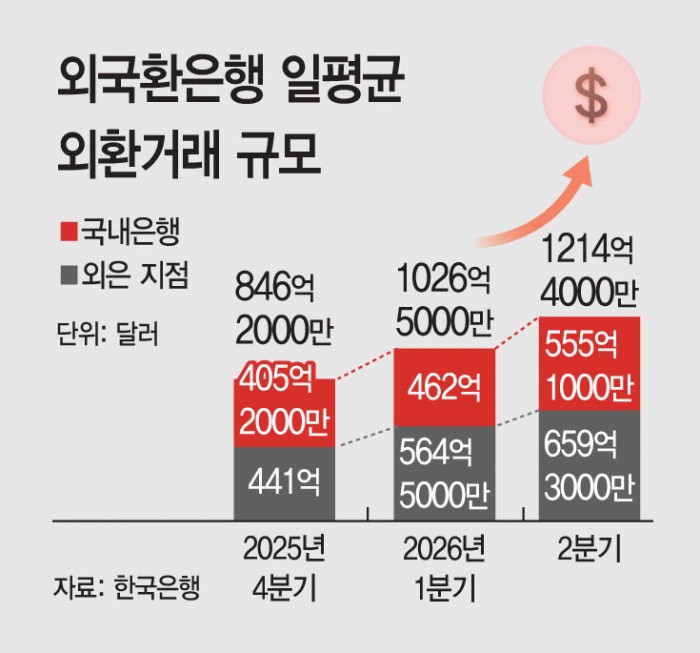
The volume of the FX trading market is also on the rise. According to the foreign exchange trading trends of authorized foreign exchange banks released by the Bank of Korea, daily average FX trading volume by authorized foreign exchange banks in the second quarter of this year reached 121.44 billion dollars (approximately 166 trillion won), marking the highest level since statistical compilation began in 2008. Domestic banks' transaction volume stood at 55.51 billion dollars, up 9.3 billion dollars (20.1%) from the previous quarter (46.2 billion dollars).
Banks view FX platforms as a key vehicle for securing corporate banking clients while growing non-interest income. Increasing corporate transactions across spot exchange, forward exchange, and FX swaps not only broadens foreign exchange fee revenue, but FX transactions can also serve as an entry point to expand business into other products such as foreign currency deposits, overseas remittances, trade finance, and cash management services (CMS). Through this, lenders can anticipate expanding non-interest income across corporate finance as a whole.
Seo Ki-soo, a professor in the Department of Financial Information Engineering at Seokyeong University, said, "With multiple factors affecting exchange rates—such as foreign currency supply and demand driven by the semiconductor boom continuing since last year, along with volatility in exchange rates and global crude oil prices—the market size is expanding. In an environment where banks find it difficult to activate investment banking sectors as seen overseas, they are expanding FX platforms to scale up non-interest income."
Chae Jong-il
Most Read
-
1
Alteogen secures European patent for Keytruda SC,..

-
2
Trump shares map on social media labeling Strait o..

-
3
Celltrion seeks rheumatoid arthritis indication ex..

-
4
Kia Sportage outperforms Mazda CX-5 in German auto..

-
5
Chinese e-commerce giants AliExpress, Temu and She..

-
6
China expels No. 2 military official Zhang Youxia..

-
7
Trump rejects Iran's offer to open Strait of Hormu..

PEOPLE







-
Address : In-Young Bldg., 34, Uisadang-daero 1-gil, Yeongdeungpo-gu, Seoul
Copyright by ASIATODAY CO., LTD. All rights resereved