



Yomiuri reports Trump urged Xi to hold talks with Takaichi at U.S.-China summit
Oct 02, 2026, 10:01 am


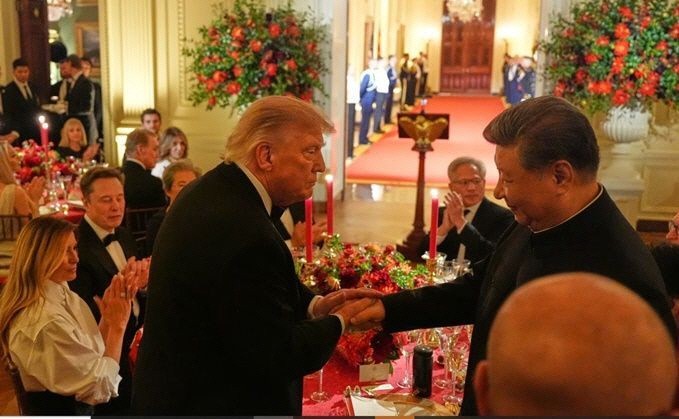 |
| President Donald Trump shakes hands with Chinese President Xi Jinping during a state dinner in the East Room of the White House in Washington, D.C., on September 24. / AP, Yonhap News |
U.S. President Donald Trump urged Chinese President Xi Jinping to engage in direct dialogue with Japanese Prime Minister Sanae Takaichi during their bilateral summit last month, Japan's Yomiuri Shimbun reported on the 2nd. Amid chilled Japan-China ties over the Taiwan issue, the report from Japan notes that the U.S. voiced support for its ally Japan while calling for bilateral dialogue between the two nations. For South Korea, which must balance trilateral security cooperation with the U.S. and Japan alongside managing ties with Beijing, this serves as an indicator of Washington's East Asian diplomatic direction.
Citing multiple Japanese government sources, the Yomiuri reported that President Trump made the remark during the U.S.-China summit held in Washington on September 24 (local time). President Trump reportedly detailed the substance of that conversation directly to Prime Minister Takaichi during a phone call two days later.
According to the report, President Xi criticized Tokyo's actions while discussing regional affairs in East Asia. China has stepped up its criticism of Japan, labeling the Takaichi cabinet's security policies "neo-militarism." Rather than aligning with President Xi, President Trump described Prime Minister Takaichi as a "strong leader" and urged the Chinese and Japanese leaders to hold direct discussions.
However, the report reflects accounts conveyed by Japanese government officials based on what President Trump told Prime Minister Takaichi. How President Xi responded to the call for dialogue was not disclosed. Prime Minister Takaichi also refrained from detailing the specific conversation immediately following the phone call, stating only that the U.S. and Japan agreed to contribute jointly to the peace and stability of the region and the world.
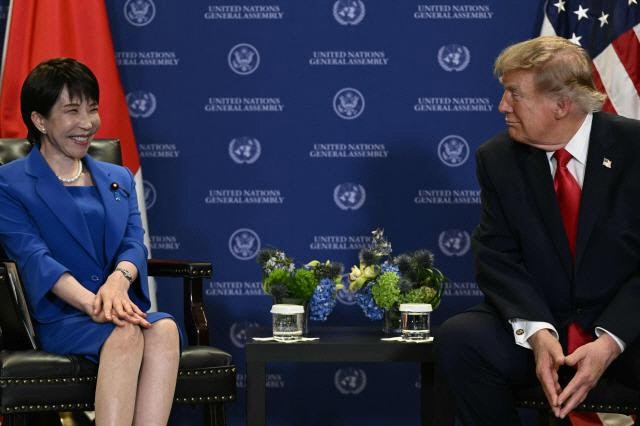 |
| U.S. President Donald Trump (right) and Japanese Prime Minister Sanae Takaichi hold talks on the sidelines of the UN General Assembly in New York on September 22 (local time). / AFP, Yonhap News |
The Japanese government attaches significance to bilateral coordination between Washington and Tokyo ahead of the U.S.-China summit. Prime Minister Takaichi also conveyed her willingness to communicate with China when she met with President Trump in New York on September 22. According to the Yomiuri, a senior Japanese government official evaluated that the advance coordination held meaningful value and served as an example demonstrating mutual trust between the U.S. and Japanese leaders.
The central roadblock in Japan-China relations remains the Taiwan issue. The Yomiuri reported that dialogue at the summit and foreign minister levels has been cut off since Prime Minister Takaichi's parliamentary remarks regarding a Taiwan contingency in November of last year. While Japan maintains that the door to dialogue is open, China has taken issue with Takaichi's remarks. The Chinese Foreign Ministry called for the withdrawal of the statement as recently as February this year. A gap thus persists between Japan, which is proposing dialogue, and China, which is demanding a retraction.
The friction is not limited to Taiwan. Official records released by Japan's Ministry of Foreign Affairs from previous summits between Takaichi and Xi list Chinese military activity in the East China Sea, rare earth export controls, and import restrictions on Japanese agricultural and fisheries products as key contentious items. With security and trade concerns deeply entangled, whether resuming top-level contact would actually lead to resolving individual disputes remains a separate question.
A notable point for South Korea is that Washington presented its support for Tokyo alongside a call to improve Japan-China relations. If the report holds true, the U.S. can be interpreted as backing Japan while concurrently asking it to manage friction with Beijing through dialogue. However, it is difficult to extrapolate this as U.S. endorsement of Japan's broader China policy, nor does it indicate that China has shifted its stance.
The next pivotal juncture is the Asia-Pacific Economic Cooperation (APEC) summit scheduled to be held in China in November. According to the Yomiuri, Prime Minister Takaichi plans to visit China to attend the gathering. The key question is whether U.S. support, as underscored by Japan, will materialize into an actual Japan-China summit, or whether talks will remain deadlocked over divergent positions surrounding the Taiwan issue.
Choi Young-jae
Most Read
-
1
Alteogen secures European patent for Keytruda SC,..

-
2
Trump shares map on social media labeling Strait o..

-
3
Celltrion seeks rheumatoid arthritis indication ex..

-
4
Kia Sportage outperforms Mazda CX-5 in German auto..

-
5
Chinese e-commerce giants AliExpress, Temu and She..

-
6
China expels No. 2 military official Zhang Youxia..

-
7
Houthi rebels release video claiming downing of Sa..

PEOPLE






-
Address : In-Young Bldg., 34, Uisadang-daero 1-gil, Yeongdeungpo-gu, Seoul
Copyright by ASIATODAY CO., LTD. All rights resereved