



Micron beats forecasts with surprise earnings
Oct 02, 2026, 09:52 am


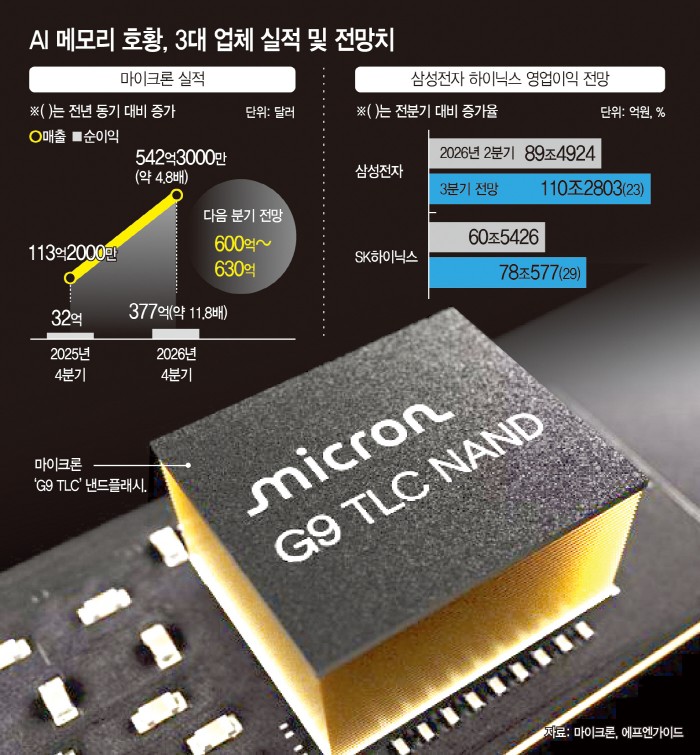 |
U.S. memory semiconductor firm Micron posted earnings beating market expectations on the back of expanding artificial intelligence (AI) demand. Quarterly revenue surged to about 4.8 times and net profit to about 11.8 times compared to the same period last year.
Presenting next-quarter revenue guidance that also topped market expectations, Micron is raising annual earnings expectations for Samsung Electronics and SK Hynix. In particular, observers note that strong performance among memory makers will continue as expanding high-bandwidth memory (HBM) demand coincides with supply constraints for standard DRAM.
According to Micron on the 1st, the company recorded revenue of 54.23 billion dollars and net profit of 37.7 billion dollars in its fiscal fourth-quarter 2026 earnings announced on the 30th of last month (local time). Compared to revenue of 11.32 billion dollars and net profit of 3.2 billion dollars in the same period last year, the figures grew roughly 4.8-fold and 11.8-fold, respectively. Analysts view that expanding memory demand driven by AI infrastructure investments led to the earnings surge.
Micron projected that its growth momentum will continue into the next quarter. The company presented revenue guidance of 60 billion to 63 billion dollars for the first quarter of fiscal 2027.
This also exceeds market expectations of 57.02 billion dollars. Surging AI memory demand appears to have driven up profitability as it squeezed standard DRAM supplies and pushed up prices.
Supply constraints are expected to last through next year. Citing remarks by Samsung Electronics Executive Vice President Kim Tae-woo on the 29th of last month, Reuters reported that HBM's share of overall DRAM industry wafer capacity is expected to rise from around 20% currently to approximately 30% next year.
Executive Vice President Kim explained that because HBM and standard DRAM compete for the same wafer capacity, expanding HBM production could further constrain standard DRAM supply.
As DRAM profitability rises, performance gaps may emerge depending on each company's product mix. According to market research firm TrendForce, Samsung Electronics' DRAM revenue in the second quarter of this year reached 60.98 billion dollars, up 63.4% from the previous quarter. Along with higher average selling prices (ASP), increased shipments resulting from mass production and delivery of HBM4 contributed to the revenue expansion.
On the other hand, SK Hynix's DRAM revenue rose 37.9% to 38.59 billion dollars during the same period. TrendForce analyzed that because SK Hynix held the highest share of HBM in total bit shipments among the three major memory makers, the upside in its ASP was relatively constrained. This suggests that rising standard DRAM prices could work to Samsung Electronics' relative advantage.
TrendForce projected that contract prices for standard DRAM in the third quarter would rise 13% to 18% compared to the previous quarter. The pace of price gains is seen slowing, but the upward trend is expected to persist. In the upcoming earnings releases from South Korea's two memory giants, attention is centering on how much the increase in standard DRAM prices was reflected in their revenue and profitability.
Indeed, according to consensus estimates compiled by FnGuide as of the 30th of last month, Samsung Electronics' third-quarter operating profit was projected at 110.2803 trillion won, up roughly 20% from the preceding quarter. SK Hynix is also expected to post an operating profit of 78.0577 trillion won over the same period, an increase of about 29%. If forecasts hold, both companies will register record quarterly operating profits. Samsung Electronics is scheduled to disclose its preliminary third-quarter earnings on the 8th, while SK Hynix is expected to announce its results later this month.
Lee Ji-sun
Most Read
-
1
Alteogen secures European patent for Keytruda SC,..

-
2
Trump shares map on social media labeling Strait o..

-
3
Celltrion seeks rheumatoid arthritis indication ex..

-
4
Kia Sportage outperforms Mazda CX-5 in German auto..

-
5
Chinese e-commerce giants AliExpress, Temu and She..

-
6
China expels No. 2 military official Zhang Youxia..

-
7
Houthi rebels release video claiming downing of Sa..

PEOPLE







-
Address : In-Young Bldg., 34, Uisadang-daero 1-gil, Yeongdeungpo-gu, Seoul
Copyright by ASIATODAY CO., LTD. All rights resereved