



Household loans at five major commercial banks decrease for the first time in six months
Oct 02, 2026, 10:22 am


 |
Amid a regulatory stance prioritizing total volume management for household debt, the balance of household loans at South Korea's five major commercial banks decreased last month for the first time in six months. In contrast, corporate loans climbed for the ninth consecutive month amid intensifying competition over productive finance, posting the largest gain in two years and three months.
The shift reflects banks' commercial strategies to expand corporate financing under household loan ceilings, aligning with corporate demand for liquidity to refinance corporate bonds. However, with over 70% of the new corporate borrowing concentrated in large conglomerates, disparities in capital access between large corporations and small and medium-sized enterprises (SMEs) have further deepened.
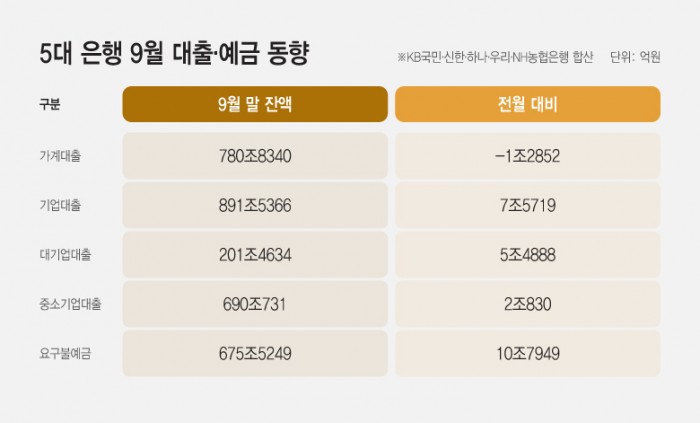
According to the financial sector on the 1st, the combined household loan balance of KB Kookmin, Shinhan, Hana, Woori, and NH NongHyup Bank stood at 780.8340 trillion won at the end of last month. This marks a decrease of 1.2852 trillion won from the previous month (782.1192 trillion won) and the first monthly drop in household lending across these banks in six months since March this year.
A sharp deceleration in mortgage lending drove the overall decline. The monthly increase in mortgages plunged from 3.3319 trillion won in August to 125.2 billion won in September, while unsecured credit loans shrank by 1.3415 trillion won. With commercial banks keeping lending thresholds high to comply with quota targets set by financial regulators, consecutive benchmark interest rate hikes pushed up mortgage rates and dampened borrower demand. Indeed, the average interest rate on newly extended bank mortgages reached 4.66% per annum in August, up 0.18 percentage points from the prior month to hit its highest level in three years and nine months.
Corporate loans, on the other hand, expanded substantially. The balance of corporate lending across the five major banks reached 891.5366 trillion won at the end of last month, rising 7.5719 trillion won from August. This marked the ninth straight month of expansion this year and the first time the monthly increase exceeded 7 trillion won since June 2024 (8.0250 trillion won). Analysts attribute the surge to aggressive corporate banking sales pushes tailored to meet the policy drive for productive finance and corporate loan expansion.
Diversification in corporate fundraising channels also played a role. The Bank of Korea recently cited banks' stepped-up marketing alongside corporate funding needs to repay maturing corporate bonds as catalysts for the growth in corporate debt. In August, net redemptions of corporate bonds reached 900 billion won due to heavy issuance costs driven by rising bond yields. Demand for bank borrowings to pay down existing debts rather than issuing new debt was directly captured in corporate loan totals.
Large corporations drove the bulk of the expansion. Loans to large firms rose 5.4888 trillion won within a month to stand at 201.4634 trillion won, topping the 200-trillion-won mark. Large corporations accounted for 72.5% of total new corporate loan growth in September, rising from 59.5% in August. In contrast, the balance of SME loans reached 690.0731 trillion won, adding only 2.0830 trillion won. This increment contracted compared to August (2.5367 trillion won). The divergence is seen as stemming from banks' stronger incentives to screen for prime-grade borrowers such as large corporations as delinquency rates rise among an increasing number of cash-strained SMEs.
A commercial banking official stated, "Lenders are limiting household lending to essential segments like collective mortgage loans while concentrating sales efforts on corporate loans, where performance weighting under key performance indicators (KPIs) has expanded. As benchmark rates remain elevated, competition to secure high-credit prime borrowers is expected to grow even fiercer."
Han Sang-wook
Most Read
-
1
Alteogen secures European patent for Keytruda SC,..

-
2
Trump shares map on social media labeling Strait o..

-
3
Celltrion seeks rheumatoid arthritis indication ex..

-
4
Kia Sportage outperforms Mazda CX-5 in German auto..

-
5
Chinese e-commerce giants AliExpress, Temu and She..

-
6
China expels No. 2 military official Zhang Youxia..

-
7
Trump rejects Iran's offer to open Strait of Hormu..

PEOPLE







-
Address : In-Young Bldg., 34, Uisadang-daero 1-gil, Yeongdeungpo-gu, Seoul
Copyright by ASIATODAY CO., LTD. All rights resereved